I’ve noticed that even confident writers hesitate when choosing between signup or sign up. I used to second-guess it myself especially when writing emails, blogs, or website copy.
It’s one of those small grammar choices that can quietly impact your professionalism. The confusion usually comes from how English treats verbs and nouns differently.
In this guide, I’ll break everything down in a clear, practical way so you’ll never have to wonder again.
By the end, you’ll know exactly when to use each form and why it matters.
Direct Answer
“Sign up” is a verb phrase used when describing the action of registering, while “signup” (or more commonly “sign-up”) is a noun or adjective referring to the registration itself. Use sign up for actions and signup/sign-up for things or concepts.
Meanings
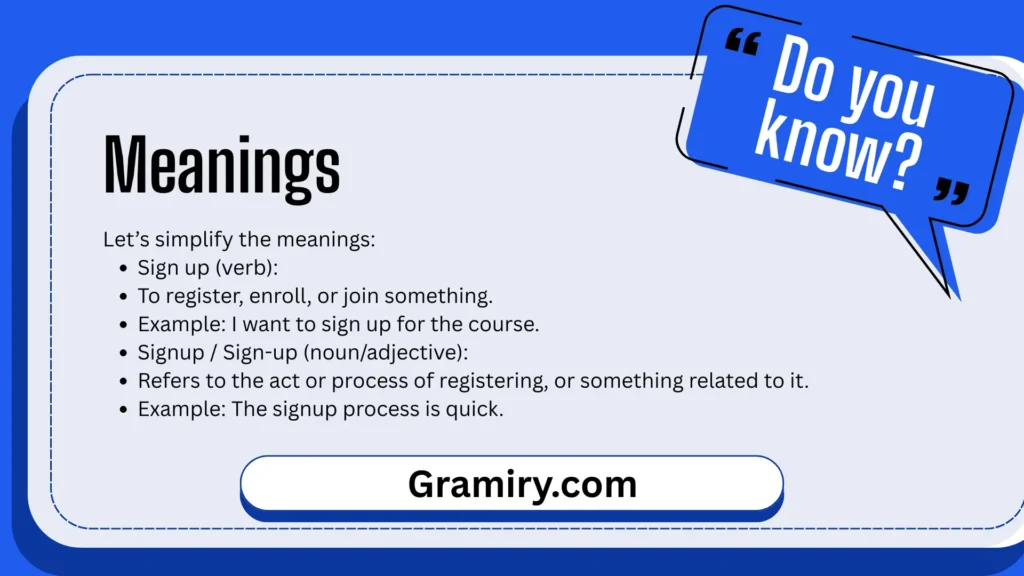
Let’s simplify the meanings:
- Sign up (verb):
To register, enroll, or join something.
Example: I want to sign up for the course. - Signup / Sign-up (noun/adjective):
Refers to the act or process of registering, or something related to it.
Example: The signup process is quick.
Think of it this way:
- Action = sign up
- Thing = signup/sign-up
Pronunciation
Interestingly, both forms are pronounced the same way:
- Sign up: /saɪn ʌp/
- Signup / Sign-up: /saɪn ʌp/
There’s no difference in spoken English. The distinction exists only in writing, which is why many people confuse them.
The Key Differences
The difference comes down to grammar and function:
- Sign up (verb phrase):
- Consists of a verb + particle
- Describes an action
- Can change tense (signs up, signed up, signing up)
- Signup / Sign-up (noun/adjective):
- Acts as a naming word or descriptor
- Cannot change tense
- Often used before another noun (e.g., signup form)
Example comparison:
- I will sign up today. ✅ (action)
- The signup is easy. ✅ (thing)
Correct Spelling
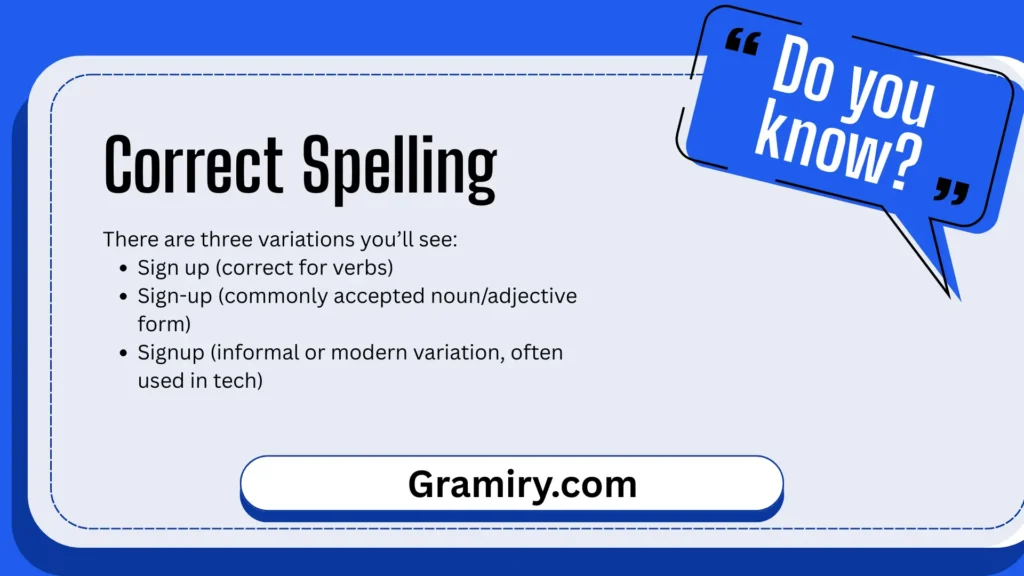
There are three variations you’ll see:
- Sign up (correct for verbs)
- Sign-up (commonly accepted noun/adjective form)
- Signup (informal or modern variation, often used in tech)
Common mistakes to avoid:
- ❌ I will signup tomorrow.
- ❌ Please sign-up here.
Correct versions:
- ✅ I will sign up tomorrow.
- ✅ The sign-up page is simple.
When in doubt, separate it if it’s an action.
Singular and Plural Forms
Since sign up is a verb, it doesn’t have singular or plural forms like nouns.
But sign-up (noun) does:
- Singular: sign-up
- Plural: sign-ups
Examples:
- We received one sign-up today.
- We received many sign-ups this week.
Grammar Rules
1. Verb Usage (Sign up)
- Always written as two words
- Can be modified by tense:
- I sign up
- I signed up
- I am signing up
2. Noun Usage (Sign-up / Signup)
- Used as a subject or object:
- The sign-up is complete.
- Can be pluralized:
- Multiple sign-ups were recorded
3. Adjective Usage
- Used before a noun:
- Sign-up form
- Signup page
4. Sentence Placement
- Verb: after subject
- Noun: as subject/object
Which One is Unique?
The uniqueness lies in context:
- “Sign up” is unique because it expresses action.
Without it, you can’t describe someone registering. - “Sign-up/signup” is unique because it labels the process or tool.
It’s commonly used in digital environments like websites, apps, and marketing funnels.
In modern UX writing, “signup” (one word) is often preferred for buttons:
- Signup Now
- Quick Signup
But in formal writing, “sign-up” is still safer.
Illustrative Examples
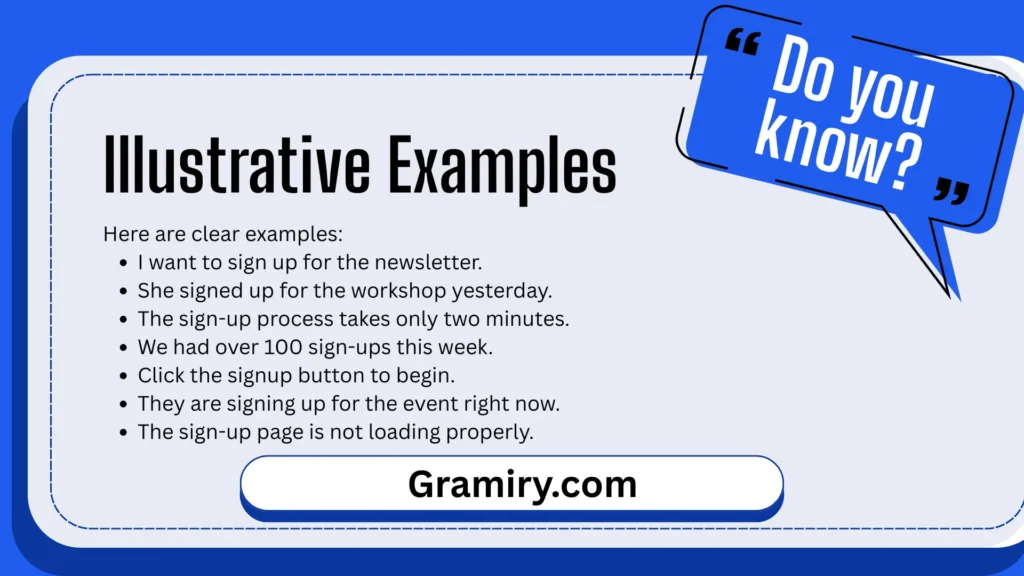
Here are clear examples:
- I want to sign up for the newsletter.
- She signed up for the workshop yesterday.
- The sign-up process takes only two minutes.
- We had over 100 sign-ups this week.
- Click the signup button to begin.
- They are signing up for the event right now.
- The sign-up page is not loading properly.
Practice Section (MCQs)
Choose the correct option:
- I will ___ for the class tomorrow.
a) signup
b) sign up
c) sign-up - The ___ form is easy to fill out.
a) sign up
b) signup
c) signing - She ___ for the event yesterday.
a) signup
b) signed up
c) sign-up - We received many ___ this week.
a) sign ups
b) sign-ups
c) sign up - Please ___ before the deadline.
a) signup
b) sign up
c) sign-up - The ___ process is quick.
a) sign up
b) signup
c) signed up - He is ___ for the course.
a) signing up
b) signup
c) sign-up - The ___ page is broken.
a) sign up
b) signup
c) signed up - I forgot to ___ yesterday.
a) signup
b) sign up
c) sign-up - There were 50 ___ today.
a) sign-ups
b) sign up
c) signuped - You should ___ early.
a) signup
b) sign up
c) sign-up - The ___ link is below.
a) sign up
b) signup
c) signed - They ___ quickly.
a) signup
b) signed up
c) sign-up - This is the ___ page.
a) sign up
b) signup
c) signing up - I am going to ___ now.
a) signup
b) sign up
c) sign-up
Answer Key
- b
- b
- b
- b
- b
- b
- a
- b
- b
- a
- b
- b
- b
- b
- b
Frequently Asked Questions (FAQs)
1. Is “signup” one word or two?
It depends on usage. As a verb, it’s always two words (sign up). As a noun, it can be signup or sign-up.
2. Which is more correct: “signup” or “sign-up”?
“Sign-up” is traditionally correct, but “signup” is widely accepted in modern digital writing.
3. Can I use “signup” as a verb?
No. Using “signup” as a verb is grammatically incorrect.
4. Why do websites use “signup” as one word?
For simplicity and design consistency, especially in buttons and UI elements.
5. Is this rule similar to other phrasal verbs?
Yes. Many English phrasal verbs follow this pattern, where the noun form becomes one word or hyphenated.
Conclusion
Understanding the difference between signup and sign up is simpler than it seems once you know the rule: action versus thing. I always remind myself—if it’s something you do, use two words; if it’s something you name, use one or hyphenated.
This small distinction can significantly improve your writing clarity and professionalism. Whether you’re drafting content, emails, or UI text, applying this correctly makes a strong impression.
Stick to the rules we covered, and you’ll never get it wrong again. Consistency is key, so choose a style and apply it thoughtfully.

Amelia Brooks is a passionate writer known for her thoughtful storytelling and emotionally rich writing style. She enjoys exploring meaningful topics that connect with readers in a simple and engaging way.
Amelia is the author of Whispers Beyond The Lantern Sky and The Quiet Colors Of Midnight Rain, two original works praised for their creativity and depth.
Her writing blends imagination with real human emotions, making every piece feel personal and memorable. When she is not writing, she spends her time reading, researching new ideas, and discovering inspiring stories from different cultures.
 Matthew Cooper
 Jordan Miles