I’ve noticed that even confident English writers sometimes hesitate when choosing between “neice” or “niece.” It’s one of those deceptively simple spelling traps that can make you second-guess yourself mid-sentence.
I used to pause every time I wrote it too, wondering if I’d flipped the letters incorrectly. If you’ve ever typed one, deleted it, and tried again, you’re not alone. In this guide, I’ll clear up the confusion once and for all.
By the end, you’ll not only know the correct spelling but also understand why it’s correct and how to remember it effortlessly.
Direct Answer
The correct spelling is “niece.” The word “neice” is a common misspelling and is incorrect in standard English. “Niece” refers to the daughter of your sibling or sibling-in-law and follows the “i before e except after c” spelling pattern.
Meanings
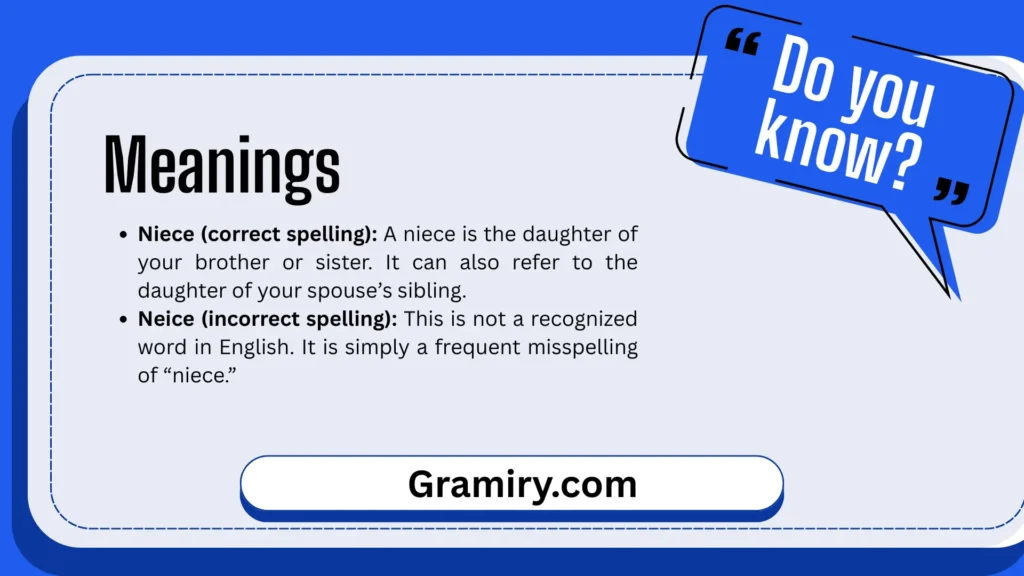
Niece (correct spelling):
A niece is the daughter of your brother or sister. It can also refer to the daughter of your spouse’s sibling.
Neice (incorrect spelling):
This is not a recognized word in English. It is simply a frequent misspelling of “niece.”
Pronunciation
The word “niece” is pronounced as:
/niːs/ (sounds like “neese”)
- It rhymes with words like peace and piece
- The “ie” combination produces a long “ee” sound
A helpful trick: ignore the confusing spelling and focus on the sound—it’s straightforward and smooth.
The Key Differences
At first glance, “neice” and “niece” look nearly identical, but only one is correct.
- “Niece” follows standard English spelling rules and appears in dictionaries.
- “Neice” is a letter reversal error—switching “i” and “e.”
- The confusion stems from English’s inconsistent spelling rules, but in this case, the correct form aligns with the familiar pattern: i before e.
Understanding this difference is crucial, especially in formal writing, where spelling accuracy matters.
Correct Spelling
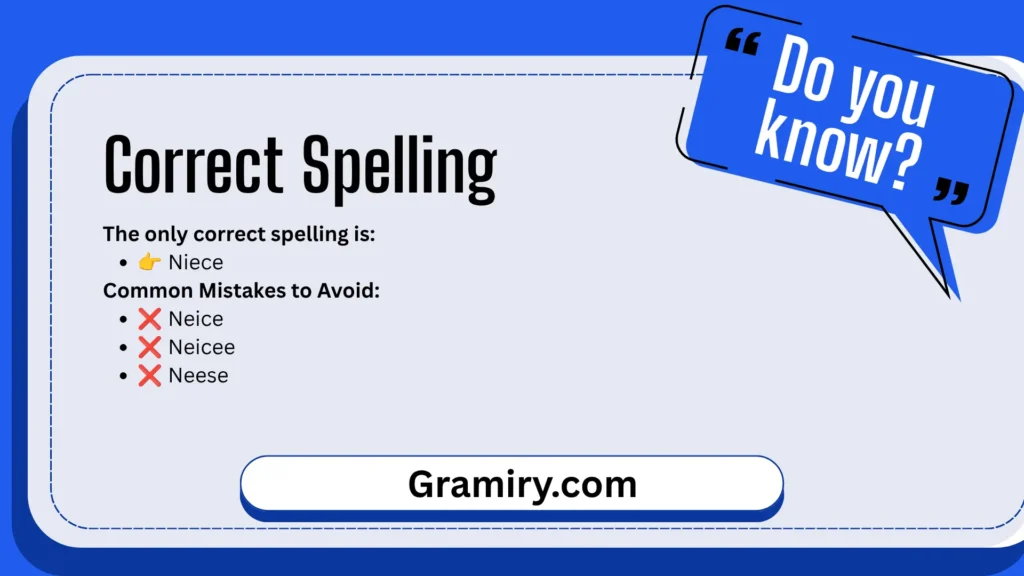
The only correct spelling is:
👉 Niece
Common Mistakes to Avoid:
- ❌ Neice
- ❌ Neicee
- ❌ Neese
Why the mistake happens:
Many people remember the rhyme:
“I before E except after C”
Since there’s no “c” before the vowel pair in niece, the correct order is i before e.
Singular and Plural Forms
| Form | Word |
| Singular | Niece |
| Plural | Nieces |
Examples:
- Singular: My niece is visiting today.
- Plural: My nieces are coming over for dinner.
To form the plural, simply add -s to the end—no spelling changes required.
Grammar Rules
Part of Speech:
- Noun (countable)
Usage Rules:
- Always used as a noun to describe a family relationship.
- Can be used with possessive forms:
- My niece’s birthday
- My nieces’ school
Placement in a Sentence:
- Subject: My niece loves painting.
- Object: I bought a gift for my niece.
Capitalization:
- Not capitalized unless part of a proper noun or title.
Which One is Unique?
The uniqueness lies in correctness:
- “Niece” is the only valid and accepted spelling in all contexts—formal, informal, academic, and professional.
- “Neice” has no legitimate use and should always be avoided.
In any situation—emails, essays, social media posts, or official documents—“niece” is the only correct choice.
Illustrative Examples
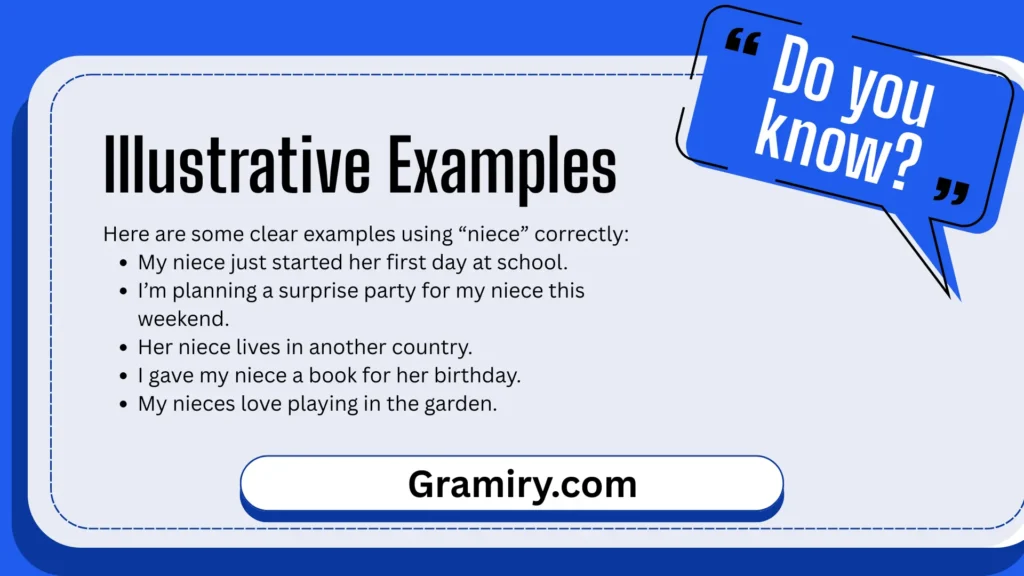
Here are some clear examples using “niece” correctly:
- My niece just started her first day at school.
- I’m planning a surprise party for my niece this weekend.
- Her niece lives in another country.
- I gave my niece a book for her birthday.
- My nieces love playing in the garden.
Each example shows how naturally the word fits into everyday communication.
Practice Section (MCQs)
Choose the correct option:
- My ___ is visiting tomorrow.
a) neice
b) niece - I bought a toy for my ___.
a) niece
b) neice - Her ___ lives in London.
a) neice
b) niece - My ___ love cartoons.
a) nieces
b) neices - The correct spelling is:
a) neice
b) niece - She is my brother’s ___.
a) niece
b) neice - My ___ birthday is next week.
a) neice’s
b) niece’s - I have two ___.
a) nieces
b) neices - He called his ___.
a) niece
b) neice - Which is incorrect?
a) niece
b) neice - My ___ loves chocolate.
a) niece
b) neice - We visited our ___.
a) niece
b) neice - The plural of niece is:
a) nieces
b) neice - She gifted her ___.
a) niece
b) neice - Choose the correct sentence:
a) My neice is smart.
b) My niece is smart.
Answer Key:
1-b, 2-a, 3-b, 4-a, 5-b, 6-a, 7-b, 8-a, 9-a, 10-b, 11-a, 12-a, 13-a, 14-a, 15-b
Frequently Asked Questions (FAQs)
1. Is “neice” ever correct?
No, “neice” is always incorrect. The proper spelling is “niece.”
2. Why is “niece” spelled with “ie” instead of “ei”?
It follows the rule “i before e except after c.” Since there’s no “c,” “ie” is correct.
3. How can I easily remember the spelling of “niece”?
Think of “niece” as similar to “piece”—both use “ie” and sound alike.
4. What is the plural of “niece”?
The plural form is “nieces,” created by simply adding “-s.”
5. Is “niece” used in formal writing?
Yes, “niece” is standard English and appropriate in all types of writing.
Conclusion
Spelling mistakes like “neice” instead of “niece” areincredibly common, but thankfully, they’re also easy to fix once you understand the rule. I’ve found that remembering the simple “i before e” guideline makes all the difference.
“Niece” is the only correct spelling, and using it consistently will improve your writing clarity and credibility.
If you’re writing casually or professionally, getting these small details right matters more than you might think. Keep practicing, and soon this confusion will be a thing of the past.

Amelia Brooks is a passionate writer known for her thoughtful storytelling and emotionally rich writing style. She enjoys exploring meaningful topics that connect with readers in a simple and engaging way.
Amelia is the author of Whispers Beyond The Lantern Sky and The Quiet Colors Of Midnight Rain, two original works praised for their creativity and depth.
Her writing blends imagination with real human emotions, making every piece feel personal and memorable. When she is not writing, she spends her time reading, researching new ideas, and discovering inspiring stories from different cultures.
 Matthew Cooper
 Jordan Miles