If you are searching for griefing or grieving, you may have noticed that these two words look almost identical, but they do not mean the same thing. A single letter changes the meaning completely, which can make it easy to choose the wrong word when writing a message, social media post, article, or gaming comment. Grieving is connected to grief, loss, sadness, and mourning, while griefing is usually used in online gaming and communities to describe deliberately annoying, disrupting, or frustrating other people.
The confusion becomes even greater because both words come from the same familiar word, grief, and they can sound quite similar when spoken. If you have seen someone write that a player was “griefing” in a game, that does not mean the player was feeling sad. Likewise, if you are talking about someone dealing with the death of a loved one, grieving is the word you need.
In this guide, you will learn the difference between griefing and grieving, including their meanings, pronunciation, spelling, word forms, sentence examples, and common mistakes. You will also see how griefing is used in gaming, how it differs from related terms such as trolling, and how to quickly decide which word fits your sentence. By the end, you should be able to recognize the difference and use both words confidently in the right context.
Griefing or Grieving: Quick Answer
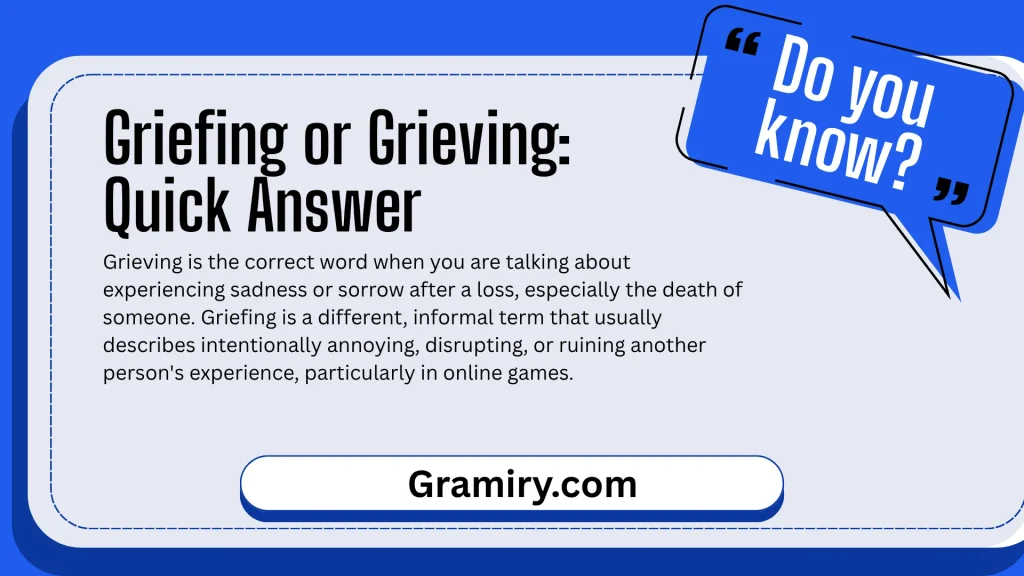
Grieving is the correct word when you are talking about experiencing sadness or sorrow after a loss, especially the death of someone. Griefing is a different, informal term that usually describes intentionally annoying, disrupting, or ruining another person’s experience, particularly in online games.
For example:
- She is grieving after the loss of her mother.
- The player was griefing his teammates.
A simple way to remember the difference is:
Grieving = dealing with grief or loss.
Griefing = deliberately causing trouble or frustration, especially online.
What Does Grieving Mean?
Grieving is the present participle of the verb grieve. It describes the process of experiencing or expressing deep sadness after a significant loss.
The word is most commonly associated with death and bereavement, but grief can occur after many kinds of losses. Someone may grieve after losing a loved one, a pet, a relationship, a home, a job, or another important part of life.
Grieving Meaning and Definition
The verb grieve means to feel or express deep sorrow, while grieving describes that ongoing process.
For example:
The family is grieving after the death of their grandmother.
Here, grieving refers to the family’s emotional response to the loss.
You can also use it without mentioning death:
He is grieving the loss of his old life.
The exact experience of grief is different for everyone. Some people openly express sadness, while others may become quiet or need more time before discussing their feelings.
How to Use Grieving in a Sentence
Grieving is normally used when the subject is dealing with a serious emotional loss.
Examples include:
- She is grieving after her father’s death.
- The family is still grieving.
- He needed time to grieve before returning to work.
- Everyone experiences grieving differently.
- She found comfort in talking to friends while grieving.
- The community gathered to support the grieving family.
- He was grieving the loss of his closest friend.
In all of these examples, grieving relates to sorrow, loss, or mourning.
Grieving vs. Mourning
Grieving and mourning are closely related, but they are not always used in exactly the same way.
Grieving generally emphasizes the emotional experience of dealing with a loss.
Mourning can refer to the outward expression of grief and, depending on the context, the social or cultural practices associated with loss.
For example:
She is grieving after her husband’s death.
This focuses on her emotional experience.
You might also say:
The family is mourning his death.
This can describe their outward response to the loss.
In everyday English, the two words can overlap, but grieving is the natural choice when you specifically want to describe the process of experiencing grief.
What Does Griefing Mean?
Griefing has a very different meaning. It is an informal term commonly associated with online gaming and internet communities.
It generally describes deliberately disrupting, annoying, frustrating, or interfering with another person’s experience.
A person who engages in this behavior is often called a griefer.
Griefing Meaning in Gaming
Gaming is one of the most common places where you will encounter the word griefing.
For example, imagine a multiplayer game in which someone repeatedly destroys another player’s creation, blocks their progress, or intentionally interferes with their gameplay simply to frustrate them.
That behavior may be described as griefing.
For example:
Someone was griefing our team throughout the match.
Here, griefing does not mean that the person was feeling sad. It means they were deliberately causing problems for the other players.
The exact behavior considered griefing can vary from one game or online community to another. Some communities may have specific rules covering disruptive behavior, harassment, sabotage, or similar conduct.
What Does a Griefer Do?
A griefer is someone who engages in griefing.
Depending on the game or community, a griefer might:
- Intentionally destroy another player’s creation
- Repeatedly interfere with another player’s progress
- Deliberately disrupt a multiplayer match
- Block or trap other players
- Sabotage teammates for entertainment
- Repeatedly provoke other players
- Ruin an experience without a legitimate gameplay purpose
For example:
The server moderator removed the griefer after several complaints.
The word griefer is therefore related to griefing, not to someone who is experiencing personal grief.
Is Griefing Only Used in Gaming?
No. Although griefing is strongly associated with gaming, the term can also appear in broader online communities.
People may use it when discussing behavior intended to disrupt or frustrate others on an online platform, server, community, or digital environment.
However, gaming remains one of the contexts where the term is most recognizable.
If you are writing about someone experiencing sadness after a death or another loss, grieving is the appropriate word, regardless of whether the situation happens online or offline.
Griefing vs. Grieving: The Key Differences
The easiest way to understand the difference is to compare their meanings, spelling, pronunciation, and context.
| Word | Meaning | Common Context | Example |
| Grieving | Experiencing or expressing sorrow after a loss | Death, loss, mourning | She is grieving after her brother’s death. |
| Griefing | Deliberately disrupting or annoying someone | Gaming and online communities | The player was griefing our team. |
The words may look similar, but they are not alternative spellings of the same word.
Meaning
The main difference is meaning.
Grieving is connected to grief. It describes the emotional process of dealing with loss.
Griefing generally describes deliberate disruptive behavior toward another person.
Compare:
He is grieving after losing his friend.
with:
He is griefing other players.
The first sentence is about emotional pain.
The second is about deliberate disruption.
Spelling and Word Formation
The spelling difference becomes easier to understand when you look at the words they come from.
Grieving comes from the verb grieve:
grieve → grieving
The spelling changes when the -ing ending is added.
Griefing, on the other hand, is an informal term formed from grief and is commonly used to describe behavior that causes frustration or trouble for others.
This is why you should not treat griefing as simply a misspelling of grieving.
They have developed into words with different uses.
Pronunciation
The two words also have a slightly different sound.
Griefing is commonly pronounced approximately like:
GREE-fing
Grieving is commonly pronounced approximately like:
GREE-ving
The most noticeable difference is the consonant sound:
- griefing → ends with an f sound
- grieving → contains a v sound
This difference can help if you hear the words in conversation, a video, a podcast, or a gaming stream.
Grief, Grieve, Grieving, Griefing, Griever, and Griefer
These related words can be confusing because they share similar letters.
Understanding the word family makes the differences easier to remember.
| Word | Meaning |
| Grief | Deep sorrow, especially following a significant loss |
| Grieve | To experience or express grief |
| Grieving | Experiencing or expressing grief |
| Griever | A person who is experiencing grief |
| Griefing | Deliberately disrupting or frustrating others, especially online |
| Griefer | A person who engages in griefing |
For example:
The griever was grieving after a major loss.
Here, both griever and grieving are connected to emotional grief.
Now compare:
The griefer was griefing other players.
Here, griefer and griefing refer to disruptive online behavior.
The similar spelling can be confusing, but the context makes the meaning clear.
Griefing vs. Trolling vs. Cheating
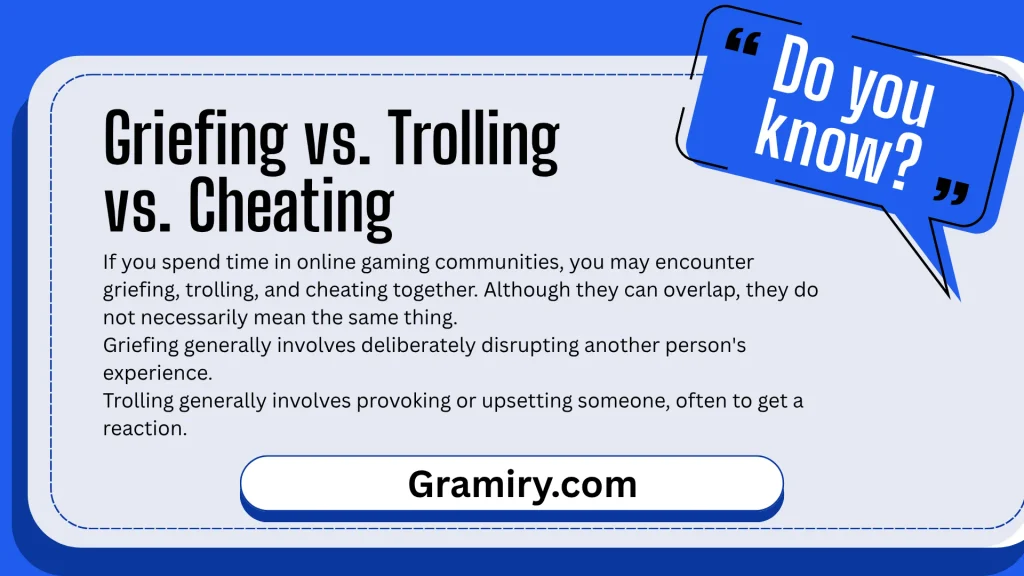
If you spend time in online gaming communities, you may encounter griefing, trolling, and cheating together. Although they can overlap, they do not necessarily mean the same thing.
Griefing generally involves deliberately disrupting another person’s experience.
Trolling generally involves provoking or upsetting someone, often to get a reaction.
Cheating involves gaining an unfair advantage by violating a game’s rules or using prohibited methods.
For example:
- A player repeatedly destroying another player’s base for no legitimate reason may be griefing.
- Someone deliberately making provocative comments to upset another player may be trolling.
- Someone using prohibited software to gain an advantage may be cheating.
These terms can have different definitions depending on the platform or game’s rules, so they should not automatically be treated as interchangeable.
Common Mistakes With Griefing and Grieving
Because the words are so similar, it is easy to choose the wrong one.
Using Griefing for Emotional Loss
Incorrect:
She is griefing after her mother’s death.
Correct:
She is grieving after her mother’s death.
When you are talking about emotional pain caused by a loss, use grieving.
Using Grieving for Gaming Disruption
Incorrect:
He was grieving the other players during the match.
Correct:
He was griefing the other players during the match.
When you mean that someone is intentionally disrupting other players, griefing is the appropriate term.
Assuming Griefing Is a Misspelling
It is also incorrect to assume that griefing is simply a typo for grieving.
For example:
The player was griefing our team.
This can be perfectly understandable in an online gaming context.
The intended meaning is not that the player was experiencing grief. It is that the player was deliberately causing problems for others.
Griefing or Grieving: Examples in Sentences
Looking at both words in complete sentences is one of the easiest ways to understand the difference.
Examples With Grieving
- She is grieving after the loss of her father.
- The family is still grieving.
- He was grieving for his close friend.
- Everyone handles grief differently.
- She needed time to grieve.
- The community supported the grieving family.
- He spent several weeks grieving his loss.
- Talking with loved ones helped her while she was grieving.
- The children were grieving after losing their beloved pet.
- He continued grieving even after several months had passed.
Each sentence involves sadness or loss.
Examples With Griefing
- The player was griefing our base.
- The server has rules against griefing.
- They reported him for griefing.
- Someone kept griefing our team during the game.
- The moderator warned the player about griefing.
- Griefing can ruin a multiplayer experience.
- The group created rules to reduce griefing.
- The player was banned after repeatedly griefing others.
- They suspected another player of griefing their builds.
- The community does not tolerate intentional griefing.
Each sentence involves deliberate disruption or frustration.
How to Remember the Difference
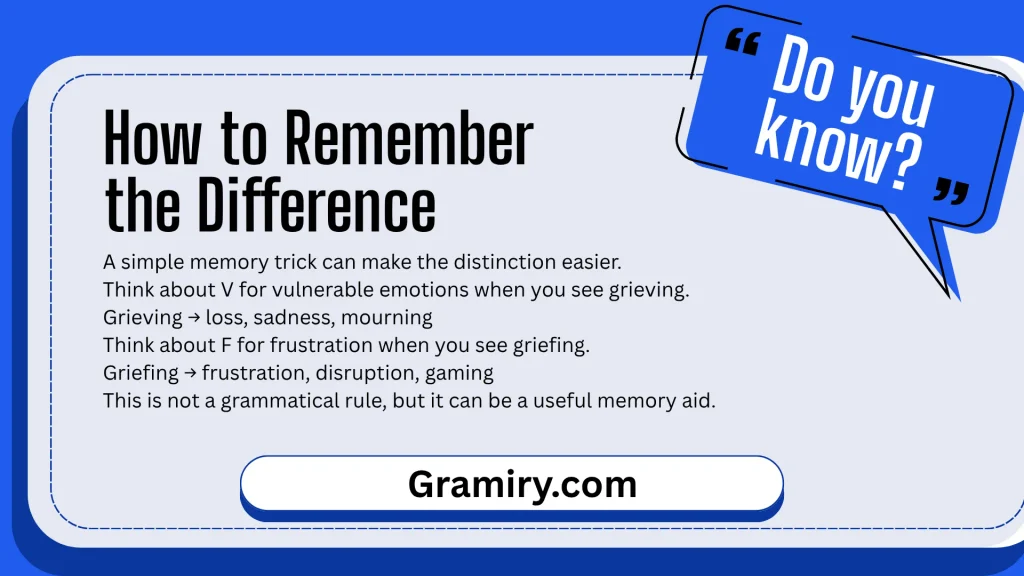
A simple memory trick can make the distinction easier.
Think about V for vulnerable emotions when you see grieving.
Grieving → loss, sadness, mourning
Think about F for frustration when you see griefing.
Griefing → frustration, disruption, gaming
This is not a grammatical rule, but it can be a useful memory aid.
Another simple method is to remember these two sentences:
She is grieving a loss.
He is griefing other players.
If the sentence is about loss, choose grieving.
If it is about deliberately causing trouble, choose griefing.
Griefing or Grieving: Which Word Should You Use?
Use grieving when your sentence is about:
- Death
- Loss
- Bereavement
- Mourning
- Emotional sadness
- Processing a significant loss
- Someone experiencing grief
Use griefing when your sentence is about:
- Online gaming
- Multiplayer games
- Servers
- Disruptive players
- Deliberately ruining another person’s experience
- Intentionally causing frustration online
A quick decision guide is:
Are you talking about someone dealing with a loss?
→ Use grieving.
Are you talking about someone deliberately disrupting another person’s experience?
→ Use griefing.
Are you talking about the person experiencing grief?
→ Use griever.
Are you talking about the person causing online disruption?
→ Use griefer.
This distinction covers most everyday uses of these words.
Frequently Asked Questions
Is it griefing or grieving?
Both words are correct, but they have different meanings. Grieving means experiencing or expressing sorrow after a loss, while griefing generally means deliberately annoying, disrupting, or frustrating someone, particularly in an online gaming environment.
Is griefing a real word?
Yes. Griefing is an established informal term, especially in gaming and online communities. It describes behavior intended to disrupt, annoy, frustrate, or interfere with another person’s experience. It is not simply another spelling of grieving.
What does griefing mean in gaming?
In gaming, griefing generally means deliberately interfering with or disrupting another player’s experience. Examples can include intentionally destroying another player’s work, blocking progress, repeatedly sabotaging gameplay, or otherwise causing frustration. The exact definition can vary between games and communities.
What does grieving mean?
Grieving means experiencing or expressing deep sorrow following a loss. It is commonly associated with the death of a loved one, but people can grieve many different types of significant losses.
Is griefing the same as trolling?
Not necessarily. Griefing generally focuses on deliberately disrupting another person’s experience, particularly in gaming. Trolling generally involves provoking or upsetting people, often to get a reaction. The two behaviors can overlap, but they are not automatically the same.
What do you call someone who is griefing?
A person who engages in griefing is commonly called a griefer. This term is particularly common in online gaming communities.
Is grieving the correct word for mourning?
Yes. Grieving is a standard word for the emotional process of dealing with a loss, while mourning can refer to the outward expression of grief or related social and cultural practices. The two words often overlap in everyday English.
Why are griefing and grieving confused?
They are easily confused because they look and sound very similar and both are associated with the word grief. However, grieving relates to experiencing grief, while griefing has developed as an informal term for deliberately causing frustration or disruption, especially online.
Conclusion
The difference between griefing or grieving comes down to context. Grieving is the correct word when you are talking about experiencing or expressing sorrow after a loss. Griefing is an informal term most commonly used for deliberately disrupting, annoying, or frustrating another person, especially in online gaming.
Remember the simplest distinction: you grieve a loss, but someone may be griefing other players.
If you are talking about sadness, mourning, or bereavement, choose grieving. If you are talking about intentional disruption in a game or online community, griefing is usually the word you need. Once you understand this difference, it becomes much easier to recognize and use both terms correctly.

Jordan Miles is a passionate writer known for creating thoughtful and engaging content that connects with modern readers. With years of experience in digital publishing, he focuses on storytelling, culture, lifestyle, and meaningful ideas that inspire curiosity.
He is also the author of The Silent Horizon and Echoes Beyond Midnight, two original works praised for their emotional depth and imaginative writing style.
Jordan believes great writing should feel simple, honest and memorable. Through his work, he continues to share fresh perspectives that keep readers connected and inspired.
 Matthew Cooper
 Amelia Brooks