
If you have ever wondered whether to write loss or lost, you are dealing with a very common English grammar confusion. The two words look closely related because they both come from the same word family, but they do not serve the same grammatical purpose. Choosing the wrong one can make an otherwise simple sentence incorrect.
The good news is that the difference between loss and lost is easy to understand once you know how they work. Loss is mainly a noun, while lost is usually the past tense or past participle of the verb lose. The word lost can also work as an adjective in certain sentences.
For example, you would say, “I lost my wallet,” but “The loss of my wallet was frustrating.” The first sentence describes an action, while the second describes the result or experience of that action.
In this guide, we will look at loss, lost, and lose together, explain their meanings and grammar, compare them in real sentences, cover common expressions and mistakes, and give you a simple way to choose the correct word every time.
Loss or Lost: The Quick Answer
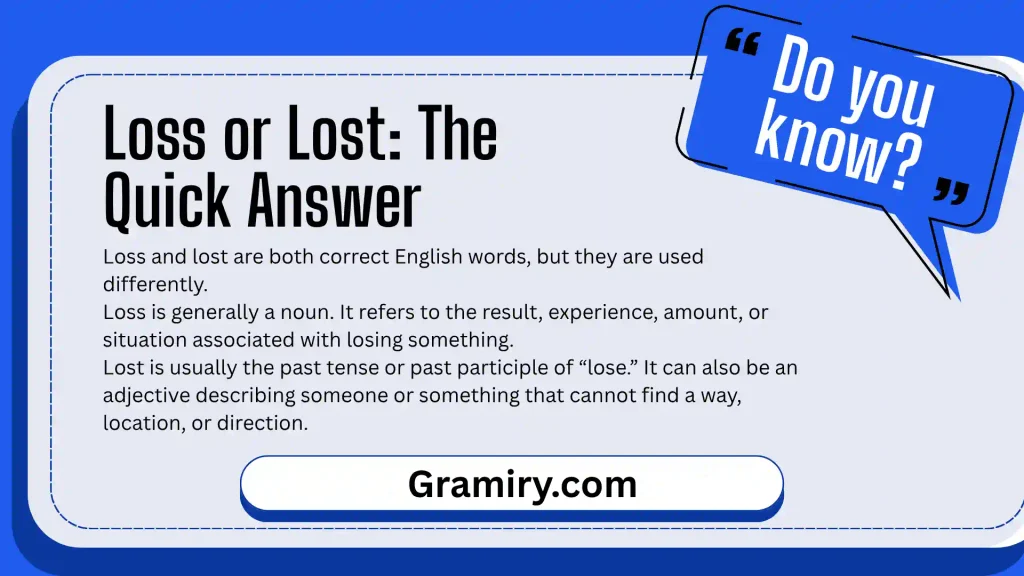
Loss and lost are both correct English words, but they are used differently.
Loss is generally a noun. It refers to the result, experience, amount, or situation associated with losing something.
Lost is usually the past tense or past participle of “lose.” It can also be an adjective describing someone or something that cannot find a way, location, or direction.
For example:
- I lost my phone yesterday.
- The loss of my phone was frustrating.
- I have lost my phone.
- I feel lost without my phone.
A simple rule is:
Lose = present or base verb
Lost = past verb or past participle
Loss = noun
Once you understand this word family, it becomes much easier to decide whether loss or lost belongs in your sentence.
Loss vs. Lost at a Glance
Before looking at the details, here is the basic difference.
| Word | Grammar Role | Meaning | Example |
| Lose | Verb | To no longer have, fail to keep, or be defeated | I might lose my keys. |
| Lost | Verb | Past form of lose | I lost my keys. |
| Lost | Past participle | Used with have, has, or had | I have lost my keys. |
| Lost | Adjective | Unable to find a way or direction | I feel lost. |
| Loss | Noun | The result or experience of losing | The loss was difficult. |
The Simple Rule to Remember
Think about what your sentence is trying to do.
If you are describing an action, you may need lose or lost.
If you are naming the result or experience, you probably need loss.
Compare:
- I lose things easily.
- I lost my keys yesterday.
- I have lost my keys.
- The loss of my keys caused a problem.
The words are connected, but each one has a different job.
What Does Loss Mean?
Loss is a noun. It describes the fact, result, amount, or experience of losing something.
The thing involved in the loss can be almost anything: money, property, time, confidence, an opportunity, a relationship, or even a person.
Loss as a Noun
Because loss is a noun, it can appear after words such as the, a, my, your, their, significant, major, financial, personal, and great.
Examples include:
- The loss was unexpected.
- It was a major loss for the company.
- The loss of his job affected his family.
- She experienced a personal loss.
- The team suffered a disappointing loss.
Notice that loss is naming a thing, event, or experience rather than directly describing the act of losing.
Common Meanings of Loss
The word loss has several meanings depending on context.
It can describe losing something physically:
The loss of my wallet caused a problem.
It can describe losing money:
The company reported a financial loss.
It can describe defeat:
The team suffered a painful loss.
It can describe bereavement:
Her death was a devastating loss for the family.
It can describe a reduction:
The program focuses on healthy weight loss.
It can describe the disappearance of something important:
The loss of public trust can damage an organization.
So, loss is not limited to something that has simply disappeared. Its meaning changes slightly depending on the situation.
Common Expressions With Loss
You will often see loss in fixed phrases and common combinations.
Some examples include:
- financial loss
- personal loss
- weight loss
- data loss
- loss of control
- loss of confidence
- loss of interest
- loss of hope
- loss of income
- loss of contact
- loss of opportunity
- a great loss
For example:
The company suffered a significant financial loss.
The accident resulted in a loss of control.
The family is still dealing with their personal loss.
Regular exercise may support healthy weight loss.
These examples show why loss is best understood as a noun rather than simply another form of lost.
What Does Lost Mean?
Lost is most commonly associated with the verb lose.
The basic forms are:
Lose → Lost → Lost
The first lost is the simple past form, while the second is the past participle.
For example:
I lose my keys sometimes.
I lost my keys yesterday.
I have lost my keys.
The word lost can also function as an adjective.
Lost as the Past Tense of Lose
When something happened in the past, lost is the simple past form of lose.
Examples:
- I lost my phone yesterday.
- She lost her wallet.
- We lost the match.
- He lost his job last year.
- They lost their tickets.
- The company lost several customers.
In each example, lost tells us about something that happened.
This is why you should not write:
❌ I loss my phone yesterday.
The correct sentence is:
✅ I lost my phone yesterday.
The past tense of lose is lost, not loss.
Lost as a Past Participle
Lost is also used as a past participle with helping verbs such as have, has, and had.
Examples:
- I have lost my keys.
- She has lost her phone.
- We have lost our opportunity.
- They had lost the documents.
- He has lost interest in the project.
This is another important reason why loss cannot replace lost.
For example:
❌ I have loss my wallet.
✅ I have lost my wallet.
The word after have needs to be the past participle lost.
Lost as an Adjective
Lost can also describe a person or thing that cannot find its location, direction, or purpose.
Examples:
- I feel lost without a plan.
- The child looked lost.
- We were lost in the city.
- He seemed lost during the discussion.
- She felt lost after leaving her old job.
In these examples, lost is not simply telling us that someone lost an object. It describes a state or condition.
This is an important distinction because lost can have more than one grammatical function.
Where Does Lose Fit In?
Although the search phrase is loss or lost, understanding lose makes the difference much easier.
The three words belong to the same word family, but they perform different grammatical jobs.
Lose vs. Lost vs. Loss
Think of them this way:
Lose is the base form of the verb.
Don’t lose your keys.
Lost is the past tense or past participle.
I lost my keys yesterday.
I have lost my keys.
Loss is a noun.
The loss of my keys was frustrating.
This pattern is worth remembering because many mistakes happen when these three forms are mixed together.
Easy Word-Family Examples
Here are some examples showing how one idea can use all three forms:
I don’t want to lose my job.
I lost my job last month.
The loss of my job was difficult.
Another example:
Don’t lose hope.
He lost hope after several failures.
The loss of hope made the situation harder.
And another:
We could lose control of the situation.
The driver lost control of the vehicle.
The loss of control caused an accident.
This approach is useful because it lets you see the grammatical difference rather than simply memorizing definitions.
Loss or Lost in Real Sentences
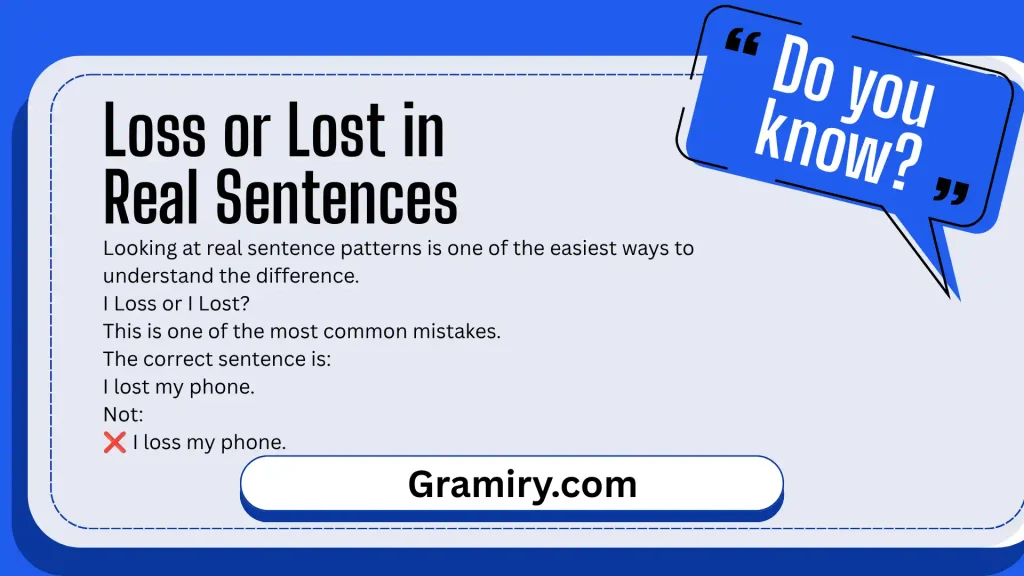
Looking at real sentence patterns is one of the easiest ways to understand the difference.
I Loss or I Lost?
This is one of the most common mistakes.
The correct sentence is:
I lost my phone.
Not:
❌ I loss my phone.
Why?
Because the sentence describes something that happened in the past. The base verb is lose, and its past tense is lost.
You can also say:
I have lost my phone.
But you cannot normally say:
❌ I have loss my phone.
Remember:
lose → lost
not:
lose → loss
The Loss or The Lost?
Another common mistake is using lost where a noun is required.
For example:
❌ The lost of his job was difficult.
The correct sentence is:
✅ The loss of his job was difficult.
Why?
Because the sentence needs a noun after the. Loss is the noun.
Compare:
He lost his job.
The loss of his job was difficult.
Both sentences communicate a related idea, but their grammar is different.
Have Lost or Have Loss?
After have, has, or had, use lost when you are using the verb lose in the perfect tense.
Correct:
I have lost my wallet.
She has lost interest.
They had lost their chance.
Incorrect:
❌ I have loss my wallet.
❌ She has loss interest.
However, loss can still appear in a sentence with have when it is being used as a noun.
For example:
The company has experienced a financial loss.
Here, loss is a noun connected to financial, while experienced is the verb.
Loss of vs. Lost
The phrases loss of and lost often express similar ideas but use different grammar.
Compare:
The loss of confidence affected her performance.
She lost confidence in her abilities.
Another pair:
The loss of interest surprised the teacher.
The student lost interest in the subject.
Another:
The loss of control caused a problem.
The driver lost control.
This is a useful pattern to remember:
loss of + noun
and often:
lost + noun
For example:
loss of hope → lost hope
loss of interest → lost interest
loss of control → lost control
loss of contact → lost contact
The exact structure depends on the sentence, but the comparison makes the relationship easier to recognize.
Common Expressions With Loss and Lost
Both words appear in many everyday expressions.
Financial Loss and Lost Money
Loss is frequently used when discussing business and money.
Examples:
The company suffered a financial loss.
The business reported a significant loss.
With lost, the focus is usually on the action or result involving the person or organization:
The company lost money last year.
He lost a large amount of money.
The distinction is simple:
The company lost money.
The company suffered a loss.
Both are correct, but the grammatical structure changes.
Loss of Control and Lost Control
Both expressions are common.
The driver lost control of the vehicle.
The loss of control caused the accident.
The first sentence uses lost as a verb.
The second uses loss as a noun.
Loss of Interest and Lost Interest
You can say:
She lost interest in the project.
Or:
Her loss of interest was obvious.
Again, the meaning is closely related, but the grammar changes.
Loss of Hope and Lost Hope
Compare:
He lost hope after several failures.
His loss of hope was concerning.
Both sentences describe a similar situation.
The first uses lost as a verb, while the second uses loss as a noun.
At a Loss
The expression at a loss has a special meaning.
If you are at a loss, you do not know what to say, do, or think in a particular situation.
For example:
I was at a loss for words.
She was at a loss about what to do next.
This expression is different from simply saying that something was lost.
Common Mistakes to Avoid
Understanding the most common errors can make the difference much easier to remember.
Mistake 1: Using Loss as a Verb
Incorrect:
I loss my keys yesterday.
Correct:
I lost my keys yesterday.
Loss is a noun, while lost is the past tense of lose.
Mistake 2: Writing “The Lost of”
Incorrect:
The lost of his job was unexpected.
Correct:
The loss of his job was unexpected.
When you need a noun meaning the result or experience of losing, use loss.
Mistake 3: Saying “Have Loss”
Incorrect:
I have loss my phone.
Correct:
I have lost my phone.
After have, has, or had, use lost when forming the perfect tense of lose.
Mistake 4: Confusing Lose and Lost
Incorrect:
Yesterday, I lose my wallet.
Correct:
Yesterday, I lost my wallet.
Lose is the base or present form. Lost is the past form.
Mistake 5: Assuming Lost Always Means “Missing”
Lost can mean more than something being missing.
For example:
I lost the game.
Here, it means you were defeated.
I feel lost.
Here, it describes an emotional or mental state.
I have lost interest.
Here, it means your interest has disappeared.
So, always consider the context.
Loss or Lost in American and British English
There is no major American-versus-British spelling difference between loss and lost.
Both American and British English use:
- lose
- lost
- loss
For example:
I lost my wallet.
This sentence is correct in both varieties of English.
Likewise:
The loss was unexpected.
The grammar remains the same.
Therefore, if you are writing for readers in the United States, United Kingdom, Canada, Australia, Pakistan, India, or other English-speaking regions, you generally do not need to choose between loss and lost based on regional spelling.
The choice depends on grammar and meaning, not nationality.
Loss or Lost: A Simple Decision Guide
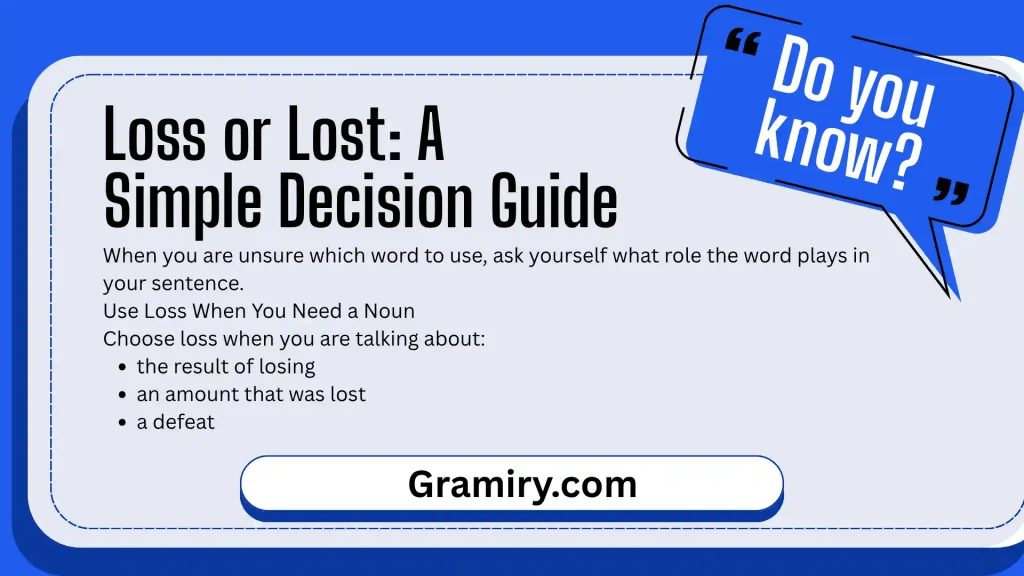
When you are unsure which word to use, ask yourself what role the word plays in your sentence.
Use Loss When You Need a Noun
Choose loss when you are talking about:
- the result of losing
- an amount that was lost
- a defeat
- a reduction
- bereavement
- an absence or disappearance
Examples:
It was a terrible loss.
The company suffered a financial loss.
The loss of data caused problems.
His death was a great loss.
Use Lost When You Need the Past Form of Lose
Choose lost when you are describing something that happened in the past.
Examples:
I lost my keys.
She lost her job.
We lost the game.
They lost contact.
Use Lost With Have, Has, or Had
Examples:
I have lost my wallet.
She has lost interest.
They had lost their opportunity.
Use Lost as an Adjective
Examples:
I feel lost.
The child looked lost.
He seemed lost during the conversation.
Loss, Lost, or Lose? Practice Quiz
Now test yourself.
Choose the Correct Word
1. I ___ my keys yesterday.
a) loss
b) lost
c) lose
Answer: lost
The sentence refers to a past action, so lost is correct.
2. The company suffered a financial ___.
a) lost
b) lose
c) loss
Answer: loss
The sentence needs a noun, so loss is correct.
3. Don’t ___ hope.
a) loss
b) lost
c) lose
Answer: lose
The sentence uses the base form of the verb.
4. She has ___ interest in the project.
a) loss
b) lost
c) lose
Answer: lost
The sentence uses has + past participle, so lost is correct.
5. I feel ___ without a clear plan.
a) loss
b) lost
c) lose
Answer: lost
Here, lost is functioning as an adjective describing a person’s state.
6. The ___ of his job was difficult for his family.
a) loss
b) lost
c) lose
Answer: loss
The sentence needs a noun, so loss is correct.
Frequently Asked Questions
Is it “I loss” or “I lost”?
The correct phrase is “I lost.” The word lost is the past tense of lose. For example, you should say, “I lost my phone yesterday.” Loss is a noun, so it cannot normally be used as the past-tense verb in this sentence.
What is the difference between loss, lost, and lose?
Lose is the base form of the verb, lost is its past tense and past participle, and loss is a noun. For example, “I may lose my phone,” “I lost my phone,” and “The loss of my phone was frustrating” use all three forms correctly.
Is loss a noun or a verb?
Loss is primarily a noun. It refers to the result, experience, amount, or situation associated with losing something. For example, “The company suffered a financial loss” uses loss as a noun.
Is lost a verb or an adjective?
Lost can be both a verb and an adjective. As a verb, it is the past tense or past participle of lose, as in “I lost my keys.” As an adjective, it can describe someone who cannot find their way or feels uncertain, as in “I feel lost.”
Is “the lost of” correct?
No, “the lost of” is generally incorrect when you mean the result or experience of losing something. The correct phrase is “the loss of.” For example, say “the loss of my job,” not “the lost of my job.”
Is “loss of” grammatically correct?
Yes. “Loss of” is a common and grammatically correct phrase when loss functions as a noun. Examples include “loss of control,” “loss of confidence,” “loss of income,” and “loss of interest.”
What is the past tense of lose?
The past tense of lose is lost. For example, “I lose my keys sometimes” changes to “I lost my keys yesterday.” The past participle is also lost, as in “I have lost my keys.”
Can loss be plural?
Yes. The plural form of loss is losses.
For example:
The company suffered a major loss.
The company reported several losses.
The spelling changes from loss to losses when referring to more than one loss.
Conclusion
The difference between loss or lost is much easier once you remember that they have different grammatical roles. Loss is a noun that describes the result, experience, amount, or situation connected with losing. Lost is usually the past tense or past participle of lose, although it can also function as an adjective.
The easiest word family to remember is:
Lose → Lost → Lost
while loss is the noun.
So, you would say “I lost my phone,” but “The loss of my phone was frustrating.” You would also say “I have lost my phone,” not “I have loss my phone.”
When choosing between the words, ask yourself whether you are describing an action or naming a result or experience. That simple check will help you use lose, lost, and loss correctly in everyday writing, professional communication, schoolwork, and online conversations.

Jordan Miles is a passionate writer known for creating thoughtful and engaging content that connects with modern readers. With years of experience in digital publishing, he focuses on storytelling, culture, lifestyle, and meaningful ideas that inspire curiosity.
He is also the author of The Silent Horizon and Echoes Beyond Midnight, two original works praised for their emotional depth and imaginative writing style.
Jordan believes great writing should feel simple, honest and memorable. Through his work, he continues to share fresh perspectives that keep readers connected and inspired.
 Matthew Cooper
 Amelia Brooks