I remember the first time I saw the word “writting” in an email and wondered whether it was actually a valid spelling.
If you’ve ever paused while typing and asked yourself, “Is it writing or writting?”, you’re definitely not alone. This is one of the most common spelling mistakes in English because many words double their consonants before adding -ing.
However, English spelling rules can be tricky and full of exceptions. In this guide, I will explain the difference between writing and writting, show you the correct spelling, provide grammar rules, examples, and practice exercises, and help you avoid this mistake forever.
Direct Answer
The correct spelling is writing. The word writting is a misspelling and is not recognized as a standard English word. When the verb write changes to its present participle form, the silent e is removed before adding -ing, resulting in writing, not writting.
Meanings
Writing
Writing is the present participle and gerund form of the verb write.
It can refer to:
- The act of creating text using words and sentences.
- The skill or process of expressing ideas through written language.
- A written work such as an article, letter, book, or report.
Examples:
- She is writing a novel.
- Writing helps improve communication skills.
- His writing is clear and engaging.
Writting
Writting has no accepted meaning in modern English because it is simply an incorrect spelling of writing.
Pronunciation
Writing
Pronunciation: /ˈraɪ.tɪŋ/
It sounds like:
RYE-ting
Breakdown:
- Write = /raɪt/
- Writing = /ˈraɪ.tɪŋ/
Examples:
- Writing a letter
- Creative writing
- Academic writing
Writting
Since writting is not a valid English word, it has no official pronunciation.
The Key Differences
| Feature | Writing | Writting |
| Correct English Word | Yes | No |
| Dictionary Recognition | Yes | No |
| Standard Usage | Yes | No |
| Accepted in Academic Writing | Yes | No |
| Present Participle of Write | Yes | No |
The confusion often occurs because many English verbs double the final consonant before adding -ing.
Examples:
- Sit → Sitting
- Run → Running
- Swim → Swimming
However, write follows a different spelling rule because it ends with a silent e.
Write → Writing
Not:
Write → Writting ❌
Correct Spelling
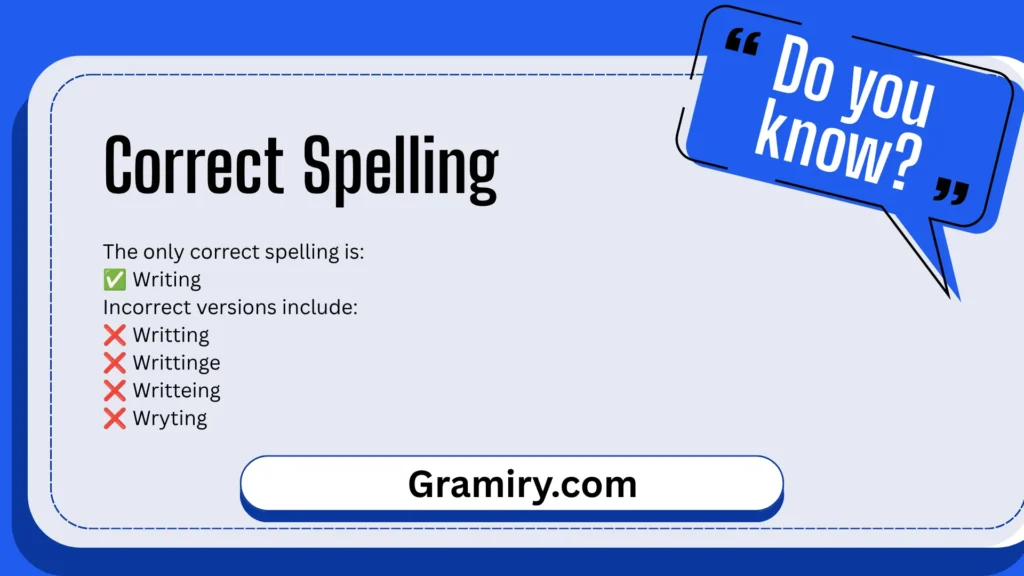
The only correct spelling is:
✅ Writing
Incorrect versions include:
❌ Writting
❌ Writtinge
❌ Writteing
❌ Wryting
Why Is Writing Correct?
When a verb ends with a silent e, English grammar generally requires removing the e before adding -ing.
Examples:
| Base Verb | Correct Form |
| Write | Writing |
| Make | Making |
| Take | Taking |
| Drive | Driving |
| Create | Creating |
Therefore:
Write + ing = Writing
Singular and Plural Forms
The word writing is generally an uncountable noun when referring to the activity.
Singular Usage
- Writing is an important skill.
- Her writing has improved significantly.
Plural Usage
When referring to multiple written works, writings can be used.
Examples:
- The author’s writings are famous worldwide.
- Ancient writings provide historical insights.
| Form | Example |
| Writing | Writing improves critical thinking. |
| Writings | Shakespeare’s writings remain influential. |
Grammar Rules
Understanding the grammar behind writing makes the spelling easier to remember.
Rule 1: Drop the Silent E
When a verb ends with a silent e, remove the e before adding -ing.
Examples:
- Write → Writing
- Drive → Driving
- Make → Making
Rule 2: Use Writing as a Verb
As a present participle:
- I am writing an essay.
- They are writing reports.
Rule 3: Use Writing as a Noun
As a gerund:
- Writing requires practice.
- Writing can be therapeutic.
Rule 4: Do Not Double the T
The consonant doubling rule does not apply because write ends with a silent e.
Incorrect:
- Writting
Correct:
- Writing
Rule 5: Maintain Consistency
In formal, academic, and professional communication, always use writing.
Which One Is Unique?
Among the two forms, writing is the only unique and valid English word.
It is used in various contexts:
Academic Context
- Academic writing
- Research writing
- Essay writing
Professional Context
- Business writing
- Technical writing
- Report writing
Creative Context
- Creative writing
- Fiction writing
- Script writing
Everyday Communication
- Email writing
- Letter writing
- Journal writing
Because writting is not recognized in standard English, it should never be used in any of these situations.
Illustrative Examples
Here are some example sentences showing the correct use of writing:
- She spends two hours every day writing in her journal.
- Writing a book requires patience and dedication.
- His writing style is simple and effective.
- We are writing a report for our manager.
- Creative writing encourages imagination.
- Writing clearly helps readers understand your message.
- The professor praised her academic writing.
- I enjoy writing articles during my free time.
- Writing skills are essential in many careers.
- They are writing invitations for the event.
Practice Section (MCQs)
1. Which spelling is correct?
A. Writting
B. Writing
C. Wryting
D. Writteing
2. What is the present participle of “write”?
A. Writting
B. Writed
C. Writing
D. Wrote
3. Which sentence is correct?
A. She is writting a book.
B. She is writing a book.
C. She writing a book.
D. She writeing a book.
4. What should happen to the silent “e” in write before adding -ing?
A. Double it
B. Remove it
C. Keep it
D. Replace it
5. Which word is a noun?
A. Writing
B. Writting
C. Writed
D. Wrote
6. Which phrase is correct?
A. Creative writting
B. Creative writing
C. Creative writed
D. Creative writeing
7. Which spelling appears in dictionaries?
A. Writting
B. Writing
C. Both
D. Neither
8. Which sentence contains an error?
A. I enjoy writing poems.
B. Writing improves communication.
C. She is writting a letter.
D. His writing is excellent.
9. Which form refers to multiple written works?
A. Writing
B. Writtings
C. Writings
D. Wrotes
10. What is the base verb of writing?
A. Wrote
B. Written
C. Write
D. Writting
11. Which profession relies heavily on writing?
A. Author
B. Editor
C. Journalist
D. All of the above
12. Which word is misspelled?
A. Writing
B. Reading
C. Writting
D. Speaking
13. Which rule applies to write?
A. Double the final consonant
B. Remove the silent e
C. Add ed first
D. None
14. Which sentence is grammatically correct?
A. They are writting emails.
B. They writing emails.
C. They are writing emails.
D. They are write emails.
15. Which option is always correct?
A. Writting
B. Writtng
C. Writing
D. Writeing
Answer Key
- B
- C
- B
- B
- A
- B
- B
- C
- C
- C
- D
- C
- B
- C
- C
Frequently Asked Questions (FAQs)
Is writting ever correct in English?
No. Writting is always considered a spelling mistake. The correct form is writing.
Why don’t we double the “t” in writing?
Because the verb write ends with a silent e. The grammar rule requires dropping the e before adding -ing.
Is writing a verb or a noun?
It can be both. It functions as a verb when describing an action and as a noun when referring to the activity or skill.
What is the plural of writing?
The plural form is writings when referring to multiple written works or documents.
How can I remember the correct spelling?
Remember this simple formula:
Write − e + ing = Writing
This rule applies to many similar verbs ending in silent e.
Conclusion
The confusion between writing and writting is extremely common, but the solution is simple once you understand the spelling rule.
The correct form is always writing, created by removing the silent e from write and adding -ing. The spelling writting is incorrect and should be avoided in academic, professional, and everyday communication.
Understanding how silent e verbs change will help you spell many other words correctly as well. Whenever you’re unsure, remember the formula write → writing. With consistent practice and attention to grammar rules, you’ll never confuse these spellings again.

Jordan Miles is a passionate writer known for creating thoughtful and engaging content that connects with modern readers. With years of experience in digital publishing, he focuses on storytelling, culture, lifestyle, and meaningful ideas that inspire curiosity.
He is also the author of The Silent Horizon and Echoes Beyond Midnight, two original works praised for their emotional depth and imaginative writing style.
Jordan believes great writing should feel simple, honest and memorable. Through his work, he continues to share fresh perspectives that keep readers connected and inspired.
 Amelia Brooks
 Matthew Cooper