I remember staring at my chemistry homework, utterly stuck. The question seemed simple: “Is solubility a physical or chemical property?” But the more I read, the more confused I became because sugar dissolves in water without changing its chemical structure, yet an Alka-Seltzer tablet fizzes and transforms.
I realized I wasn’t alone. Most students and even some professionals mix this up. In this guide, I’ll give you the crystal-clear answer, break down the grammar and usage of the term, and ensure you never hesitate again whether you’re writing a lab report or teaching a class.
Direct Answer
Solubility is a physical property, not a chemical one. It describes the ability of a solute to dissolve in a solvent without altering the chemical identity of either substance. The process is reversible by physical means (e.g., evaporation), and no new chemical bonds are permanently formed.
Meanings
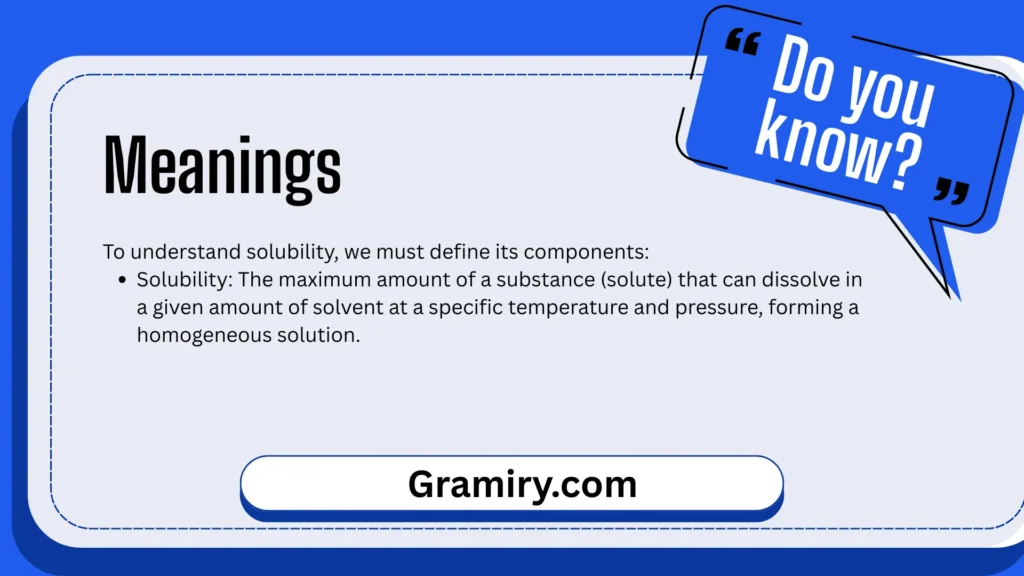
To understand solubility, we must define its components:
- Solubility: The maximum amount of a substance (solute) that can dissolve in a given amount of solvent at a specific temperature and pressure, forming a homogeneous solution.
- Physical property: A characteristic that can be observed or measured without changing the substance’s chemical composition (e.g., color, melting point, density).
- Chemical property: A characteristic that describes a substance’s ability to undergo a specific chemical change or reaction (e.g., flammability, reactivity with acid).
Thus, when we ask “is solubility a physical or chemical property,” we are really asking: Does measuring solubility change the substance’s molecular structure? The answer is no—dissolved sugar is still sugar.
Pronunciation
- Solubility: /ˌsɒl.jəˈbɪl.ə.ti/ (UK) or /ˌsɑːl.jəˈbɪl.ə.t̬i/ (US)
- Break it down: sol-u-bil-i-ty (5 syllables). Stress falls on the bil.
- Physical: /ˈfɪz.ɪ.kəl/ (2 syllables: fiz-i-cal)
- Chemical: /ˈkem.ɪ.kəl/ (3 syllables: kem-i-cal)
- Property: /ˈprɒp.ə.ti/ (4 syllables: prop-er-ty)
Common mispronunciation: Avoid saying “sol-U-bility” with heavy emphasis on “sol.” Instead, lightly stress “bil”: sahl-yuh-BIL-uh-tee.
The Key Differences
While “physical” and “chemical” properties are taught side by side, their difference is foundational to science. Here’s the nuance:
| Aspect | Physical Property | Chemical Property |
| Identity of substance | Unchanged | Changed into new substance(s) |
| Reversibility | Usually reversible by physical means | Often irreversible or requires chemical reaction |
| Observation | No chemical reaction needed | Chemical reaction must occur |
| Examples | Solubility, melting point, density, color | Flammability, toxicity, oxidation state |
Now, you might ask: “But doesn’t dissolving sometimes involve energy changes or bond breaking?” Yes—but that doesn’t make it a chemical property. In physical dissolution, intermolecular forces (like hydrogen bonding) are overcome, but covalent or ionic bonds within the solute remain intact (e.g., NaCl dissociates into ions, but they reassemble upon evaporation). A chemical property would require that sugar turns into alcohol or carbon dioxide.
The technical nuance: Solubility is a physical property because the process of dissolution does not create new chemical substances. Even if ions separate (as in salt), the chemical formula of the solute remains the same after recovery.
Correct Spelling
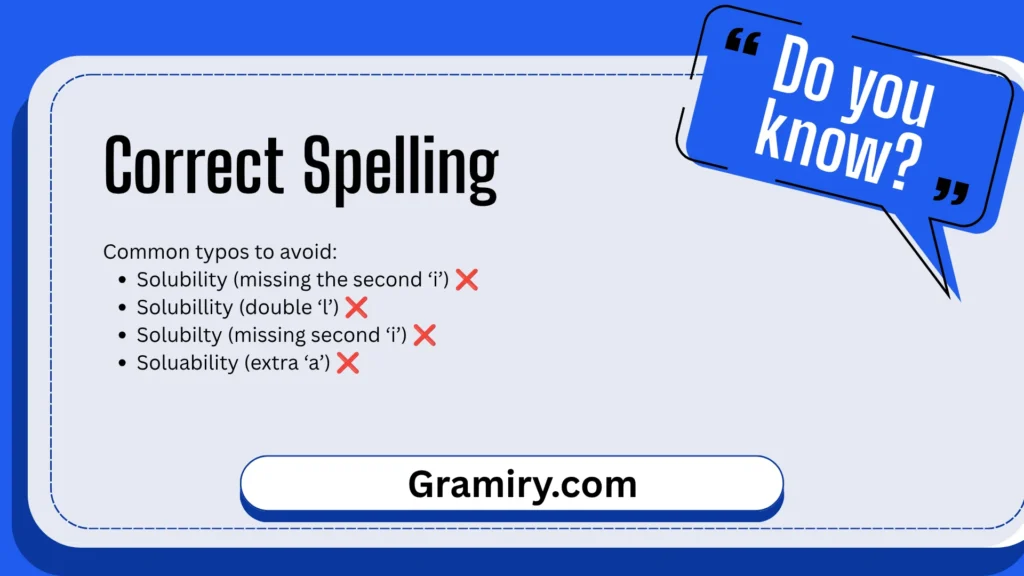
The standard spelling is solubility (no hyphen, no double letters except the double ‘l’ is not present wait: actually, it has one ‘l’ after ‘o’? Let’s check: S-O-L-U-B-I-L-I-T-Y. Yes: solubility). Common typos to avoid:
- Solubility (missing the second ‘i’) ❌
- Solubillity (double ‘l’) ❌
- Solubilty (missing second ‘i’) ❌
- Soluability (extra ‘a’) ❌
Remember: soluble + ity → solubility (drop the ‘e’ from soluble, add -ity).
Singular and Plural Forms
This keyword behaves unusually:
- Singular: solubility (uncountable in most scientific contexts). Example: “The solubility of salt in water is 359 g/L.”
- Plural: solubilities (used when comparing different substances or conditions). Example: “The solubilities of sodium chloride and silver chloride differ drastically.”
In academic writing, you will rarely pluralize it unless comparing multiple solutes or solvents. For everyday grammar, treat it like “water” (usually singular).
Grammar tip: When asking “is solubility a physical or chemical property,” always use the singular form because you are referring to the concept as a whole.
Grammar Rules
Let’s dissect the grammar of “is solubility a physical or chemical property”:
- Parts of speech:
- Solubility → noun (abstract, uncountable in main sense)
- Physical → adjective modifying “property”
- Chemical → adjective modifying “property”
- Property → noun (countable)
- Is → linking verb (third person singular present)
- Sentence structure: The question follows a copular verb pattern: [Subject] + [linking verb] + [subject complement (adjective + noun)]. “A physical or chemical property” is a compound subject complement.
- Placement of the keyword: In declarative sentences, “solubility” typically comes as subject or object. Example: “Scientists measure solubility using standard conditions.” Never use “solubility” as a verb (no, you cannot “solubilize” a compound—that’s a different word: solubilize).
- Capitalization: Do not capitalize “solubility” unless at the start of a sentence. It is not a proper noun.
- Common grammatical error: Using “solubility” as a countable noun without context. Incorrect: “I measured three solubilities of sugar.” Correct: “I measured solubility values for three sugar samples.”
Which One Is Unique?
Among the hundreds of scientific terms that blur the line between physical and chemical, solubility holds a unique educational role. Why? Because it is the most commonly cited counterexample that novices mistake for a chemical property.
Here’s the unique context:
- When a student sees effervescence (fizzing) during dissolution (e.g., Alka-Seltzer in water), they assume a chemical reaction occurred. But that fizz comes from trapped CO₂ gas being released physically—or sometimes an actual reaction (like acid + base). That’s why teachers explicitly ask: “Is solubility a physical or chemical property?” to train observation skills.
- In advanced chemistry, miscibility (liquid-liquid solubility) and partial solubility maintain the same physical classification, unless chemisorption (chemical bonding to surface) occurs—but that’s not pure solubility anymore.
Uniqueness note: Solubility is one of the few properties that depends so heavily on temperature and pressure without changing identity. Most other physical properties (like mass) are less variable.
Illustrative Examples
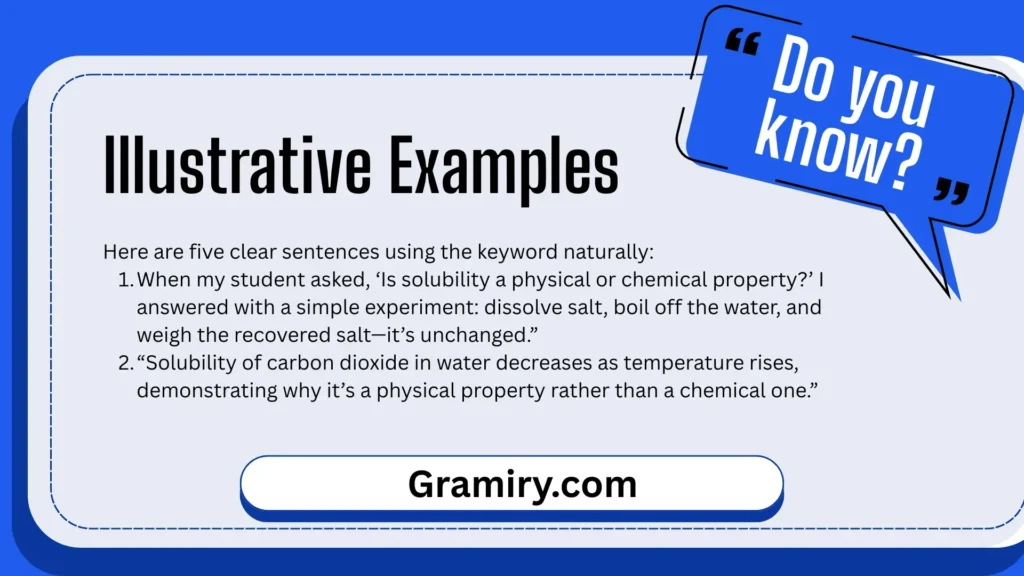
Here are five clear sentences using the keyword naturally:
- “When my student asked, ‘Is solubility a physical or chemical property?’ I answered with a simple experiment: dissolve salt, boil off the water, and weigh the recovered salt—it’s unchanged.”
- “Solubility of carbon dioxide in water decreases as temperature rises, demonstrating why it’s a physical property rather than a chemical one.”
- “Even though sugar disappears in tea, solubility remains a physical property because no new molecules like ethanol or acetic acid form.”
- “To test whether solubility is a physical or chemical property, chemists use filtration or evaporation; if the solute reappears identical, the process was physical.”
- “In pharmaceutical science, drug solubility is measured as a physical property because it affects absorption without altering the drug’s chemical structure.”
Practice Section (MCQs)
Test your understanding with these 15 questions. Answer key at the bottom.
- Is solubility a physical or chemical property?
a) Chemical only
b) Physical only
c) Both depending on the solute
d) Neither - Which of these is evidence that solubility is a physical property?
a) The solution changes color permanently
b) The solute can be recovered by evaporation
c) A gas is produced that cannot be reversed
d) The solvent becomes acidic - What happens to the chemical identity of sodium chloride when it dissolves in water?
a) It changes into chlorine gas
b) It changes into sodium metal
c) It remains NaCl, just dissociated into ions
d) It forms hydrochloric acid - Which of the following is a chemical property?
a) Solubility in water
b) Melting point
c) Flammability
d) Density - True or false: Solubility can be a chemical property if the solute reacts with the solvent.
a) True — then it’s called reactive solubility
b) False — that process is no longer called solubility but a chemical reaction
c) True — all solubility is chemical
d) False — solubility is always chemical - What is the correct spelling?
a) Solubility
b) Solubillity
c) Solubilty
d) Soluability - Which sentence uses the plural form correctly?
a) The solubility of gases are different.
b) The solubilities of KCl and NaCl vary with temperature.
c) Solubility are measured in grams per liter.
d) He studied three solubility’s. - Part of speech of “solubility” in “Solubility is crucial for biochemistry”?
a) Adjective
b) Verb
c) Noun
d) Adverb - Which factor most affects solubility but does not make it a chemical property?
a) Presence of a catalyst
b) Temperature
c) Chemical reactivity of solute
d) Oxidation state - If a substance “dissolves” but also decomposes into new compounds, is solubility a physical or chemical property in that case?
a) Physical — because it dissolved
b) Chemical — because the original substance is gone
c) Both physical and chemical simultaneously
d) Neither — the term “solubility” no longer applies - Which statement is grammatically correct?
a) Are solubility a physical property?
b) Solubility are important.
c) Solubility is a physical property.
d) The solubility were measured. - When writing a lab report, which phrase is best?
a) “The solubility of the compound was determined at 25°C.”
b) “The compound solubilitied easily.”
c) “We solubilitated the sample.”
d) “Solubility are temperature dependent.” - Which is NOT a physical property?
a) Solubility
b) Boiling point
c) Reactivity with oxygen
d) Electrical conductivity - Pronunciation: Which syllable is stressed in “solubility”?
a) SOL
b) u
c) BIL
d) ty - Why do students often mistakenly think solubility is a chemical property?
a) Because it requires heat sometimes
b) Because they see bubbles or color changes that resemble reactions
c) Because solubility is not measurable
d) Because textbooks say so
Answer Key:
1-b, 2-b, 3-c, 4-c, 5-b, 6-a, 7-b, 8-c, 9-b, 10-b, 11-c, 12-a, 13-c, 14-c, 15-b
Frequently Asked Questions (FAQs)
1. Is solubility always a physical property for every substance?
Yes, by definition. If a substance reacts chemically with the solvent (e.g., sodium metal in water), that is no longer measuring solubility—it’s measuring reactivity. Solubility assumes physical dissolution only.
2. Can solubility ever be considered a chemical property in industry?
No. However, some industrial processes use “apparent solubility” when reactions occur, but pure scientific terminology reserves “solubility” for physical processes.
3. Why do some teachers say “it depends” when asked is solubility a physical or chemical property?
They may be referring to edge cases like carbon dioxide in water (forms carbonic acid). But even then, only a tiny fraction reacts; the dominant process is physical. Most education standards classify solubility as purely physical.
4. Does the grammar of “solubility” change in different English dialects?
No, the noun is identical in US, UK, and Australian English. Pronunciation varies slightly (rhotic vs. non-rhotic), but spelling and grammar remain standard.
5. How can I remember that solubility is physical?
Use the “recovery test”: If you can get the original substance back by evaporation or cooling without a chemical reaction, the property is physical. This works for solubility 100% of the time.
Conclusion
So, is solubility a physical or chemical property? The definitive answer is physical every time, for every non-reactive system. We’ve seen that the identity of the solute remains unchanged, the process is reversible, and no new chemical bonds are formed.
Remember the recovery test: if you can get your original substance back, you’re looking at a physical property. My final piece of advice: whenever confusion arises, ask yourself, “Does this process change what the molecules actually are?” If not, you’re in the physical realm.
Keep this guide handy for your next exam, lab report, or classroom debate. You’ve got this.

Matthew Cooper is a passionate writer who loves exploring human emotions, modern culture, and everyday life experiences through meaningful storytelling. With years of creative writing experience, he has built a reputation for crafting engaging and thought-provoking content that connects naturally with readers.
He is the author of Beneath The Crimson Hour and When The Moon Turned Silver, two original works known for their deep themes and immersive writing style.
Matthew enjoys turning simple ideas into powerful narratives that inspire curiosity and reflection. His work focuses on authenticity, creativity, and delivering valuable insights in a clear and engaging way.
 Jordan Miles
 Amelia Brooks