
I remember the first time I paused mid-sentence, unsure whether to write “I use to” or “I used to.” It felt like such a small detail but getting it wrong can instantly affect clarity and credibility. If you’ve ever hesitated over this phrase, you’re definitely not alone.
Many English learners and even native speakers struggle with this exact confusion. The good news? Once you understand the rule, it becomes incredibly easy to apply.
In this guide, I’ll break everything down in a simple, practical way so you never second-guess yourself again.
Direct Answer
“I used to” is correct when talking about past habits or states, while “I use to” is only correct in negative or question forms (e.g., Did you use to…?). The difference depends on grammar structure, especially the use of auxiliary verbs like “did.”
Meanings
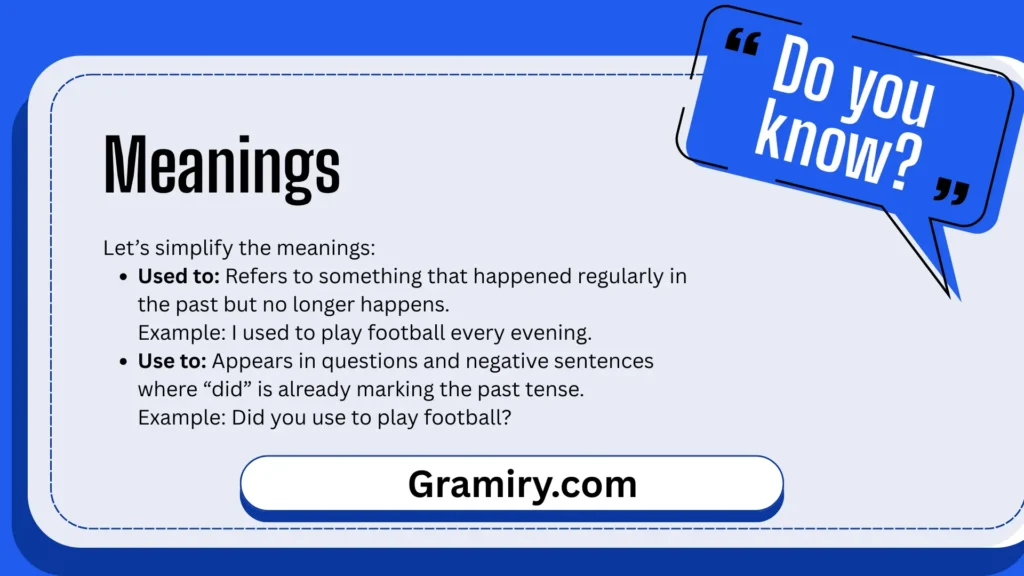
Let’s simplify the meanings:
- Used to: Refers to something that happened regularly in the past but no longer happens.
Example: I used to play football every evening. - Use to: Appears in questions and negative sentences where “did” is already marking the past tense.
Example: Did you use to play football?
The key idea is that both relate to the past—but their structure differs.
Pronunciation
Interestingly, pronunciation adds to the confusion.
- Used to is often pronounced as: yoost-too or yoosta (/ˈjuːstə/)
- The “d” in “used” is often silent in speech.
- Use to in questions sounds almost identical:
Did you use to…? → Did you yoost-too…?
Because they sound nearly the same, learners often rely on spelling rules rather than pronunciation.
The Key Differences
Here’s where things become crystal clear:
- Used to
- Used in affirmative sentences
- Indicates past habits or repeated actions
- Example: I used to wake up early
- Use to
- Used after “did” in questions and negatives
- The past tense is already shown by “did”
- Example: Did you use to wake up early?
👉 The rule:
If there’s no “did,” use “used to.”
If there is “did,” use “use to.”
Correct Spelling
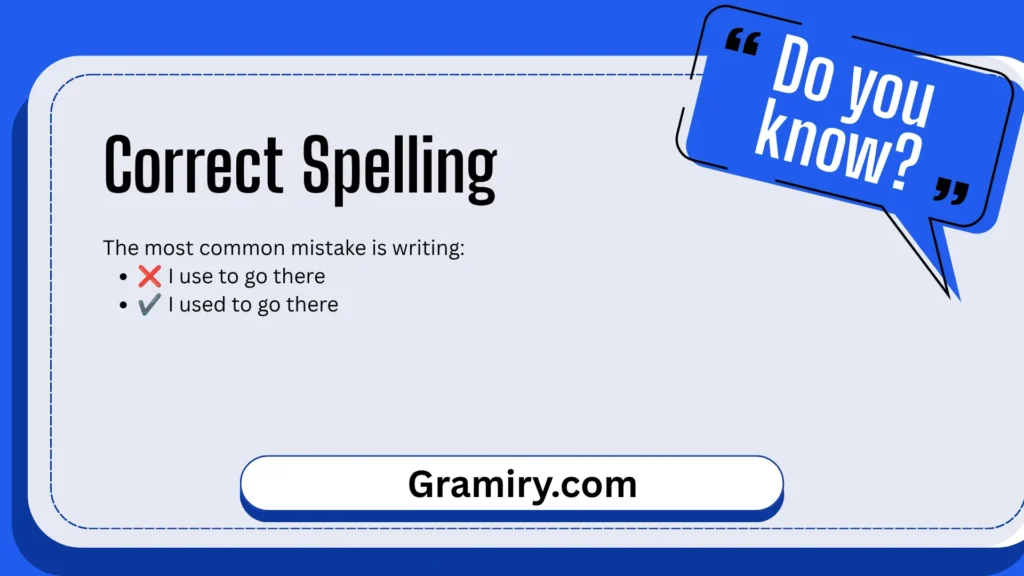
The most common mistake is writing:
❌ I use to go there
✔️ I used to go there
Other common typos:
- “I useto” ❌
- “I used too” ❌ (wrong meaning)
- “I use too” ❌
Always double-check:
- Affirmative sentence → used to
- With “did” → use to
Singular and Plural Forms
Good news—this phrase does not change based on singular or plural subjects.
- I used to travel
- She used to travel
- They used to travel
The structure stays the same regardless of subject. The only variation happens with auxiliary verbs:
- Did he use to…?
- Did they use to…?
Grammar Rules
Understanding the grammar makes everything easier.
1. Used to = Modal-like structure
- Functions like a semi-modal verb
- Always followed by base verb:
- I used to eat, not eating
2. Use to with “Did”
- “Did” already marks past tense
- So “use” stays in base form:
- Did you use to go? ✔️
- Did you used to go? ❌
3. Negative Form
- Didn’t use to (NOT didn’t used to)
- I didn’t use to like coffee
4. Sentence Position
- Typically appears before the main verb:
- I used to live there
Which One is Unique?
“Used to” is the more unique and standalone expression.
Why?
- It specifically describes past habits or states that no longer exist
- There’s no exact one-word replacement in English
Meanwhile, “use to” is not really a phrase on its own—it only exists because of grammatical structure (with “did”).
👉 So if you’re choosing based on importance or independence:
- Used to = meaningful phrase
- Use to = structural necessity
Illustrative Examples
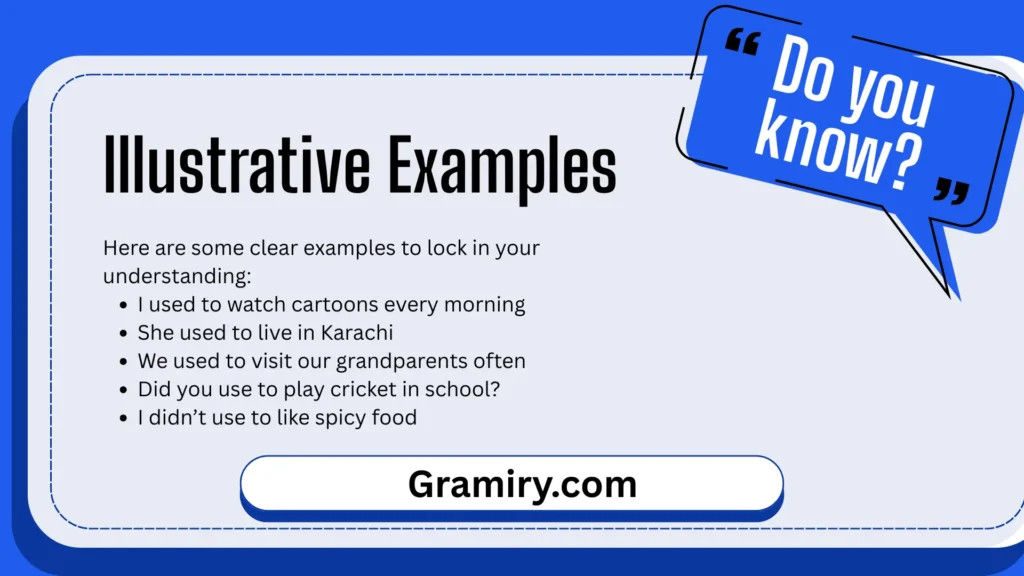
Here are some clear examples to lock in your understanding:
- I used to watch cartoons every morning
- She used to live in Karachi
- We used to visit our grandparents often
- Did you use to play cricket in school?
- I didn’t use to like spicy food
Bonus contrast:
- ✔️ I used to drink tea
- ✔️ Did you use to drink tea?
- ❌ I use to drink tea
Practice Section (MCQs)
Choose the correct option:
- I ___ wake up early when I was younger.
a) use to
b) used to - Did you ___ play outside as a child?
a) used to
b) use to - She ___ love chocolate, but now she avoids it.
a) used to
b) use to - We didn’t ___ travel much before.
a) used to
b) use to - He ___ be very shy in school.
a) used to
b) use to - Did they ___ live here?
a) used to
b) use to - I didn’t ___ understand this rule before.
a) used to
b) use to - She ___ go jogging every day.
a) used to
b) use to - Did he ___ call you often?
a) used to
b) use to - We ___ eat out frequently.
a) used to
b) use to - They didn’t ___ like this movie.
a) used to
b) use to - I ___ believe in ghosts.
a) used to
b) use to - Did she ___ work here?
a) used to
b) use to - He didn’t ___ smoke.
a) used to
b) use to - I ___ ride a bike every evening.
a) used to
b) use to
Answer Key
1-b, 2-b, 3-a, 4-b, 5-a, 6-b, 7-b, 8-a, 9-b, 10-a, 11-b, 12-a, 13-b, 14-b, 15-a
Frequently Asked Questions (FAQs)
1. Is “I use to” ever correct?
Yes, but only in questions or negatives with “did” (e.g., Did you use to…?).
2. Why don’t we say “did you used to”?
Because “did” already indicates past tense, so “used” becomes “use.”
3. Is “used to” a verb?
It’s considered a semi-modal expression, not a standard verb.
4. Can I use “used to” for present habits?
No. It strictly refers to past habits that no longer happen.
5. What’s the difference between “used to” and “would”?
Both describe past habits, but “used to” can also describe past states, while “would” cannot.
Conclusion
I’ve been there staring at a sentence, unsure whether to write “use to” or “used to.” But now you can see it’s not random at all it’s purely about structure.
Remember the golden rule: use “used to” in statements and “use to” with “did.” Once you internalize this, the confusion disappears completely.
Practice a few examples, pay attention when reading, and soon it’ll feel natural. Small grammar details like this can make a big difference in how polished your English sounds.

Jordan Miles is a passionate writer known for creating thoughtful and engaging content that connects with modern readers. With years of experience in digital publishing, he focuses on storytelling, culture, lifestyle, and meaningful ideas that inspire curiosity.
He is also the author of The Silent Horizon and Echoes Beyond Midnight, two original works praised for their emotional depth and imaginative writing style.
Jordan believes great writing should feel simple, honest and memorable. Through his work, he continues to share fresh perspectives that keep readers connected and inspired.
 Matthew Cooper
 Amelia Brooks