I’ve noticed that one of the most common grammar questions people struggle with is surprisingly simple: does x or y come first? At first glance, it feels like a minor detail but it can actually affect clarity, tone, and even correctness. I used to second-guess myself when writing phrases like “bread and butter” or “you and I,” wondering if I had the order right.
If you’ve ever paused mid-sentence to rethink word order, you’re not alone. This confusion often comes from a mix of grammar rules, conventions, and natural language patterns. The good news? There is a logic behind it.
In this guide, I’ll break everything down clearly so you can stop guessing and start writing with confidence.
Direct Answer
In most cases, “x or y” follows natural, conventional, or grammatical order, where shorter, more familiar, or logically prior elements come first. However, context, emphasis, politeness, and fixed expressions often determine which comes first rather than a strict universal rule.
Meanings
Before diving deeper, let’s clarify what we mean by “does x or y come first.”
- X and Y: These represent two words, phrases, or elements being compared or paired.
- Come first: Refers to the order in which elements appear in a sentence or phrase.
This question usually arises when:
- Listing two items (e.g., tea or coffee)
- Using pronouns (e.g., you and I vs. I and you)
- Following common expressions (e.g., black and white)
In essence, it’s about word order and its correctness or naturalness in English.
Pronunciation
The phrase “does x or y come first” is pronounced as:
- /dʌz ɛks ɔːr waɪ kʌm fɜːrst/
Breaking it down:
- Does → “duhz”
- X → “eks”
- Or → “or” (often reduced to “ər” in fast speech)
- Y → “why”
- Come → “kum”
- First → “ferst”
In natural speech, it often sounds like:
👉 “duhz eks er why kum ferst?”
The Key Differences
When deciding whether x or y comes first, several linguistic factors come into play:
1. Fixed Expressions
Some phrases have a set order that rarely changes:
- Bread and butter
- Black and white
- Salt and pepper
Changing the order sounds unnatural.
2. Politeness Rule
When referring to yourself and others:
- Correct: You and I
- Less polite: I and you
English prefers putting others before oneself.
3. Length and Rhythm
Shorter or simpler words often come first:
- Fish and chips (not chips and fish, in most contexts)
4. Logical or Chronological Order
Events are usually listed in the order they happen:
- Cause and effect
- Day and night
5. Emphasis
Sometimes the order changes depending on what you want to emphasize:
- Tea or coffee? (neutral)
- Coffee or tea? (emphasizing coffee)
Correct Spelling
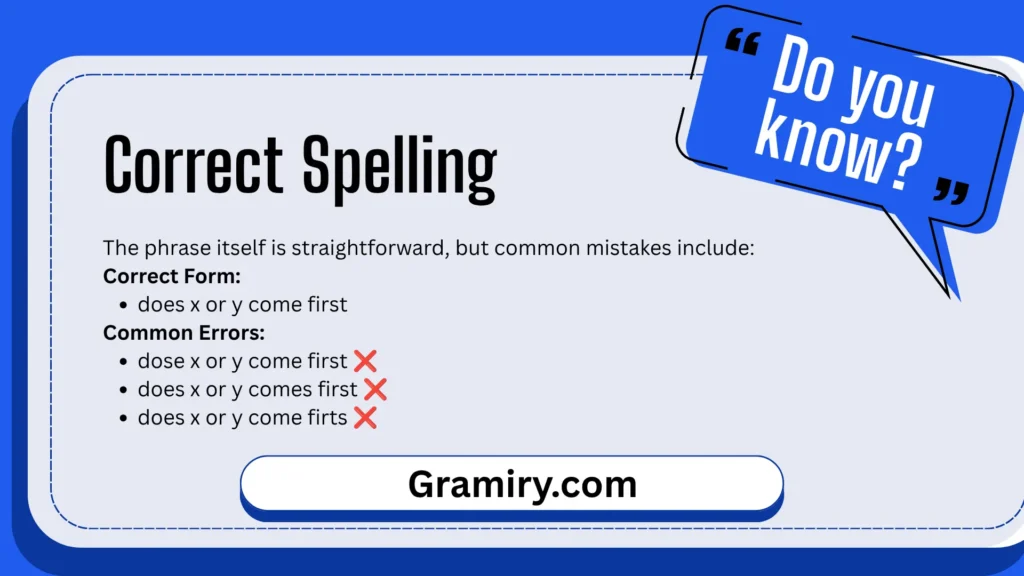
The phrase itself is straightforward, but common mistakes include:
Correct Form:
- does x or y come first
Common Errors:
- dose x or y come first ❌
- does x or y comes first ❌
- does x or y come firts ❌
Key Rule:
After “does”, always use the base verb:
- Correct: does come
- Incorrect: does comes
Singular and Plural Forms
The phrase doesn’t change much in singular or plural contexts, but the subject inside the sentence may affect verb agreement.
Examples:
- Does tea or coffee come first?
- Do tea and coffee come first?
Key Difference:
- “Or” → singular verb (usually)
- “And” → plural verb
So:
- Tea or coffee comes first ✔
- Tea and coffee come first ✔
Grammar Rules
1. Coordinating Conjunctions
The phrase uses “or”, a coordinating conjunction that links alternatives.
2. Subject-Verb Agreement
With “or,” the verb often agrees with the closest subject:
- Does tea or snacks come first?
- Does snacks or tea come first?
3. Pronoun Order Rule
When using pronouns:
- Correct: You and I
- Incorrect: I and you
4. Parallel Structure
Both elements (x and y) should match grammatically:
- Correct: Reading or writing
- Incorrect: Reading or to write
5. Conventional Order Rule
English prefers certain fixed patterns based on:
- Sound (rhythm)
- Meaning
- Tradition
Which One is Unique?
Neither “x” nor “y” is inherently unique—the uniqueness depends on context.
However, certain situations favor one over the other:
X Comes First When:
- It is more important
- It occurs earlier in time
- It is shorter or simpler
- It follows a fixed phrase
Y Comes First When:
- It is being emphasized
- It’s more relevant to the discussion
- It sounds more natural in that context
Example:
- Mom and dad ✔ (common usage)
- Dad and mom ✔ (less common, but acceptable depending on emphasis)
So, uniqueness is context-driven, not rule-driven.
Illustrative Examples
Here are some clear examples to show how “does x or y come first” works in real usage:
- Does tea or coffee come first in your morning routine?
- Does the introduction or conclusion come first when writing an essay?
- Does chicken or egg come first in this recipe?
- Does planning or execution come first in a project?
- Does theory or practice come first in learning?
Bonus variations:
- Should I choose tea or coffee first?
- Which comes first: planning or action?
Practice Section (MCQs)
Choose the correct option:
- ___ you and I go first?
A. Does
B. Do
C. Did
D. Doing - Which is correct?
A. I and you
B. You and I
C. Me and you
D. You and me - Which sounds more natural?
A. Butter and bread
B. Bread and butter
C. Both
D. None - Does tea or coffee ___ first?
A. come
B. comes
C. coming
D. came - Which follows politeness rules?
A. Me and John
B. John and I
C. I and John
D. Myself and John - Which is a fixed expression?
A. Pepper and salt
B. Salt and pepper
C. Both
D. None - Which is correct?
A. Does she or they comes first
B. Does she or they come first
C. Do she or they come first
D. Do she or they comes first - Which emphasizes coffee?
A. Tea or coffee
B. Coffee or tea
C. Both equally
D. None - Which is grammatically parallel?
A. Running or to swim
B. Running or swimming
C. Run or swimming
D. To run or swimming - Which is correct?
A. Does x or y comes first
B. Does x or y come first
C. Do x or y comes first
D. Do x or y come - Which follows natural order?
A. Night and day
B. Day and night
C. Both
D. None - Which is correct verb agreement?
A. Tea and coffee comes first
B. Tea and coffee come first
C. Tea and coffee coming first
D. Tea and coffee came first - Which sounds more natural?
A. Black and white
B. White and black
C. Both
D. None - Which is correct?
A. Does he or I comes first
B. Does he or I come first
C. Do he or I come first
D. Do he or I comes first - Which follows politeness?
A. Me and my friend
B. My friend and I
C. I and my friend
D. Myself and friend
Answer Key
- B
- B
- B
- A
- B
- B
- B
- B
- B
- B
- B
- B
- A
- B
- B
Frequently Asked Questions (FAQs)
1. Is there a strict rule for which word comes first?
No, English doesn’t have a single strict rule. Word order depends on convention, clarity, and context rather than fixed grammar laws.
2. Why do some phrases sound wrong when reversed?
Because they are fixed expressions shaped by usage over time. Changing them disrupts natural rhythm and familiarity.
3. Should I always put others before myself?
Yes, in formal and polite contexts, it’s standard to say “you and I” instead of “I and you.”
4. Does word order affect meaning?
Sometimes yes. Changing the order can shift emphasis or clarity, even if the sentence remains grammatically correct.
5. How can I know the correct order?
The best way is exposure and practice—reading, listening, and noticing common patterns in everyday English.
Conclusion
Understanding does x or y come first isn’t about memorizing one rigid rule it’s about recognizing patterns in English. I’ve found that once you pay attention to fixed expressions, politeness rules, and natural rhythm, things start to click quickly.
In most cases, the correct order is the one that sounds natural and follows established usage. When in doubt, think about clarity, context, and common phrasing.
With practice, you’ll stop hesitating and start choosing the right order instinctively. And honestly, that’s when your English begins to feel truly fluent.

Matthew Cooper is a passionate writer who loves exploring human emotions, modern culture, and everyday life experiences through meaningful storytelling. With years of creative writing experience, he has built a reputation for crafting engaging and thought-provoking content that connects naturally with readers.
He is the author of Beneath The Crimson Hour and When The Moon Turned Silver, two original works known for their deep themes and immersive writing style.
Matthew enjoys turning simple ideas into powerful narratives that inspire curiosity and reflection. His work focuses on authenticity, creativity, and delivering valuable insights in a clear and engaging way.
 Amelia Brooks
 Jordan Miles