If you are searching for parenthesis or parentheses, you may be unsure which word is correct and when to use each one. Both words are correct, but they are not interchangeable. The main difference is simple: parenthesis is singular, while parentheses is plural. This can be confusing because the punctuation marks ( ) normally appear together as a pair.
If you have ever wondered whether to say “a parenthesis” or “parentheses,” you are not alone. Many writers and English learners also search for the plural of parenthesis, the correct spelling of parentheses, and the difference between parenthesis and parentheses. The good news is that the rule is easy once you understand how singular and plural forms work.
In this guide, I’ll explain exactly what parenthesis and parentheses mean, when to use each word, and how they work in real sentences. I’ll also cover the correct plural spelling, pronunciation, opening and closing parentheses, common mistakes such as “parenthesises,” and the difference between parentheses, brackets, and braces. By the end, you’ll know exactly which form to use whenever you write about or use ( ) in English.
Parenthesis or Parentheses: Quick Answer
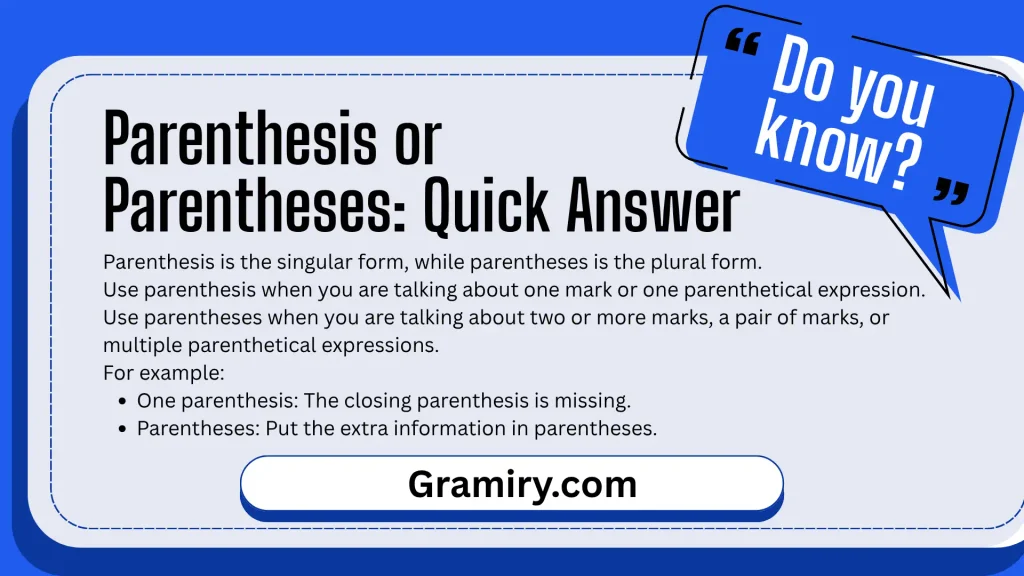
Parenthesis is the singular form, while parentheses is the plural form.
Use parenthesis when you are talking about one mark or one parenthetical expression.
Use parentheses when you are talking about two or more marks, a pair of marks, or multiple parenthetical expressions.
For example:
- One parenthesis: The closing parenthesis is missing.
- Parentheses: Put the extra information in parentheses.
- One pair: The date is written in parentheses.
- Several pairs: The document contains too many parentheses.
The easiest rule to remember is:
Parenthesis = singular
Parentheses = plural
What Does Parenthesis Mean?
Parenthesis is a singular noun. It can refer to one of the curved punctuation marks ( ), or it can describe additional information inserted into a sentence.
For example:
I forgot to add the closing parenthesis.
Here, “parenthesis” refers to one punctuation mark.
The word can also refer to an inserted thought or expression:
The sentence contains a parenthesis that gives additional information.
This second meaning is important because “parenthesis” is not only the name of a punctuation mark. It can also describe information that is inserted into a sentence.
Parenthesis as a Singular Punctuation Mark
The two curved marks are:
( = opening parenthesis
) = closing parenthesis
If you are referring to just one of them, parenthesis is the correct singular word.
Examples:
- The opening parenthesis is missing.
- Delete the extra parenthesis.
- Add a closing parenthesis after the number.
- I accidentally removed one parenthesis.
- Check the position of the final parenthesis.
Notice that each example refers to one mark.
Parenthesis as an Inserted Expression
A parenthesis can also mean an additional word, phrase, or statement inserted into a sentence.
For example:
James, who lives nearby, came to visit.
The words “who lives nearby” add information to the sentence.
Another example is:
The meeting starts at 9 a.m. (please arrive early).
The information inside the parentheses is additional information.
This is why the word parenthesis can refer to both the punctuation and the material enclosed by it, depending on context.
What Does Parentheses Mean?
Parentheses is the plural form of parenthesis.
It is used when referring to more than one parenthesis or to the pair of curved punctuation marks ( ).
For example:
Put the explanation in parentheses.
Here, “parentheses” refers to the two marks surrounding the explanation.
You can also use it when there are several sets:
The article contains several sets of parentheses.
Why Do We Say Parentheses for the Pair?
A common question is why we say parentheses when there is one pair.
The reason is that the pair contains two individual marks:
( + ) = two parentheses
The opening mark is one parenthesis, and the closing mark is another parenthesis. Together, they are called parentheses.
For example:
Put the word in parentheses.
This means to place the word between the opening and closing marks.
Opening and Closing Parentheses
The two marks have individual names.
( is the opening parenthesis.
) is the closing parenthesis.
For example:
The opening parenthesis comes before the word.
The closing parenthesis comes after the word.
When discussing both marks together, use parentheses:
The phrase is enclosed in parentheses.
This distinction is especially useful in grammar, mathematics, programming, and editing.
Parenthesis vs. Parentheses: The Main Difference
The difference is grammatical number.
| Word | Number | Meaning | Example |
| Parenthesis | Singular | One mark or one inserted expression | The opening parenthesis is missing. |
| Parentheses | Plural | Two or more marks or expressions | Put the information in parentheses. |
Think of it this way:
One → parenthesis
More than one → parentheses
This rule works in ordinary writing as well as in technical contexts.
For example:
There is one parenthesis in the expression.
But:
There are two parentheses in the expression.
Is Parenthesis Singular or Plural?
Parenthesis is singular.
You can use it with singular words such as a, one, and each.
Examples:
- a parenthesis
- one parenthesis
- each parenthesis
- this parenthesis
- that parenthesis
Correct examples:
I need to add a parenthesis.
One parenthesis is missing.
Each parenthesis has a specific position.
Incorrect:
I need to add a parentheses.
The correct form is:
I need to add a parenthesis.
Is Parentheses Singular or Plural?
Parentheses is plural.
You can use it with plural expressions such as two, several, many, and these.
Examples:
- two parentheses
- several parentheses
- many parentheses
- these parentheses
- those parentheses
Correct:
There are two parentheses in this expression.
Correct:
Remove the unnecessary parentheses.
Incorrect:
There are two parenthesis.
The correct form is:
There are two parentheses.
What Is the Plural of Parenthesis?
The plural of parenthesis is parentheses.
The spelling changes from -is to -es:
parenthesis → parentheses
This is an irregular plural form, so you should not simply add -s to the singular word.
Why Does Parenthesis Become Parentheses?
The word parenthesis comes from Greek, and English has retained a plural pattern found in several words with similar origins.
Some other examples include:
- analysis → analyses
- diagnosis → diagnoses
- hypothesis → hypotheses
- thesis → theses
- crisis → crises
- parenthesis → parentheses
These examples can help you recognize the pattern, although English has many different plural patterns and not every word ending in -is behaves exactly the same way.
Common Incorrect Plural Spellings
Because parentheses is not formed by simply adding s, learners sometimes create incorrect forms.
Common mistakes include:
- ❌ parenthesises
- ❌ parenthesies
- ❌ parenthesi
- ❌ parenthesis as a plural
The standard plural is:
- ✅ parentheses
So remember:
Parenthesis → parentheses
How to Use Parenthesis and Parentheses in Sentences
Knowing the definition is useful, but seeing the words in real sentences makes the difference much easier to remember.
Examples With Parenthesis
Use parenthesis when referring to one.
The opening parenthesis is missing.
Add a closing parenthesis after the number.
I accidentally deleted one parenthesis.
The editor removed an unnecessary parenthesis.
There is a single parenthesis in this part of the equation.
In each example, only one mark or one singular item is being discussed.
Examples With Parentheses
Use parentheses when referring to the pair or multiple marks.
Put the extra information in parentheses.
The dates appear in parentheses.
Remove the unnecessary parentheses.
The expression contains several parentheses.
Use parentheses around the abbreviation.
Here, the word refers to the marks as a pair or to multiple marks.
When Should You Use Parenthesis or Parentheses?
A simple decision rule can help.
Use parenthesis when:
- You mean one mark.
- You say “a parenthesis.”
- You say “one parenthesis.”
- You are talking about an opening or closing mark individually.
- You are describing one parenthetical expression.
Use parentheses when:
- You mean the pair ( ).
- You are talking about two or more marks.
- You are referring to multiple sets of marks.
- You say something is “in parentheses.”
- You are discussing parentheses generally as a punctuation system.
For example:
The parenthesis is missing.
But:
The information belongs inside parentheses.
This small distinction solves most parenthesis-versus-parentheses questions.
In Parenthesis or In Parentheses?
Both expressions can appear in English, but they can have slightly different uses.
In parentheses is commonly used when referring to information enclosed by the punctuation marks.
For example:
The author’s birth year is given in parentheses.
In parenthesis can be used as an expression meaning that something is added as an aside or additional point.
For example:
She mentioned, in parenthesis, that she had already completed the work.
In everyday writing, in parentheses is particularly common when you are literally referring to the punctuation marks.
Examples of In Parentheses
The abbreviation is given in parentheses.
Put the translation in parentheses.
His date of birth appears in parentheses.
The extra explanation is in parentheses.
Examples of In Parenthesis
He added, in parenthesis, that the plan had changed.
She noted, in parenthesis, that the information was incomplete.
The exact preference can vary by context and style, so it is better to consider the intended meaning rather than treating one expression as universally correct and the other as universally wrong.
Parentheses vs. Brackets vs. Braces
Another common source of confusion is the difference between parentheses, brackets, and braces.
The symbols look different:
| Symbol | Common name |
| ( ) | Parentheses |
| [ ] | Square brackets |
| { } | Braces or curly brackets |
In American English, brackets often refers specifically to square brackets:
The editor placed the clarification in [square brackets].
Meanwhile:
The additional information is in (parentheses).
In British English, terminology can differ, and brackets or round brackets may be used for ( ).
Understanding this regional difference can prevent confusion when reading books, websites, style guides, or educational material from different countries.
Parentheses in American and British English
The basic singular and plural forms remain the same in both major varieties of English:
parenthesis = singular
parentheses = plural
The main difference is often the terminology used for the punctuation marks.
American English
In American English:
( ) are generally called parentheses.
[ ] are generally called brackets or square brackets.
For example:
Put the additional information in parentheses.
British English
British English may use brackets or round brackets for ( ).
For example:
Put the additional information in round brackets.
The word parentheses is still understood and used, particularly in formal or international contexts.
How to Pronounce Parenthesis and Parentheses
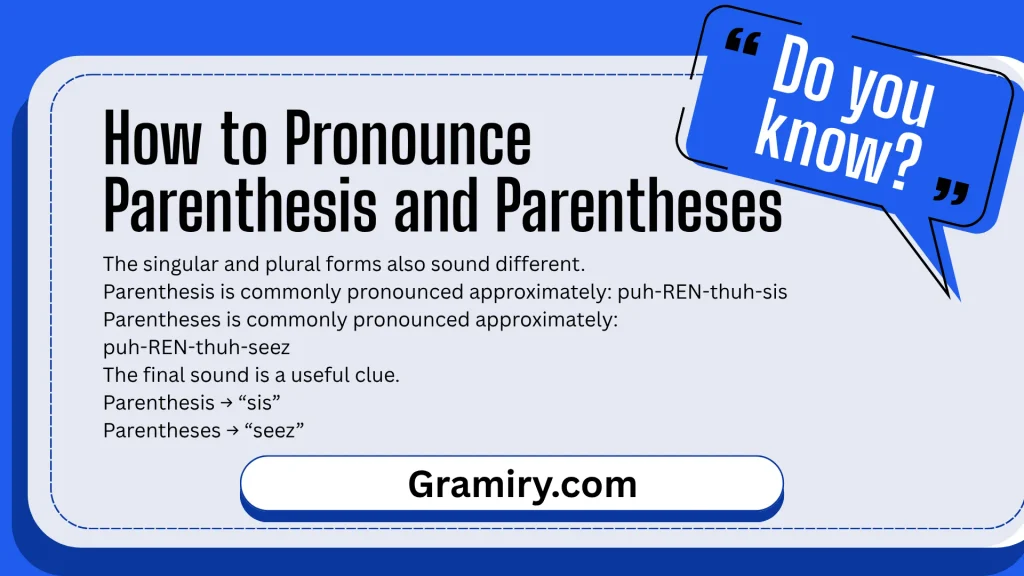
The singular and plural forms also sound different.
Parenthesis is commonly pronounced approximately:
puh-REN-thuh-sis
Parentheses is commonly pronounced approximately:
puh-REN-thuh-seez
The final sound is a useful clue.
Parenthesis → “sis”
Parentheses → “seez”
This can help you distinguish the two words when speaking.
Pronunciation in Simple Form
| Word | Easy pronunciation |
| Parenthesis | puh-REN-thuh-sis |
| Parentheses | puh-REN-thuh-seez |
The pronunciation may vary slightly depending on accent, but the singular/plural difference remains clear.
Parentheses in Mathematics
Parentheses are widely used in mathematics to group numbers and operations.
For example:
(5 + 3) × 2
The parentheses show which calculation should be treated as a group.
If you are referring to one mark, you can say:
The opening parenthesis comes before 5.
If you are referring to the complete pair, say:
The numbers are inside parentheses.
This demonstrates the same singular/plural distinction used in ordinary writing.
Parentheses in Programming
Parentheses are also common in programming languages.
For example:
print(“Hello”)
The symbols ( ) are parentheses.
If a programmer is talking about one symbol, they may say:
The closing parenthesis is missing.
If they are referring to the pair or multiple sets, they may say:
Check the parentheses in the function.
This terminology is useful when discussing syntax errors, functions, expressions, and mathematical operations in code.
Common Mistakes With Parenthesis and Parentheses
Because the words are similar, several errors appear frequently.
Mistake: A Parentheses
Incorrect:
Add a parentheses here.
Correct:
Add a parenthesis here.
Because a indicates one item, the singular noun is required.
Mistake: Two Parenthesis
Incorrect:
There are two parenthesis.
Correct:
There are two parentheses.
Because the sentence refers to more than one, use the plural form.
Mistake: Parenthesises
Incorrect:
Put the information in parenthesises.
Correct:
Put the information in parentheses.
“Parenthesises” is not the standard plural form.
Mistake: Parenthesies
Incorrect:
The words are inside parenthesies.
Correct:
The words are inside parentheses.
The correct spelling ends in -heses.
Mistake: Parenthesi
Incorrect:
The plural of parenthesis is parenthesi.
Correct:
The plural of parenthesis is parentheses.
English does not use “parenthesi” as the standard plural form.
Is “Parenthesises” Correct?
No. Parenthesises is not the standard plural form of parenthesis.
The correct plural is:
parentheses
Remember the spelling:
parenthesis → parentheses
For example:
The information is enclosed in parentheses.
Not:
The information is enclosed in parenthesises.
Is “Parenthesies” Correct?
No. Parenthesies is also not the standard spelling.
The correct word is:
parentheses
A useful way to memorize the spelling is to break it into parts:
parenth + eses
You do not need to memorize the etymology to use it correctly. Simply remember that the plural is parentheses.
Is “A Parenthesis” or “A Parentheses” Correct?
The correct phrase is:
a parenthesis
Because a is singular, it must be followed by the singular noun.
Examples:
I found a parenthesis in the sentence.
Add a parenthesis before the number.
The editor removed a parenthesis.
Do not write:
a parentheses
Instead, use:
a parenthesis
If you are referring to the pair, you can simply say:
Put the phrase in parentheses.
Parenthesis and Parentheses: Quick Examples
Here is a simple reference you can return to:
One mark:
The closing parenthesis is missing.
Two marks:
The expression contains two parentheses.
A pair:
Put the phrase in parentheses.
Multiple pairs:
The document contains several parentheses.
Singular expression:
The sentence contains a parenthesis.
Plural expressions:
The paragraph contains several parentheses.
Frequently Asked Questions
Is parenthesis singular or plural?
Parenthesis is singular. It can refer to one punctuation mark or one inserted expression. For example, “The closing parenthesis is missing” uses the singular form correctly.
Is parentheses singular or plural?
Parentheses is plural. It can refer to two or more individual parenthesis marks or to a pair of curved marks used together. For example, “Put the information in parentheses” is correct.
What is the plural of parenthesis?
The plural of parenthesis is parentheses. The word does not become “parenthesises” or “parenthesies.” The correct spelling is parenthesis → parentheses.
What is the singular of parentheses?
The singular form of parentheses is parenthesis.
For example:
One parenthesis
Two parentheses
Is parenthesises a correct word?
No. The standard plural form is parentheses. “Parenthesises” is a common spelling mistake caused by trying to form the plural by adding an ending to the singular word.
Do I say “a parenthesis” or “a parentheses”?
Say a parenthesis because “a” requires a singular noun.
Correct:
Add a parenthesis.
Incorrect:
Add a parentheses.
Are parentheses and brackets the same thing?
It depends on the variety of English and the context. In American English, parentheses generally refers to ( ), while brackets generally refers to [ ]. British English can use brackets or round brackets for ( ).
What are the marks ( ) called?
The marks ( ) are commonly called parentheses when considered together. The individual marks are called an opening parenthesis and a closing parenthesis.
How do you pronounce parenthesis?
A simple pronunciation guide is puh-REN-thuh-sis. The final sound is similar to “sis.”
How do you pronounce parentheses?
A simple pronunciation guide is puh-REN-thuh-seez. The ending sounds like “seez,” which helps distinguish it from the singular form.
Is “in parenthesis” correct?
Yes. In parenthesis can be used when referring to an aside or additional point. In parentheses is commonly used when referring directly to information enclosed by the punctuation marks.
Conclusion
The choice between parenthesis or parentheses becomes easy once you remember the singular-plural difference. Parenthesis is singular, while parentheses is plural. If you are referring to one mark, use parenthesis. If you are referring to the pair ( ), multiple marks, or information enclosed by them, parentheses is usually the appropriate choice.
Remember this simple rule:
Parenthesis = one
Parentheses = more than one
So you would write “a parenthesis” but “two parentheses.” You should also remember that parentheses is the correct plural spelling, not “parenthesises,” “parenthesies,” or “parenthesi.” Once this pattern becomes familiar, you can use both words confidently in grammar, everyday writing, mathematics, and programming.

Jordan Miles is a passionate writer known for creating thoughtful and engaging content that connects with modern readers. With years of experience in digital publishing, he focuses on storytelling, culture, lifestyle, and meaningful ideas that inspire curiosity.
He is also the author of The Silent Horizon and Echoes Beyond Midnight, two original works praised for their emotional depth and imaginative writing style.
Jordan believes great writing should feel simple, honest and memorable. Through his work, he continues to share fresh perspectives that keep readers connected and inspired.
 Matthew Cooper
 Amelia Brooks