I still remember the first time a reader corrected me in the comments section of my blog. I had written, “She gave me an empathic nod,” and someone asked, “Did you mean empathetic?” For a moment, I second-guessed everything I knew about English.
Then I looked it up and realized both were correct. But that didn’t stop the confusion. If you’ve ever stared at your screen wondering whether to type empathic or empathetic, you’re not alone. In this guide, I’ll break down the subtle but important differences between these two words, give you clear grammar rules, and help you never second-guess yourself again.
Direct Answer
Empathic and empathetic are synonyms meaning “showing the ability to understand and share another person’s feelings.” Empathetic is far more common in modern English, while empathic is shorter, older, and often preferred in psychology and technical writing. Use either, but be consistent.
Meanings
Let’s start simple. Both words derive from empathy, which is the capacity to recognize, feel, and understand what someone else is experiencing.
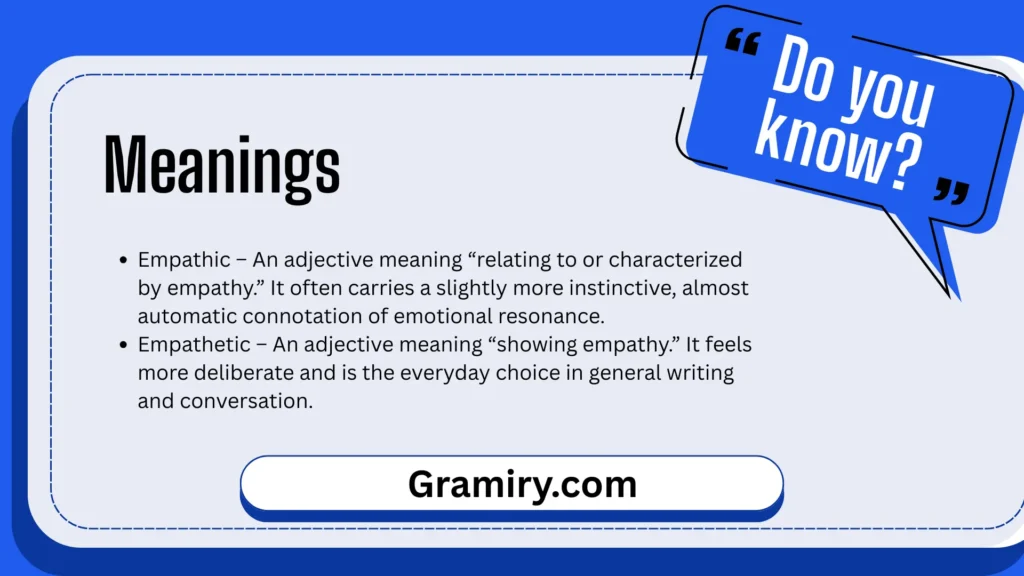
- Empathic – An adjective meaning “relating to or characterized by empathy.” It often carries a slightly more instinctive, almost automatic connotation of emotional resonance.
- Empathetic – An adjective meaning “showing empathy.” It feels more deliberate and is the everyday choice in general writing and conversation.
Think of it this way: empathy is the noun. Add *-ic* or -etic to make it an adjective. Both work, but they have slightly different stylistic homes.
Pronunciation
You’ll sound like a pro once you nail these.
- Empathic – /em-ˈpa-thik/ (stress on the second syllable: em-PATH-ik). The “th” is soft, like in “think.”
- Empathetic – /em-pə-ˈthe-tik/ (four syllables: em-puh-THET-ik). Notice the extra soft “uh” sound before the stressed “THET.”
Say them aloud: em-PATH-ik vs. em-puh-THET-ik. The first is punchier; the second flows more naturally in casual speech.
The Key Differences
On the surface, both mean “having or showing empathy.” But nuance matters.
| Feature | Empathic | Empathetic |
| Frequency | Rare (1-5% of usage) | Common (95-99% of usage) |
| Formality | Slightly more technical | Neutral / conversational |
| Connotation | Instinctive, almost telepathic connection | Learned, conscious understanding |
| Preferred in | Psychology, sci-fi, clinical writing | Everyday English, business, self-help |
| Length | 8 letters | 10 letters |
The most important difference? Empathic often describes a capacity—an innate trait. Empathetic describes a behavior or response. For example, an empath (a person with high natural empathy) is empathic by nature. But you can act in an empathetic way even if you’re not naturally empathic.
Correct Spelling
The standard spelling for modern English is empathetic. It appears roughly 20 times more often in books, news articles, and general web content.
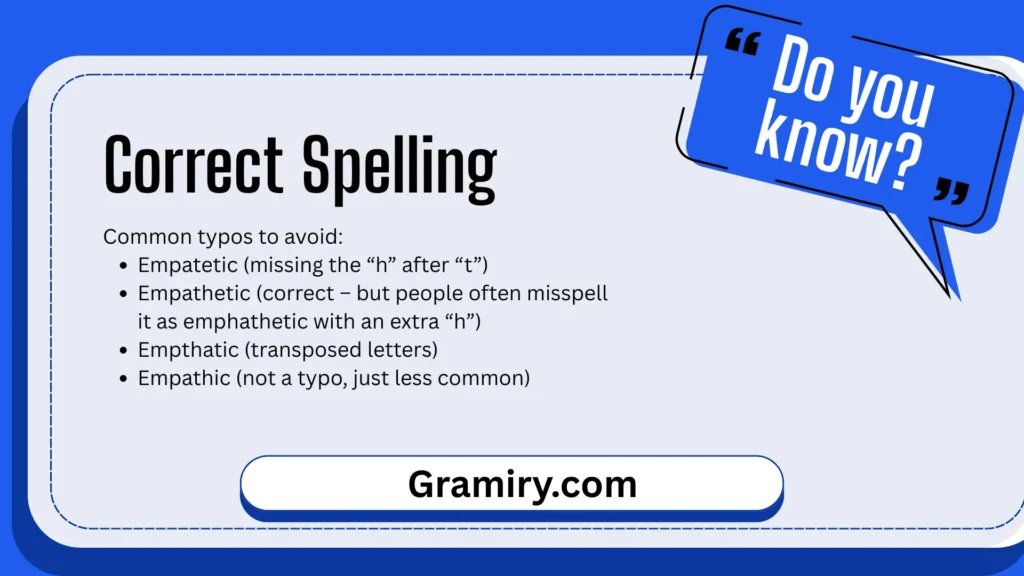
Common typos to avoid:
- Empatetic (missing the “h” after “t”)
- Empathetic (correct – but people often misspell it as emphathetic with an extra “h”)
- Empthatic (transposed letters)
- Empathic (not a typo, just less common)
If you’re unsure, type empathetic. You will almost never be wrong.
Singular and Plural Forms
These are adjectives, so they don’t have singular/plural forms in the way nouns do. However, they modify singular or plural nouns:
- Singular: an empathic doctor, an empathetic response
- Plural: empathic listeners, empathetic leaders
The adjective itself never changes. What can change is the noun form empath (a person with high empathy), which becomes empaths in plural.
Also note: you can have empathic abilities (plural noun modified by singular adjective) or more empathetic (comparative form—yes, adjectives have degrees, but not number).
Grammar Rules
Let’s get technical—but not boring. Here are the grammatical rules governing empathic and empathetic.
1. Part of Speech
Both are adjectives. They describe nouns (people, actions, responses, environments).
2. Placement
- Attributive (before noun): She offered an empathetic ear.
- Predicative (after linking verb): His response was deeply empathic.
3. Comparison
Like most two+ syllable adjectives, form comparatives and superlatives with more and most:
- more empathic / more empathetic
- most empathic / most empathetic
Avoid “empathicker” (incorrect).
4. Adverb Forms
- empathically (e.g., “He nodded empathically.”)
- empathetically (e.g., “She listened empathetically.”)
Both are valid, but empathetically is far more common.
5. Noun Forms
You cannot say “an empathic” or “an empathetic” to mean a person. Use empath or a person with empathy.
6. Prepositions
Typically followed by to, toward, or with:
- empathetic to someone’s struggles
- empathic toward a friend
- empathetic with a situation
7. Negative Forms
Use unempathic or unempathetic (both rare but acceptable). More natural: lacking empathy.
Which One Is Unique?
Now for the fun part. Is either word unique? Yes—in specific contexts.
- Empathic is unique in clinical psychology and neuroscience. Researchers often use empathic accuracy (the ability to accurately read another’s emotions) and empathic distress (feeling another’s pain as if it were your own). The shorter form feels more clinical and precise.
- Empathic is also unique in speculative fiction. You’ll see empathic powers, empathic bonds (telepathic-like emotional connections), or empathic aliens. Writers choose empathic here because it sounds more mysterious and less clinical than empathetic.
- Empathetic is unique in business communication, parenting advice, and self-help. Phrases like empathetic leadership, empathetic listening, and empathetic parenting dominate because the word feels warmer and more accessible.
So if you’re writing a psychology paper or a sci-fi novel, lean toward empathic. If you’re writing a blog post, email, or cover letter, choose empathetic.
Illustrative Examples
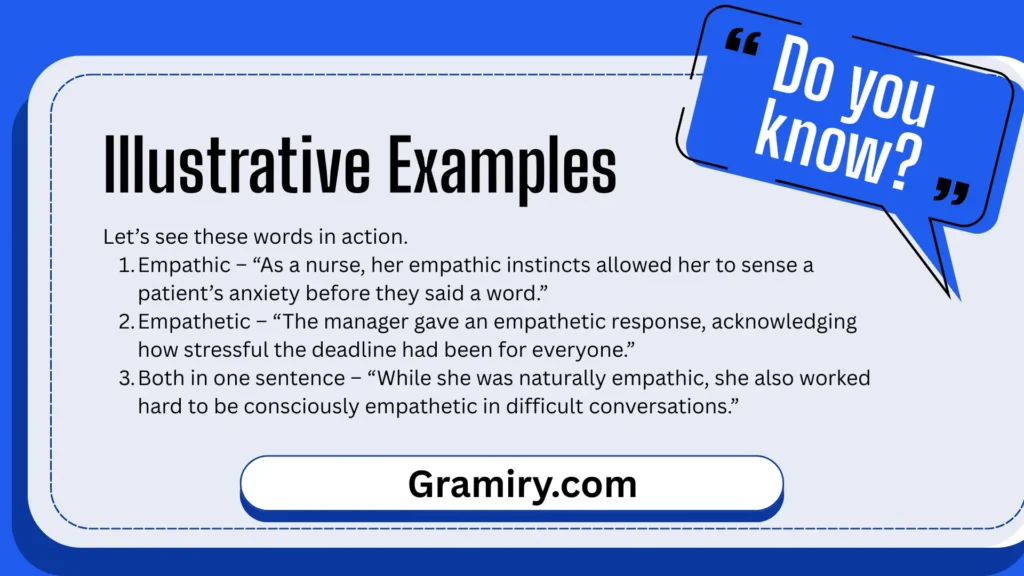
Let’s see these words in action.
- Empathic – “As a nurse, her empathic instincts allowed her to sense a patient’s anxiety before they said a word.”
- Empathetic – “The manager gave an empathetic response, acknowledging how stressful the deadline had been for everyone.”
- Both in one sentence – “While she was naturally empathic, she also worked hard to be consciously empathetic in difficult conversations.”
- Empathic (sci-fi context) – “The alien species communicated through an empathic link, sharing emotions instead of words.”
- Empathetic (business context) – “An empathetic leader doesn’t just solve problems—they make employees feel heard.”
Practice Section (MCQs)
Test yourself with these 15 multiple-choice questions. Answer key at the bottom.
1. Which word is more common in modern everyday English?
- A) Empathic
- B) Empathetic
- C) Both are equally common
- D) Neither
2. “She gave me an ______ nod, as if she knew exactly how I felt.” Which fits best in general writing?
- A) empathic
- B) empathetic
- C) empath
- D) empathical
3. In psychology research, which term is often preferred for clinical precision?
- A) Empathetic
- B) Emphatic (note spelling difference)
- C) Empathic
- D) Empathetical
4. Choose the correct adverb form.
- A) Empathically
- B) Empathetically
- C) Both are acceptable
- D) Neither
5. Which sentence uses the word correctly?
- A) He is an empathetic.
- B) She showed an empathetic.
- C) They offered an empathetic response.
- D) That was very empath of you.
6. What is the noun form meaning “a person with high empathy”?
- A) Empathic
- B) Empathetic
- C) Empath
- D) Empathyist
7. “His abilities were almost telepathic—truly ______.” Which word fits the sci-fi tone?
- A) empathetic
- B) empathic
- C) emphatic
- D) empractical
8. Which preposition is NOT typically used with these adjectives?
- A) to
- B) toward
- C) for
- D) with
9. “The therapist’s ______ approach helped the client feel safe.” Best choice for a clinical report?
- A) empathic
- B) empathetic
- C) both are fine
- D) empathical
10. What is the comparative form of empathetic?
- A) Empatheticer
- B) More empathetic
- C) Most empathetic
- D) Empatheticest
11. Identify the misspelling.
- A) Empathetic
- B) Empathic
- C) Empatetic
- D) All are correct
12. “She listened ______ to her friend’s story.” Choose the best adverb.
- A) empath
- B) empathic
- C) empathetically
- D) empathically (both C & D are acceptable, but which is more common?)
13. Which field uniquely favors empathic over empathetic?
- A) Business writing
- B) Parenting blogs
- C) Neuroscience
- D) Email etiquette
14. “An ______ leader builds trust by acknowledging emotions.” Fill in the blank for a corporate training manual.
- A) empathic
- B) empathetic
- C) emphatic
- D) empath
15. True or False: You can use empathic and empathetic interchangeably in all contexts without any difference in nuance.
- A) True
- B) False
Answer Key:
1-B, 2-B, 3-C, 4-C, 5-C, 6-C, 7-B, 8-C, 9-C, 10-B, 11-C, 12-C (empathetically is more common), 13-C, 14-B, 15-B (nuance and context matter)
Frequently Asked Questions (FAQs)
1. Is “empathic” a real word?
Yes, absolutely. It appears in major dictionaries (Merriam-Webster, Oxford) and has been in use since the early 20th century. It is not a mistake—just less common.
2. Can I use “empathic” and “empathetic” interchangeably?
In casual writing, yes. But in formal or technical contexts, be aware that empathic leans toward innate capacity and clinical tone, while empathetic leans toward learned behavior and general use.
3. Which word should I use in a job interview or cover letter?
Use empathetic. It’s more familiar to recruiters and sounds warmer. Example: “I pride myself on being an empathetic team member.”
4. Is there a difference between “emphatic” and “empathic”?
Yes—a critical one. Emphatic (with an “f” sound) means forceful or strongly expressive. Do not confuse them. “He was emphatic in his refusal” ≠ “He was empathic in his refusal.”
5. Why did “empathetic” become more popular than “empathic”?
Linguistic analogy. English already had sympathetic (from sympathy), so empathetic (from empathy) followed the same pattern. Empathic is the older form, but it lost the popularity contest to the more intuitive -pathetic ending.
Conclusion
So here’s my final advice after years of wrestling with this pair: stop stressing. Both empathic and empathetic are correct adjectives that describe the beautiful human ability to feel with others. If you want to sound natural and modern, choose empathetic 95% of the time.
If you’re writing for a psychology journal or a science fiction novel, empathic will serve you well. The real mistake isn’t choosing one over the other it’s worrying so much that you avoid using either. Now go write with confidence, and maybe share a little empathy along the way.

Jordan Miles is a passionate writer known for creating thoughtful and engaging content that connects with modern readers. With years of experience in digital publishing, he focuses on storytelling, culture, lifestyle, and meaningful ideas that inspire curiosity.
He is also the author of The Silent Horizon and Echoes Beyond Midnight, two original works praised for their emotional depth and imaginative writing style.
Jordan believes great writing should feel simple, honest and memorable. Through his work, he continues to share fresh perspectives that keep readers connected and inspired.
 Amelia Brooks
 Matthew Cooper