I still remember the moment a sharp-eyed editor circled “alright” on my manuscript and scribbled, “Use all right instead.” I felt a flash of embarrassment—had I been spelling it wrong for years? Like you, I’d seen both forms everywhere: in emails, novels, text messages, and even news headlines.
But is one actually correct? Or are both fine, just with different vibes? In this post, I’m going to settle the “alright or all right” debate once and for all. You’ll learn exactly when to use each, what the grammar rules say, and how to write with confidence. No more second-guessing.
Direct Answer
“Alright” and “all right” can both mean “acceptable,” “satisfactory,” or “yes.” However, traditional grammar prefers “all right” as the standard spelling. “Alright” is widely used but still considered informal or nonstandard by many style guides. For formal writing, choose “all right.”
Meanings
Let’s break down what these two forms actually mean.
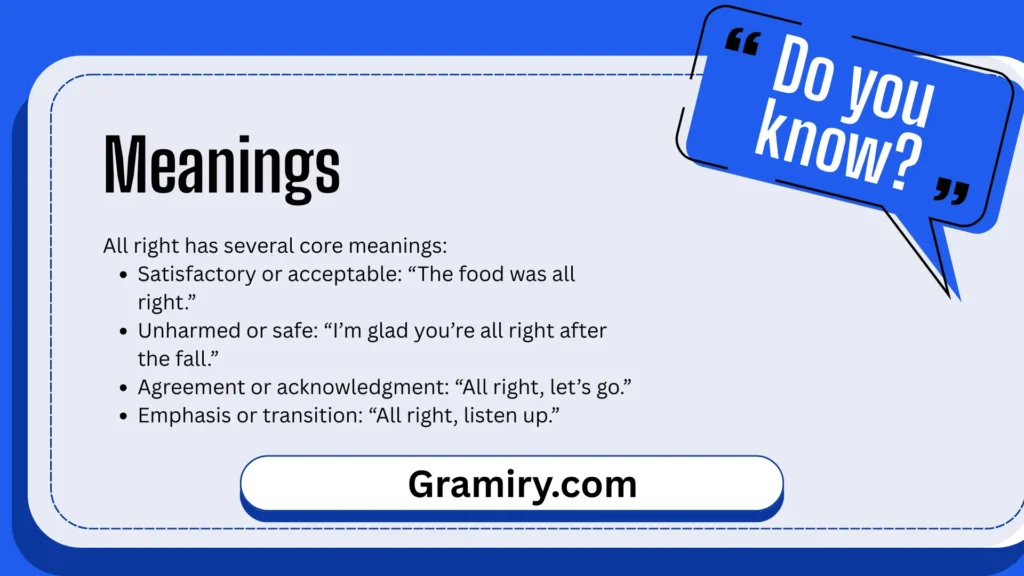
All right has several core meanings:
- Satisfactory or acceptable: “The food was all right.”
- Unharmed or safe: “I’m glad you’re all right after the fall.”
- Agreement or acknowledgment: “All right, let’s go.”
- Emphasis or transition: “All right, listen up.”
Alright carries the exact same meanings. The only difference is spelling. Yes—truly. There is no shade of meaning that separates them. If you write “The movie was alright,” you mean the same thing as “The movie was all right.” The distinction is purely about formality and acceptance, not definition.
Pronunciation
Both “alright” and “all right” are pronounced identically in natural speech.
- Phonetic spelling: /ˌɔːl ˈraɪt/
- Breakdown: “awl” (like “ball” without the B) + “RITE” (rhymes with “light” and “night”)
Say them slowly: all right → in rapid speech, the two words blend together so seamlessly that “alright” emerged as a single written word. You’ll never hear a difference; the debate lives only on the page.
The Key Differences
Here is where most writers get tangled. Technically, “all right” is the older, fully accepted form, while “alright” is a newer contraction (like “already” or “always” but with a rockier reception).
| Aspect | All Right | Alright |
| Status | Standard, formal, universally accepted | Informal, common but debated |
| Age | Old English origins | Appeared in late 19th century |
| Style guides | AP, Chicago, APA recommend | Rejected by most formal guides |
| Typical use | Academic, business, journalism | Fiction, dialogue, casual writing |
The real difference is permission. “All right” has a hall pass to any context. “Alright” may get you side-eye from a strict editor.
Correct Spelling
The standard spelling is all right (two words, space in between). This is never wrong.
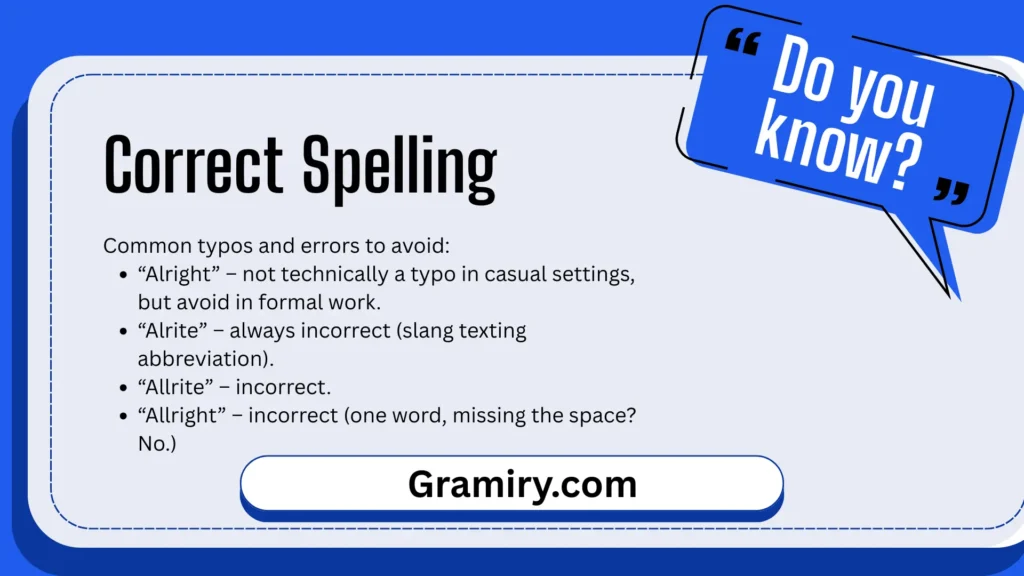
Common typos and errors to avoid:
- “Alright” – not technically a typo in casual settings, but avoid in formal work.
- “Alrite” – always incorrect (slang texting abbreviation).
- “Allrite” – incorrect.
- “Allright” – incorrect (one word, missing the space? No.)
If you’re writing a cover letter, thesis, or published article, spell it all right. If you’re texting a friend, alright is fine.
Singular and Plural Forms
Neither “all right” nor “alright” has a true plural form because they function as adjectives, adverbs, or interjections—not nouns.
But watch for subject-verb agreement in sentences:
- Singular: “Everything is all right.”
- Plural: “All the answers were all right.” (Here “answers” is plural, but “all right” remains unchanged.)
You never say “all rights” (that means legal permissions) or “alrights” (not a word). So no plural spelling changes. Simple.
Grammar Rules
Let’s get technical. Both “all right” and “alright” can serve three grammatical roles:
1. Adjective (predicate only – after a linking verb)
- Meaning: acceptable, satisfactory, or unharmed.
- “The pizza tastes all right.”
- “She feels alright now.”
2. Adverb
- Meaning: satisfactorily or without problem.
- “The car runs all right despite its age.”
- “He did alright on the test.”
3. Interjection (sentence starter)
- Meaning: okay, agreed, or attention-getting.
- “All right, let’s begin.”
- “Alright, I hear you.”
What you cannot do: Use either word before a noun as an attributive adjective. We don’t say “an all right meal” (awkward). Instead say “a decent meal.” And no hyphenation needed unless you’re creating a compound modifier (rare, e.g., “all-right feeling” – but avoid this).
One more rule: In negative questions, “all right” is preferred. “Isn’t that all right with you?” (Not “alright” in formal writing.)
Which One Is Unique?
Now for the juicy part: in which unique scenario is one term clearly better?
Unique context #1: Formal or academic writing
Always choose all right. Example: a research paper, legal document, or job application. “Alright” will look like a mistake to many readers.
Unique context #2: Dialogue and fiction
Here, alright shines because it reflects natural speech. A character saying “It’s alright, I’ll handle it” sounds authentic. “All right” can feel slightly stiff in very casual dialogue.
Unique context #3: Idiomatic set phrases
Some fixed expressions strongly prefer “all right”:
- “All right already!” (annoyance)
- “That’s all right” (it’s fine / you’re welcome)
- “All right, then” (resignation or transition)
But you’ll also see “Alright, okay!” in modern novels. No unique context requires “alright” exclusively.
The bottom line: If you want to be 100% safe and professional, use all right everywhere. If you’re writing informally and want to match spoken rhythm, alright is acceptable—but know that some purists will silently judge you.
Illustrative Examples
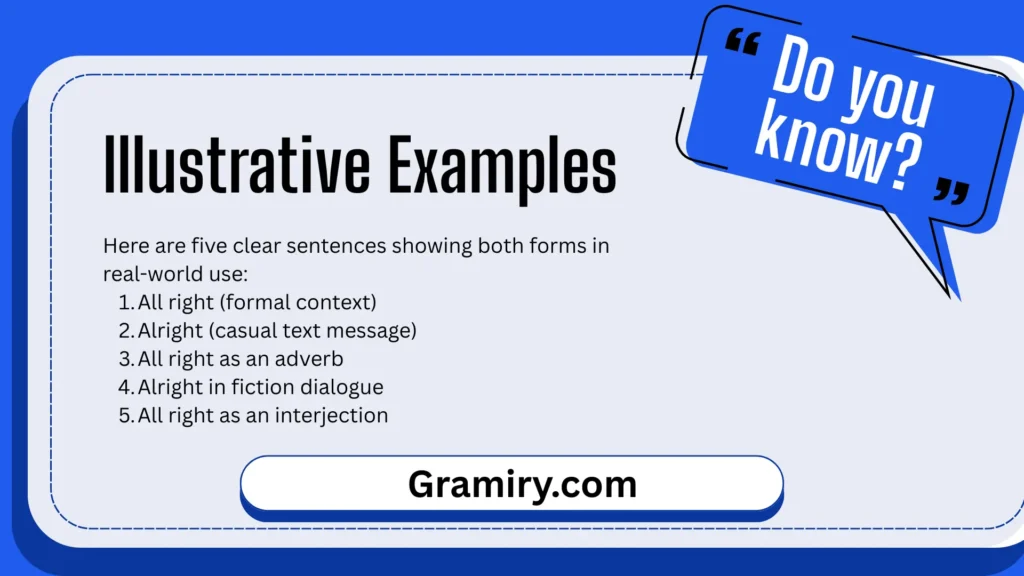
Here are five clear sentences showing both forms in real-world use.
- All right (formal context):
“After reviewing the patient’s vitals, the doctor confirmed that she was all right.” - Alright (casual text message):
“Don’t worry about dinner—it’s alright if we just order pizza.” - All right as an adverb:
“The engine ran all right for a 1998 model.” - Alright in fiction dialogue:
“Alright, listen,” she whispered. “We only have one chance.” - All right as an interjection:
“All right, class, turn to page 42.”
Practice Section (MCQs)
Test your understanding with these 15 multiple-choice questions. Choose the best option based on standard formal English (unless a question specifies context).
- Which spelling is preferred in a university research paper?
A) alright
B) all right
C) alrite
D) allright - “Don’t worry, everything will be ______ in the end.” (Formal letter)
A) alright
B) all right
C) all-right
D) alrite - Which sentence uses the word as an adjective?
A) “All right, let’s move on.”
B) “The car runs all right.”
C) “I feel all right today.”
D) “All right, I heard you.” - True or false: “Alright” is older than “all right.”
A) True
B) False - Choose the incorrect spelling.
A) all right
B) alright
C) allrite
D) Both B and C are used in some contexts, but C is always wrong. - Which style guide rejects “alright” in formal writing?
A) AP Stylebook
B) Chicago Manual of Style
C) Both AP and Chicago
D) Neither - Fill in the blank (casual dialogue): “______, I’ll meet you at 8.”
A) All right
B) Alright
C) Both are fine here
D) All-right - What part of speech is “all right” in: “She did all right on the exam”?
A) Adjective
B) Adverb
C) Interjection
D) Noun - Which is never correct in any standard English?
A) alright
B) all right
C) allrite
D) all-right (hyphenated) - In a job cover letter, you should write:
A) “I believe my qualifications are alright for this role.”
B) “I believe my qualifications are all right for this role.”
C) “I believe my qualifications are all-right for this role.”
D) Both A and B are equally formal. - “The children were shaken but ______ after the minor accident.”
A) alright
B) all right
C) both are acceptable here, but B is safer
D) alrite - Which sentence uses the term as an interjection?
A) “The food was all right.”
B) “All right, that’s enough arguing.”
C) “He drives all right in the snow.”
D) “Everything is all right now.” - “Alright” is most similar in formation to which word?
A) always
B) already
C) altogether
D) all four (always, already, altogether, and alright all began as two words) - Choose the correct sentence for a business email:
A) “Is it alright if I send the report tomorrow?”
B) “Is it all right if I send the report tomorrow?”
C) “Is it allrite if I send the report tomorrow?”
D) Both A and B are fine, but B is more professional. - Which statement is true?
A) “Alright” means “somewhat good,” while “all right” means “completely correct.”
B) There is no difference in meaning—only formality and acceptance.
C) “All right” cannot be used as an adverb.
D) “Alright” is the only correct form in British English.
Answer Key
- B
- B
- C (predicate adjective after “feel”)
- B (false – “all right” is older)
- C (“allrite” is always wrong)
- C
- C
- B (modifies “did”)
- C
- B
- C
- B
- D
- D
- B
Frequently Asked Questions (FAQs)
1. Is “alright” a real word?
Yes, “alright” is a real word. It appears in major dictionaries (Merriam-Webster, Oxford English Dictionary). However, it is labeled “informal” or “nonstandard.” You will find it in novels, blogs, and lyrics—but not in most academic or journalistic style guides.
2. Why do some people hate “alright”?
Linguistic purists argue that “alright” is an unnecessary contraction of “all right,” similar to how “all together” became “altogether” (which has a different meaning: “completely”). They claim “alright” hasn’t earned full respect yet. Plus, early 20th-century critics condemned it, and that bias stuck.
3. Can I use “alright” in a college essay?
Generally, no. Unless your professor explicitly allows informal language, stick with “all right” in academic writing. Many instructors will mark “alright” as an error. When in doubt, choose “all right”—it’s never wrong.
4. Is there any situation where “all right” is wrong?
No. “All right” is always correct. Even in the most casual text message, “all right” works fine (though it may look slightly formal). You will never be penalized for using “all right” in any context.
5. Do “alright” and “all right” have different meanings in British vs. American English?
No difference in meaning. British English is slightly more tolerant of “alright” in informal writing, but formal British publications (like The Guardian or The Economist) still prefer “all right.” American English follows the same rule: formal = all right; informal = either.
Conclusion
So here’s what I want you to remember: “alright or all right” isn’t a battle of right vs. wrong—it’s a battle of formal vs. informal. “All right” is your safe, professional, never-fail choice. Use it in essays, reports, emails, and anything that matters. “Alright” works for texts, tweets, and novel dialogue where you want a relaxed, natural rhythm. The meaning never changes, only the context. My final advice? Master “all right” first. Once you’re confident, sprinkle in “alright” where it feels right. And when someone corrects you, smile and say, “All right—you’ve got a point.”

Matthew Cooper is a passionate writer who loves exploring human emotions, modern culture, and everyday life experiences through meaningful storytelling. With years of creative writing experience, he has built a reputation for crafting engaging and thought-provoking content that connects naturally with readers.
He is the author of Beneath The Crimson Hour and When The Moon Turned Silver, two original works known for their deep themes and immersive writing style.
Matthew enjoys turning simple ideas into powerful narratives that inspire curiosity and reflection. His work focuses on authenticity, creativity, and delivering valuable insights in a clear and engaging way.
 Amelia Brooks
 Jordan Miles