
I still remember the first time I saw someone write “ween” when they actually meant “wean.” At first glance, the two words look almost identical, and because they sound similar, it’s easy to mix them up.
If you’ve ever wondered whether to use ween or wean, you’re definitely not alone. Many English learners and native speakers make this mistake because both words are legitimate English terms.
In this guide, I’ll explain exactly what each word means, when to use it, and how to avoid common errors. By the end, you’ll never have to second-guess ween or wean again.
Direct Answer
Ween and wean are different words with different meanings. Wean means to gradually stop someone or something from dependence on food, habits, or behaviors. Ween is an old-fashioned verb meaning “to think,” “suppose,” or “believe.” In modern English, wean is far more common than ween.
Meanings
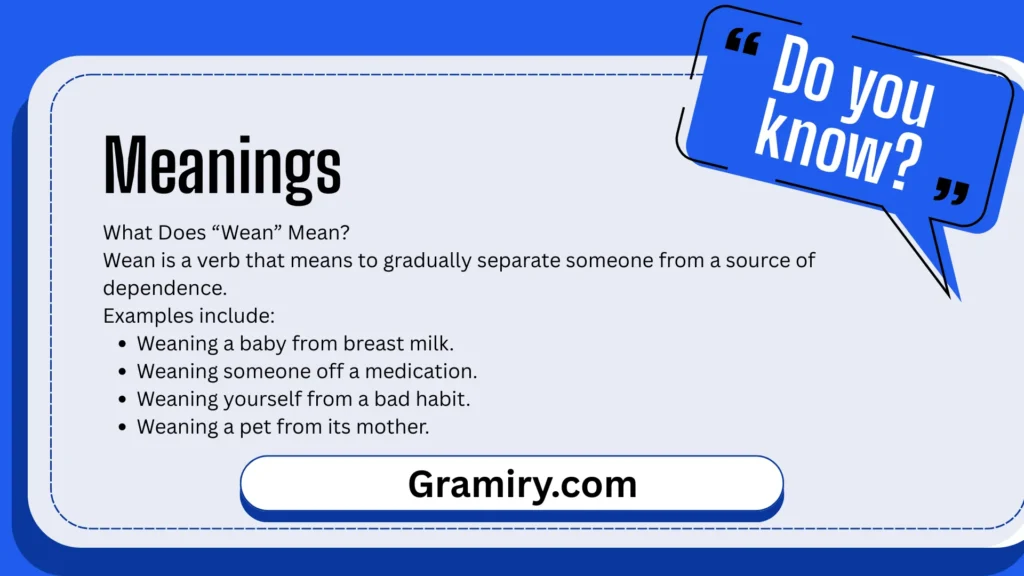
What Does “Wean” Mean?
Wean is a verb that means to gradually separate someone from a source of dependence.
Examples include:
- Weaning a baby from breast milk.
- Weaning someone off a medication.
- Weaning yourself from a bad habit.
- Weaning a pet from its mother.
The key idea behind wean is gradual reduction or withdrawal.
What Does “Ween” Mean?
Ween is an old or literary verb meaning:
- To think
- To suppose
- To believe
- To imagine
Examples:
- I ween that he will arrive soon.
- She weened the task would be easy.
Today, ween is rarely used except in historical, poetic, or literary contexts.
Pronunciation
Although the words look different, their pronunciations are very similar.
Wean
Pronunciation: /wiːn/
Sounds like:
- bean
- clean
- seen
Ween
Pronunciation: /wiːn/
Sounds exactly the same as:
- wean
- bean
- green
Because both words are pronounced identically, spelling becomes especially important when writing.
The Key Differences
| Feature | Wean | Ween |
| Part of Speech | Verb | Verb |
| Meaning | Gradually remove dependence | Think, suppose, believe |
| Usage Frequency | Very common | Rare and archaic |
| Modern English | Widely used | Rarely used |
| Context | Parenting, habits, addiction, training | Literature, poetry, historical texts |
| Example | Wean a child from milk | I ween he is correct |
The biggest distinction is that wean relates to reducing dependence, while ween relates to believing or thinking.
Correct Spelling
The correct spelling depends entirely on your intended meaning.
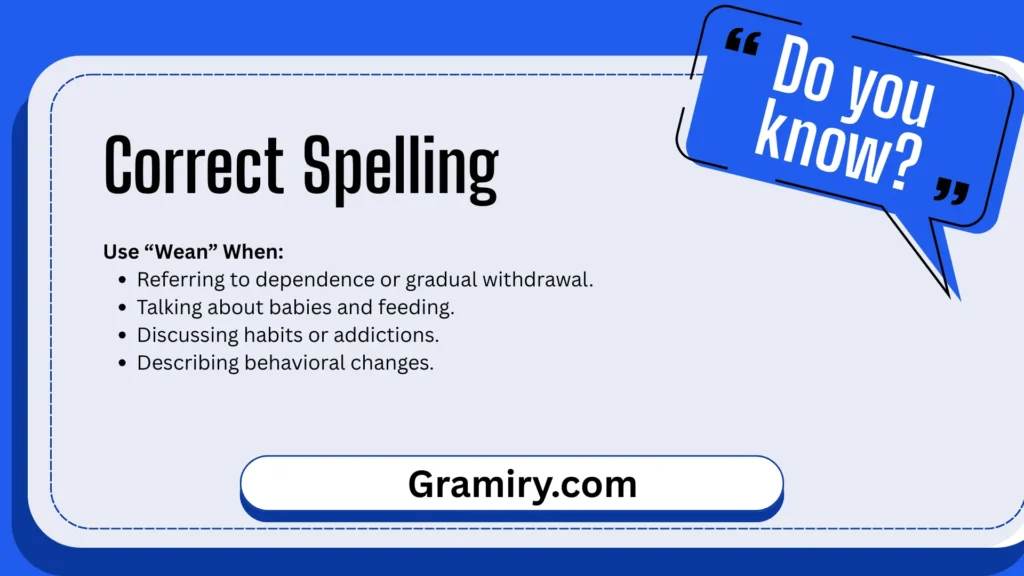
Use “Wean” When:
- Referring to dependence or gradual withdrawal.
- Talking about babies and feeding.
- Discussing habits or addictions.
- Describing behavioral changes.
Examples:
- Wean the puppy from its mother.
- Wean yourself off caffeine.
Use “Ween” When:
- Writing poetry.
- Quoting historical texts.
- Using an archaic form of “think” or “suppose.”
Examples:
- I ween he speaks the truth.
- They ween their efforts were successful.
Common Typos to Avoid
Many writers accidentally:
- Write ween off caffeine instead of wean off caffeine.
- Write ween a baby instead of wean a baby.
- Confuse the words because they sound identical.
For modern communication, wean is almost always the intended word.
Singular and Plural Forms
Since ween and wean are verbs, they do not have singular and plural noun forms in the traditional sense.
However, their verb forms change according to tense and subject.
Wean Forms
| Form | Example |
| Base Verb | Wean |
| Third Person Singular | Weans |
| Present Participle | Weaning |
| Past Tense | Weaned |
| Past Participle | Weaned |
Examples:
- She weans the baby.
- They are weaning the puppy.
- The child was weaned successfully.
Ween Forms
| Form | Example |
| Base Verb | Ween |
| Third Person Singular | Weens |
| Present Participle | Weening |
| Past Tense | Weened |
| Past Participle | Weened |
Examples:
- He weens that success is near.
- They weened incorrectly.
These forms are rare in contemporary English.
Grammar Rules
Rule 1: Wean Is Always a Verb
Correct:
- Doctors recommend parents wean infants gradually.
- She wants to wean herself from sugar.
Incorrect:
- The wean was successful. (Unless used as a regional noun in certain dialects.)
Rule 2: Wean Often Appears with “From” or “Off”
Examples:
- Wean a child from milk.
- Wean yourself off social media.
- Wean the patient off medication.
Rule 3: Ween Functions as a Verb Meaning “Think”
Examples:
- I ween that he is honest.
- They ween the journey will be difficult.
Rule 4: Avoid Using Ween in Modern Formal Writing
Because many readers are unfamiliar with it, using ween can create confusion.
Rule 5: Context Determines Meaning
Because pronunciation offers no clues, the sentence context determines which spelling is correct.
Example:
- We need to wean the baby from the bottle. ✓
- We need to ween the baby from the bottle. ✗
Which One Is Unique?
Both words are unique in different ways.
Why “Wean” Is Unique
- Frequently used in parenting.
- Common in healthcare.
- Appears in addiction recovery discussions.
- Used in behavioral psychology.
- Relevant in animal care.
Examples:
- Weaning infants.
- Weaning pets.
- Weaning patients from medications.
Why “Ween” Is Unique
- Preserves historical English traditions.
- Common in older literature.
- Appears in poetry and classic texts.
- Adds an archaic literary tone.
Modern speakers rarely encounter ween outside literary works, making it a distinctive but uncommon word.
Illustrative Examples
Here are example sentences showing the correct usage of both words.
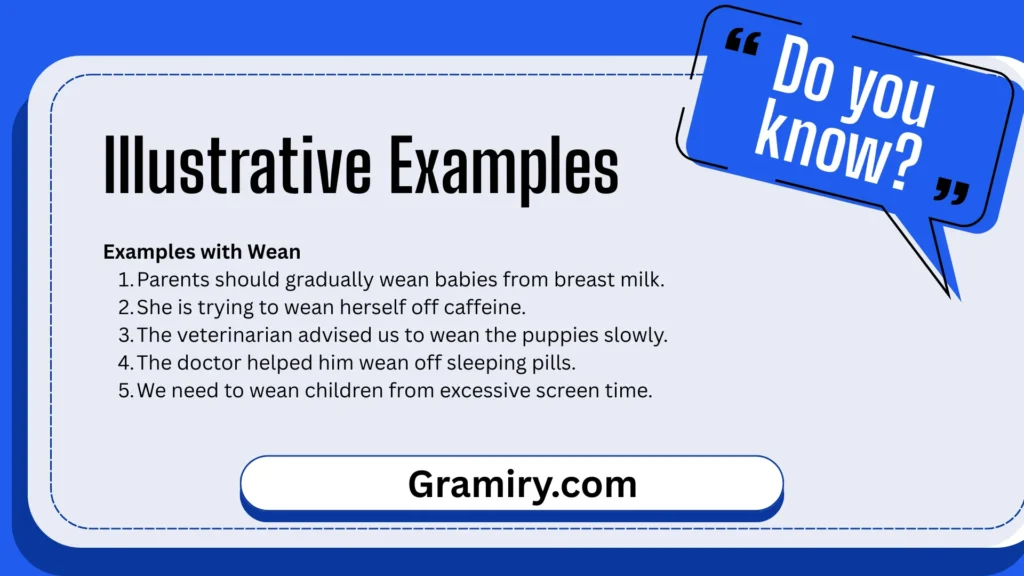
Examples with Wean
- Parents should gradually wean babies from breast milk.
- She is trying to wean herself off caffeine.
- The veterinarian advised us to wean the puppies slowly.
- The doctor helped him wean off sleeping pills.
- We need to wean children from excessive screen time.
Examples with Ween
- I ween that the answer is correct.
- They ween the journey will end soon.
- She weened that her plan would succeed.
- The poet wrote, “I ween the stars shall guide us.”
- Many readers no longer recognize the verb ween.
Practice Section (MCQs)
1. Which word means “to gradually remove dependence”?
A. Ween
B. Wean
C. Wain
D. Wien
2. Which word means “to suppose” or “believe”?
A. Wean
B. Ween
C. Wane
D. Wine
3. Which sentence is correct?
A. Ween the baby from the bottle.
B. Wean the baby from the bottle.
C. Weaned the belief.
D. Weened the bottle.
4. Which word is more common today?
A. Ween
B. Wean
C. Both equally
D. Neither
5. Which context commonly uses “wean”?
A. Parenting
B. Space travel
C. Mathematics
D. Architecture
6. “I ween he is honest” means:
A. I feed him
B. I believe he is honest
C. I ignore him
D. I teach him
7. Which spelling fits addiction recovery?
A. Ween off drugs
B. Wean off drugs
C. Wain off drugs
D. Wien off drugs
8. Which word is considered archaic?
A. Wean
B. Ween
C. Both
D. Neither
9. What part of speech is “wean”?
A. Noun
B. Adjective
C. Verb
D. Adverb
10. Which sentence is correct?
A. She weans the child from milk.
B. She weens the child from milk.
C. She weaning milk.
D. She weened milk.
11. Which word appears more often in literature?
A. Wean
B. Ween
C. Both equally
D. Neither
12. What is the past tense of “wean”?
A. Weaned
B. Weened
C. Wained
D. Wonen
13. Which phrase is correct?
A. Wean off caffeine
B. Ween off caffeine
C. Weens caffeine
D. Weened caffeine
14. Why are these words commonly confused?
A. Same spelling
B. Same pronunciation
C. Same meaning
D. Same origin
15. Which sentence uses “ween” correctly?
A. Ween the puppy from its mother.
B. I ween the weather will improve.
C. Ween off sugar.
D. Ween the baby slowly.
Answer Key
- B
- B
- B
- B
- A
- B
- B
- B
- C
- A
- B
- A
- A
- B
- B
Frequently Asked Questions (FAQs)
1. Is it ween or wean off caffeine?
The correct phrase is wean off caffeine because the meaning involves gradually reducing dependence.
2. Is “ween” still used today?
Yes, but very rarely. It mainly appears in poetry, historical writing, and literary works.
3. Why do people confuse ween and wean?
They are pronounced exactly the same, making spelling errors common in writing.
4. Can “ween” replace “wean”?
No. Despite sounding identical, they have completely different meanings and should not be used interchangeably.
5. Which word should I use in everyday English?
In most situations, you should use wean because it is the modern and commonly accepted term.
Conclusion
Understanding the difference between ween or wean is easier once you focus on their meanings rather than their pronunciation.
Wean refers to gradually reducing dependence on something and is widely used in modern English. Ween, on the other hand, is an old-fashioned word meaning “to think” or “to suppose.”
Because both words sound identical, spelling mistakes are common. Whenever you’re talking about babies, habits, medications, or addictions, choose wean.
Reserve ween for literary or historical contexts. Remember this simple distinction, and you’ll use both words with confidence and accuracy.

Matthew Cooper is a passionate writer who loves exploring human emotions, modern culture, and everyday life experiences through meaningful storytelling. With years of creative writing experience, he has built a reputation for crafting engaging and thought-provoking content that connects naturally with readers.
He is the author of Beneath The Crimson Hour and When The Moon Turned Silver, two original works known for their deep themes and immersive writing style.
Matthew enjoys turning simple ideas into powerful narratives that inspire curiosity and reflection. His work focuses on authenticity, creativity, and delivering valuable insights in a clear and engaging way.
 Jordan Miles
 Amelia Brooks