You’ve probably typed it a hundred times on resumes, cover letters, LinkedIn profiles, or grad school applications only to pause, delete, and retype. Is it “masters” or “master’s”? That tiny apostrophe feels like a landmine, and the conflicting advice online doesn’t help.
I’ve been there, and I’ve seen how this one small mark can undermine your credibility. In this guide, I’ll settle the confusion with crystal-clear rules, examples, and practice, so you never second-guess yourself again.
Direct Answer
The correct possessive form is “master’s degree” (with an apostrophe before the *s*), because the degree belongs to a “master” (a scholar who has mastered a field). Writing “masters degree” (without an apostrophe) is grammatically incorrect in standard English. Use “Master of Arts” or “Master of Science” without apostrophe.
Meanings
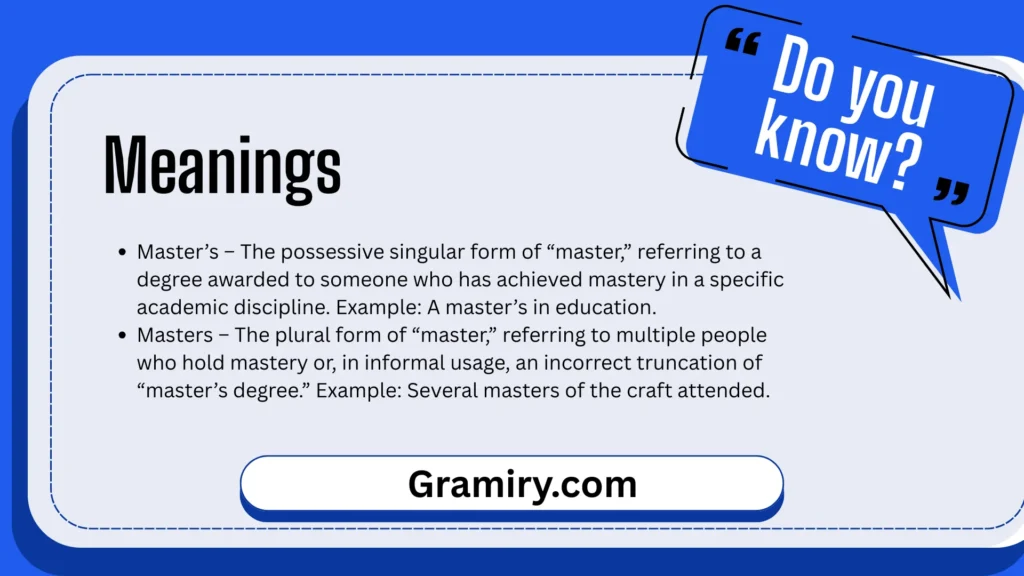
Master’s – The possessive singular form of “master,” referring to a degree awarded to someone who has achieved mastery in a specific academic discipline. Example: A master’s in education.
Masters – The plural form of “master,” referring to multiple people who hold mastery or, in informal usage, an incorrect truncation of “master’s degree.” Example: Several masters of the craft attended.
Master’s degree – A postgraduate academic degree awarded after completing a specialized program (typically 1–2 years beyond a bachelor’s).
Pronunciation
- Master’s – /ˈmæstərz/ (MAS-turz). Two syllables. The apostrophe is silent but indicates possession, not a change in sound.
- Masters – /ˈmæstərz/ (MAS-turz). Identical pronunciation. This is why confusion persists in speech—context determines meaning.
- Master’s degree – /ˈmæstərz dɪˈɡriː/ (MAS-turz di-GREE). Slight pause between “master’s” and “degree.”
The Key Differences
| Feature | Master’s (degree) | Masters (plural) |
| Grammar | Possessive noun | Plural noun |
| Apostrophe | Yes (‘) | No |
| Meaning | One degree belonging to a master | Multiple masters (people) |
| Common error | N/A | Using “masters” alone to mean “master’s degree” |
| Example | “I earned a master’s in physics.” | “The guild has ten masters.” |
Nuance: In casual writing (emails, social media), “masters” without apostrophe sometimes appears, but it’s technically an error. Academic and professional contexts demand the apostrophe. Conversely, “Master of Arts” or “Master of Science” have no apostrophe because the word “Master” functions as a title, not a possessive.
Correct Spelling
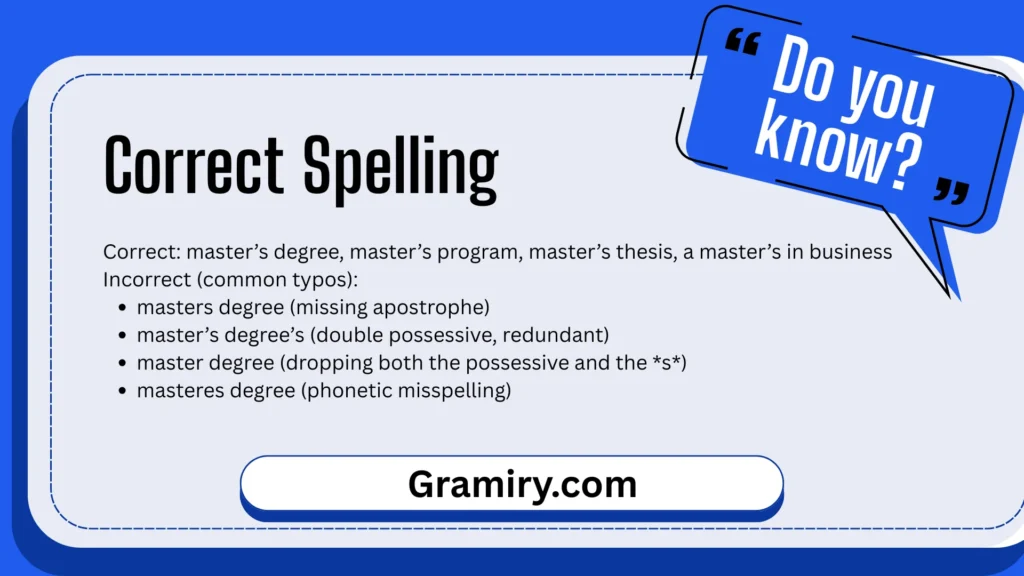
Correct: master’s degree, master’s program, master’s thesis, a master’s in business
Incorrect (common typos):
- masters degree (missing apostrophe)
- master’s degree’s (double possessive, redundant)
- master degree (dropping both the possessive and the *s*)
- masteres degree (phonetic misspelling)
Pro tip: If you can replace “master’s” with “bachelor’s” (which always has an apostrophe), you need the apostrophe.
Singular and Plural Forms
- Singular (possessive): master’s – one degree belonging to one master.
She has a master’s in chemistry. - Plural (possessive): masters’ – degrees belonging to multiple masters (rare).
The university conferred five masters’ degrees at the ceremony. (Uncommon; most writers rephrase: five master’s degrees – treating each person’s degree individually.) - Plural (non-possessive): masters – multiple experts.
The chess masters played simultaneously.
Key takeaway: For 99% of everyday writing about your own education, use master’s (singular possessive). The plural possessive masters’ appears almost exclusively in formal lists or statistics.
Grammar Rules
- Possessive apostrophe rule: When a degree is described as belonging to a “master” (a person who has mastered a field), use an apostrophe-*s*: master’s degree. Same as bachelor’s degree, doctor’s degree (though “doctorate” is more common).
- Capitalization rule: The specific degree name is capitalized: Master of Arts, Master of Science, Master of Business Administration. But the general term is lowercase: master’s degree (unless starting a sentence).
- Article use: Use *a* or my/her/his before master’s.
- ✅ I have a master’s in engineering.
- ✅ She completed her master’s last spring.
- ❌ I have master’s in engineering (missing article).
- Prepositions: Use in or of after master’s to indicate the field.
- Master’s in history (most common)
- Master’s of science (less common; “Master of Science” without apostrophe is preferred for specific degrees).
- Abbreviation rule: When abbreviating, use M.A., M.S., MBA. Never write “M’s degree.” The apostrophe disappears in abbreviations.
Which One Is Unique?
The unique context where “masters” (no apostrophe) is actually correct (but rare) is when referring to multiple master’s degrees in a casual list where the writer intentionally omits apostrophes for brevity—e.g., internal database tags: “masters, bachelors, doctorates.” However, this is not standard English.
Scenarios where one is preferred:
| Scenario | Correct form | Why |
| Resume/CV | Master’s degree in Business Administration | Formal, possessive required |
| LinkedIn headline | M.A. in Economics (or Master’s degree) | Apostrophe not needed in abbreviation |
| Academic paper | master’s thesis | Possessive shows ownership of the work |
| Speaking casually | “I have a masters” (pronounced same) | Speech allows omission, but writing still requires ‘ |
| Listing multiple graduates | Twelve masters’ degrees were awarded (rare) | Plural possessive—but most style guides suggest twelve master’s degrees |
The truly unique case: In British English, some universities use “Master degree” (no apostrophe, no *s*) for specific integrated master’s programs (e.g., MEng, MMath). But for general postgraduate degrees, the apostrophe remains standard.
Illustrative Examples
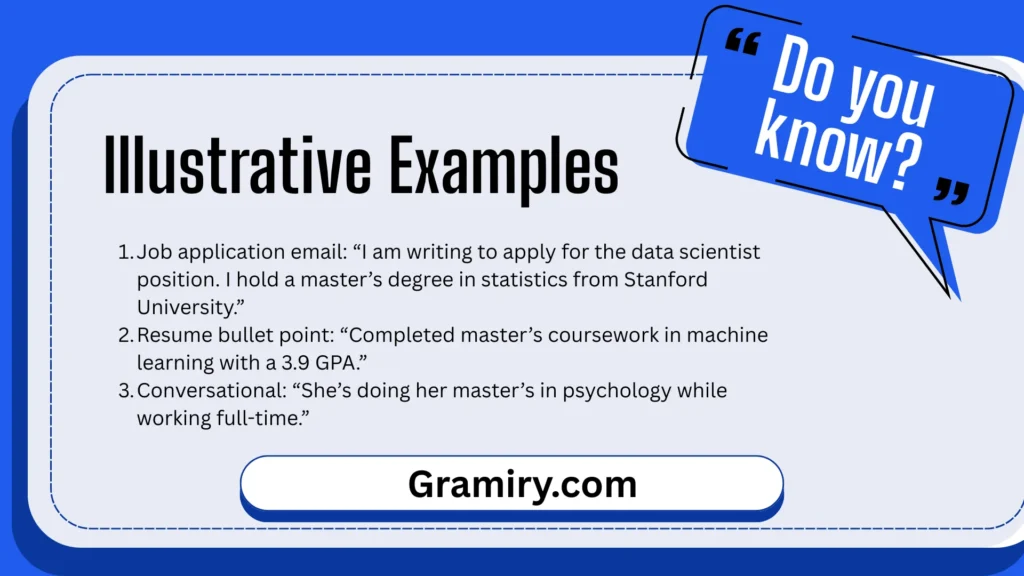
- Job application email: “I am writing to apply for the data scientist position. I hold a master’s degree in statistics from Stanford University.”
- Resume bullet point: “Completed master’s coursework in machine learning with a 3.9 GPA.”
- Conversational: “She’s doing her master’s in psychology while working full-time.”
- Formal announcement: “The Department of History congratulates the 2024 cohort of Master of Arts graduates.” (No apostrophe because “Master” is a title.)
- Plural clarification: “Both of my sisters have master’s degrees—one in nursing and one in social work.” (Each woman has her own master’s degree.)
- Incorrect correction (common error): “He said he earned two masters in five years.” → Corrected: “He said he earned two master’s degrees in five years.”
- Possessive of the degree (advanced): “The master’s program’s duration is two years.” (First apostrophe: master’s; second: program’s.)
Practice Section (MCQs)
Choose the correct option for each question.
- After six years of study, she finally received her _____.
a) masters
b) master’s
c) master
d) masters’ - Which sentence is grammatically correct?
a) I’m pursuing a Masters in Education.
b) I’m pursuing a master’s in education.
c) I’m pursuing a masters in Education.
d) I’m pursuing a master in education. - The plural possessive form (extremely rare) is spelled:
a) master’s
b) masters’s
c) masters’
d) masters - Fill in the blank: “He completed his _____ thesis last month.”
a) master
b) masters
c) master’s
d) masters’s - Which of the following is correctly capitalized?
a) She earned a Master’s degree in biology.
b) She earned a master’s degree in Biology.
c) She earned a Master’s Degree in Biology.
d) She earned a master’s degree in biology. - “MBA” stands for Master of Business Administration. Why is there no apostrophe?
a) Abbreviations never use apostrophes.
b) “Master” functions as a title, not a possessive.
c) It’s a proper noun.
d) All of the above. - Identify the incorrect sentence:
a) I have a master’s in engineering.
b) Several masters of the craft attended the seminar.
c) She’s working on her masters degree.
d) The university offers 15 master’s programs. - Which article correctly completes the sentence? “He doesn’t have _____ master’s yet.”
a) a
b) an
c) the
d) (no article) - Choose the sentence that uses the plural possessive correctly (per standard style guides):
a) The department awarded three masters’ degrees.
b) The department awarded three master’s degrees.
c) The department awarded three masters degrees.
d) The department awarded three master’s degree’s. - “Master of Science” is correct. What is the lowercase generic version?
a) master’s of science
b) master of science
c) masters of science
d) master’s in science - Which sentence is acceptable in speech but incorrect in formal writing?
a) “I got my master’s last year.”
b) “I got my masters last year.”
c) “I got a Master of Arts last year.”
d) “I got my master’s degree last year.” - Fill in the blank with the correct possessive: “All _____ theses were submitted on time.” (referring to multiple students each with one master’s degree)
a) master’s
b) masters’
c) masters’s
d) masters - Which of the following is NOT a common typo for “master’s degree”?
a) masters degree
b) master degree
c) masters’ degree
d) master’s degree’s - “She has a master’s in French literature.” What part of speech is “master’s”?
a) Plural noun
b) Possessive proper noun
c) Possessive common noun
d) Adjective - True or false: “Masters” (no apostrophe) can correctly replace “master’s” on a LinkedIn profile without any change in meaning.
a) True
b) False
Answer Key
- b – master’s
- b – I’m pursuing a master’s in education.
- c – masters’
- c – master’s
- d – She earned a master’s degree in biology. (Only “master’s” is lowercase; degree names are lowercase unless proper.)
- d – All of the above.
- c – She’s working on her masters degree. (Missing apostrophe.)
- a – a
- b – three master’s degrees (Most style guides prefer treating each degree separately.)
- a – master’s of science (Lowercase generic possessive.)
- b – “I got my masters last year.” (Common speech, but requires apostrophe in writing.)
- b – masters’ (Plural possessive: theses belonging to multiple masters.)
- d – master’s degree’s (Double possessive is rare, not a common typo.)
- c – Possessive common noun
- b – False (LinkedIn is professional; missing apostrophe is an error.)
Frequently Asked Questions (FAQs)
1. Is “masters degree” ever accepted in formal writing?
No. Major style guides (AP, Chicago, MLA, APA) all require the apostrophe: master’s degree. The only exceptions are specific degree names like “Master of Arts” (no apostrophe) or when used as a database tag for brevity.
2. Do I capitalize “master’s” in a sentence?
Only if it starts the sentence or is part of a proper noun (e.g., “Master’s Program in Data Science” as an official title). Generally, use lowercase: She earned a master’s in chemistry.
3. How do I write “master’s” on a resume if I’m worried about ATS (Applicant Tracking Systems)?
Write it correctly: Master’s degree in Computer Science. ATS can read apostrophes. Avoid “Masters” (no apostrophe) because it may flag as a typo. For maximum safety, also spell out the full degree name: Master of Science in Computer Science.
4. What’s the difference between “master’s degree” and “master’s program”?
Same possessive rule applies to both. Master’s program means the program that leads to a master’s degree. Both require the apostrophe. Incorrect: masters program.
5. Can I say “I have two master’s” without the word “degrees”?
Yes, in informal spoken English, but in formal writing, include “degrees” for clarity: I have two master’s degrees (one in economics and one in public policy). Without “degrees,” it’s ambiguous whether you mean two separate master’s qualifications or two masters (people).
Conclusion
The apostrophe in master’s degree isn’t a typographical relic it signals possession: the degree belongs to a master of a subject.
While speech blurs the difference between “masters” and “master’s,” writing demands precision. Remember that bachelor’s, master’s, and doctor’s (or doctorate) follow the same possessive logic. The only time you drop the apostrophe is with formal titles like Master of Arts or when using plural forms like masters (meaning experts).
My final advice: when in doubt, write the full phrase master’s degree or use the abbreviation M.A./M.S. Your credibility and that tiny apostrophe will thank you.

Amelia Brooks is a passionate writer known for her thoughtful storytelling and emotionally rich writing style. She enjoys exploring meaningful topics that connect with readers in a simple and engaging way.
Amelia is the author of Whispers Beyond The Lantern Sky and The Quiet Colors Of Midnight Rain, two original works praised for their creativity and depth.
Her writing blends imagination with real human emotions, making every piece feel personal and memorable. When she is not writing, she spends her time reading, researching new ideas, and discovering inspiring stories from different cultures.
 Matthew Cooper
 Jordan Miles