We’ve all been there. You’re typing a message or drafting an email, and suddenly your fingers freeze over two little words: anymore or any more. Is it one word or two?
Does it even matter? I’ve seen brilliant writers stumble here, and for years, I assumed they were just interchangeable typos. But after digging into the grammar rulebooks and style guides, I realized there’s a clean, logical split. In this post, I’ll show you exactly how to tell them apart no more second-guessing.
Direct Answer
Anymore (one word) is an adverb meaning “nowadays” or “any longer,” used in negative or interrogative sentences about time or frequency. Any more (two words) means “an additional amount” of something countable or uncountable. Use “anymore” for time, “any more” for quantity.
Meanings
Let’s break each down in plain English.
Anymore (one word)
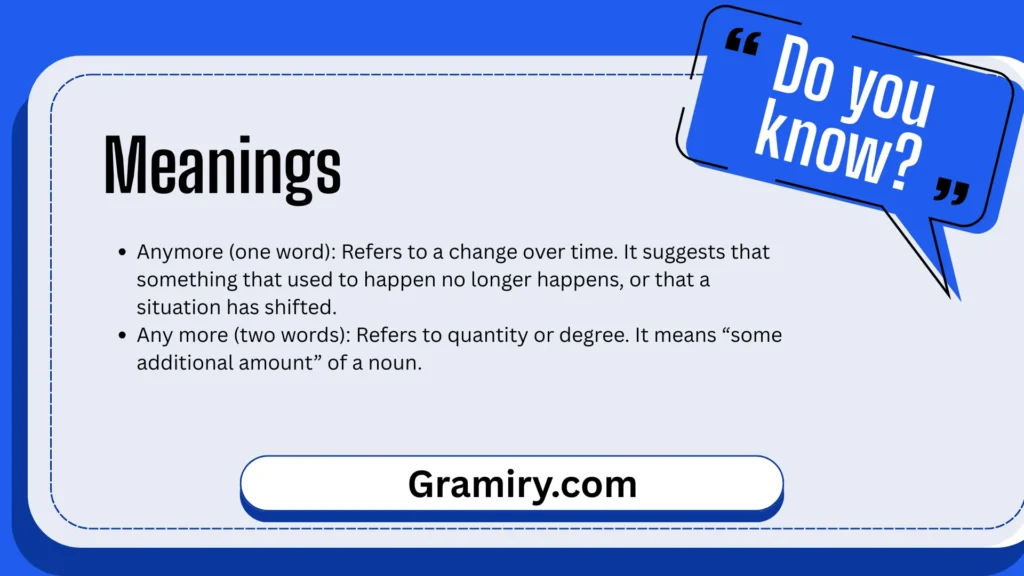
Refers to a change over time. It suggests that something that used to happen no longer happens, or that a situation has shifted. You’ll almost always find it in negative statements or questions. Think of it as a sibling of “still” or “these days.”
Any more (two words)
Refers to quantity or degree. It means “some additional amount” of a noun. The word “any” acts as a determiner, and “more” is an adjective or pronoun. If you can swap in “some additional” and the sentence still makes sense, you need two words.
Pronunciation
Anymore → /ˌɛn.iˈmɔːr/ (EN-ee-mor)
Stress falls on the third syllable: “en-ee-MOR.” The first part rhymes with “penny.” Say it quickly, almost like one smooth beat.
Any more → /ˈɛn.i mɔːr/ (EN-ee mor)
Here, “any” keeps its full two syllables with light stress on “EN,” followed by a soft pause, then “more” with equal lightness. It sounds more deliberate, as if you’re counting two separate words.
Pro tip: Native speakers often reduce “any more” to “any-more” in rapid speech, which fuels the confusion. In careful pronunciation, “anymore” is more compressed.
The Key Differences
| Dimension | Anymore (1 word) | Any more (2 words) |
| Part of speech | Adverb | Determiner + adjective/pronoun |
| Core meaning | Time (no longer, nowadays) | Quantity (additional) |
| Sentence type | Negative or questions | Any type (positive, negative, question) |
| Can follow “not” | Yes (common: “not…anymore”) | Yes (“not any more” = no additional) |
| Can follow “if” | No | Yes (“if you need any more”) |
| Refers to | Continuation of an action/state | Amount of a thing |
Nuance alert: In American English, “anymore” can appear in positive sentences meaning “these days” (e.g., “Coffee costs five bucks anymore”). This is dialectal and not standard for formal writing. Stick to negative contexts to be safe.
Correct Spelling
Standard:
- Anymore (one word, no space)
- Any more (two words, space between)
Common typos to avoid:
- ❌ “Any more” when you mean “not anymore” → “I don’t love you any more” (ambiguity alert – could mean quantity or time)
- ❌ “Anymore” before a noun → “Do you have anymore coffee?” (wrong; should be “any more coffee”)
- ❌ “Anyemore” / “Anymoore” (phonetic misspellings)
- ❌ “Any more” (missing the second ‘y’)
Memory trick: If you can delete the space without changing the meaning, it’s anymore. But that rarely works, so use the time vs. quantity rule instead.
Singular and Plural Forms
Neither anymore nor any more changes form for singular or plural—they are invariant. However, the noun that follows any more does change.
- Singular (uncountable): “Do you have any more sugar?” (sugar = singular mass noun)
- Plural (countable): “Do you have any more napkins?” (napkins = plural)
Anymore never pairs with a noun directly. It modifies verbs or whole clauses:
- “She doesn’t call anymore.” (no noun follows)
So the plurality question is really about the noun attached to any more, not the phrase itself.
Grammar Rules
1. Part of Speech Distinction
- Anymore = adverb → modifies a verb, adjective, or clause.
“He doesn’t work here anymore.” (modifies “work”) - Any more = determiner + quantifier → modifies a noun.
“I don’t need any more help.” (“any” modifies “more help”)
2. Placement in a Sentence
- Anymore typically goes at the end of a clause, though it can sometimes appear mid-sentence in informal English.
Correct: “I don’t go there anymore.”
Awkward but acceptable: “I anymore don’t go there.” - Any more appears directly before a noun (or stands alone as a pronoun).
“Take any more cookies and you’ll regret it.”
“I’ve had enough. I can’t eat any more.” (pronoun use)
3. Polarity Sensitivity
Anymore is a negative polarity item (NPI) in standard English. That means it mostly appears in:
- Negative sentences: “She won’t wait anymore.”
- Questions (implicitly negative): “Does he live there anymore?” (expecting “no”)
- Conditional “if” clauses with negative meaning: “If you’re late anymore…” (rare)
Any more has no such restriction:
“I’d like any more details you can share.” (positive sentence)
4. Ellipsis (Leaving Out the Noun)
When the noun is understood, any more can stand alone as a pronoun phrase:
“I’ve spent $50. I don’t have any more.” (understood: any more money)
Anymore cannot stand in for a noun. “I don’t have anymore” is incorrect unless you mean “I don’t have additional time/resources” – but then it’s still any more.
Which One Is Unique?
Both are unique, but let’s highlight where one has no substitute.
The unique role of anymore:
It’s the only concise way to express “no longer” in a negative time context without adding extra words. Try replacing it:
“She doesn’t sing anymore” → “She no longer sings” (works, but stiffer) → “She doesn’t sing these days” (less precise). Anymore is uniquely efficient for conversational English.
The unique role of any more:
It can modify both countable and uncountable nouns while preserving the “any” sense of indefiniteness. “Some more” suggests a specific additional amount; “any more” implies an open, unspecified quantity. Plus, any more can appear in positive sentences, which anymore cannot in standard writing.
Edge case: In negative sentences, both can appear but mean different things:
- “Don’t call me anymore.” (Stop calling me, time-based)
- “Don’t call me any more.” (Don’t call me additional times – quantity of calls)
In real life, the first is far more common.
Illustrative Examples
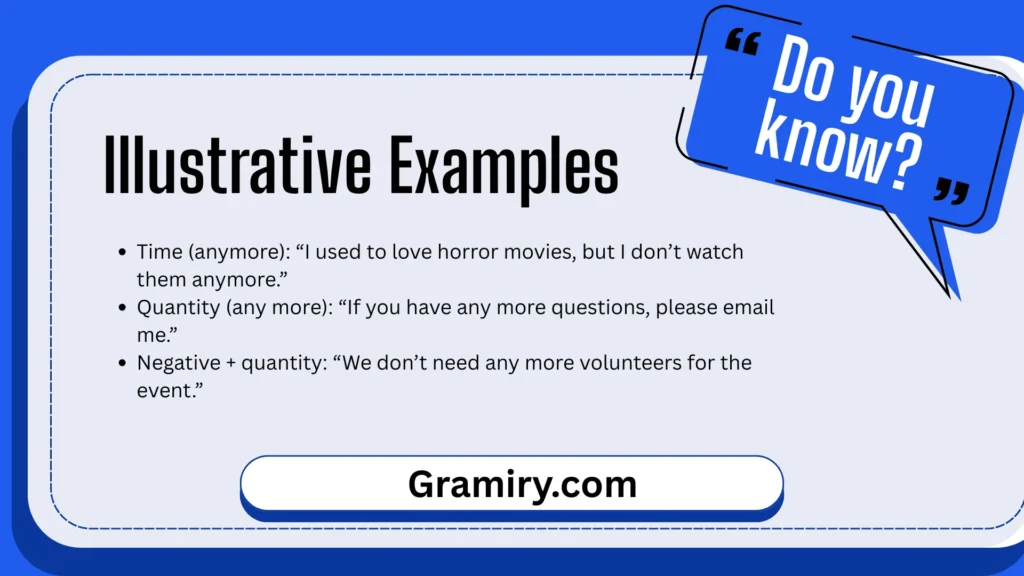
- Time (anymore): “I used to love horror movies, but I don’t watch them anymore.”
- Quantity (any more): “If you have any more questions, please email me.”
- Negative + quantity: “We don’t need any more volunteers for the event.”
- Question + time: “Does this restaurant serve breakfast anymore?”
- Pronoun use (any more): “I’ve given you all I can. There isn’t any more.”
- Positive statement (any more): “She asked whether I wanted any more pie.”
- Formal negative (anymore): “The committee no longer meets, nor does it communicate anymore.”
- Ambiguity warning: “I can’t love you any more” = either “I’ve reached my max love quantity” or “I no longer love you.” Context saves it.
Practice Section (MCQs)
Choose the correct option: anymore or any more.
- I don’t trust those news sources ____.
a) anymore
b) any more - Do you have ____ paper in the printer?
a) anymore
b) any more - She refused to eat ____ of the cake.
a) anymore
b) any more - We hardly ever see each other ____.
a) anymore
b) any more - If you need ____ help, just call.
a) anymore
b) any more - That brand doesn’t make quality shoes ____.
a) anymore
b) any more - I can’t take ____ stress this week.
a) anymore
b) any more - Is it safe to swim here ____?
a) anymore
b) any more - He hasn’t written ____ books since 2019.
a) anymore
b) any more - The old library doesn’t exist ____.
a) anymore
b) any more - Would you like ____ coffee before you leave?
a) anymore
b) any more - I don’t have ____ patience for this.
a) anymore
b) any more - They aren’t friends ____ after the argument.
a) anymore
b) any more - No ____ excuses will be accepted.
a) anymore
b) any more - I used to collect stamps, but I don’t ____.
a) anymore
b) any more
Answer Key:
1-a, 2-b, 3-b, 4-a, 5-b, 6-a, 7-b, 8-a, 9-b, 10-a, 11-b, 12-b, 13-a, 14-b, 15-a
Frequently Asked Questions (FAQs)
1. Is “anymore” ever correct in positive sentences?
In standard American and British English, no—use “these days” instead. However, some US dialects (especially in the Midwest and South) use positive “anymore” to mean “nowadays” (e.g., “Gas is expensive anymore”). Avoid in formal writing.
2. Can “any more” be two words when talking about time?
No. If you mean “no longer,” always write “anymore” (one word). “I don’t love you any more” is ambiguous; “I don’t love you anymore” is clear.
3. How do I check my writing quickly?
Replace the word with “no longer.” If it fits, use anymore. Replace with “some additional.” If that fits, use any more. If both fit, you’ve found an ambiguous sentence—rewrite it.
4. Does autocorrect help or hurt?
Autocorrect often changes “anymore” to “any more” incorrectly in negative sentences. Always double-check. Grammarly and ProWritingAid handle this rule moderately well.
5. Is “anymore” used differently in British vs. American English?
Mostly the same, though British English leans slightly more toward two-word “any more” in negative time contexts (e.g., “I don’t like it any more” – acceptable but less common). American English strongly prefers “anymore” for time.
Conclusion
The battle of anymore versus any more comes down to one clean question: Are you talking about time or quantity? If time and negation, smash them into one word: anymore.
If quantity or an additional amount of something, keep them apart: any more. I’ve seen this tiny distinction trip up native speakers daily, but now you’ve got a 5-second mental rule.
Next time you hesitate, ask yourself: “Can I replace this with ‘no longer’?” If yes, one word.
“Some additional”? Two words. Go write with confidence and don’t second-guess yourself anymore (or any more).

Jordan Miles is a passionate writer known for creating thoughtful and engaging content that connects with modern readers. With years of experience in digital publishing, he focuses on storytelling, culture, lifestyle, and meaningful ideas that inspire curiosity.
He is also the author of The Silent Horizon and Echoes Beyond Midnight, two original works praised for their emotional depth and imaginative writing style.
Jordan believes great writing should feel simple, honest and memorable. Through his work, he continues to share fresh perspectives that keep readers connected and inspired.
 Matthew Cooper
 Amelia Brooks