I know exactly what you’re thinking: “Whenever I search for ‘ready or not release date,’ half the results talk about a video game, and the other half give me grammar advice I didn’t ask for.” It’s frustrating when a simple phrase seems to have multiple identities.
But here’s the truth whether you need the factual calendar date or want to master the English expression, confusion disappears once you separate the contexts. In this guide, I’ll give you the direct answer first, then break down every linguistic detail so you never misuse or mispronounce “ready or not” again.
Direct Answer
The phrase “ready or not” has no fixed calendar release date because it is not a product. However, the tactical SWAT video game Ready or Not was released in Early Access on December 17, 2021, with its full version 1.0 launching on December 13, 2023. For the idiomatic expression, use it any time to mean “regardless of preparedness.”
Meanings
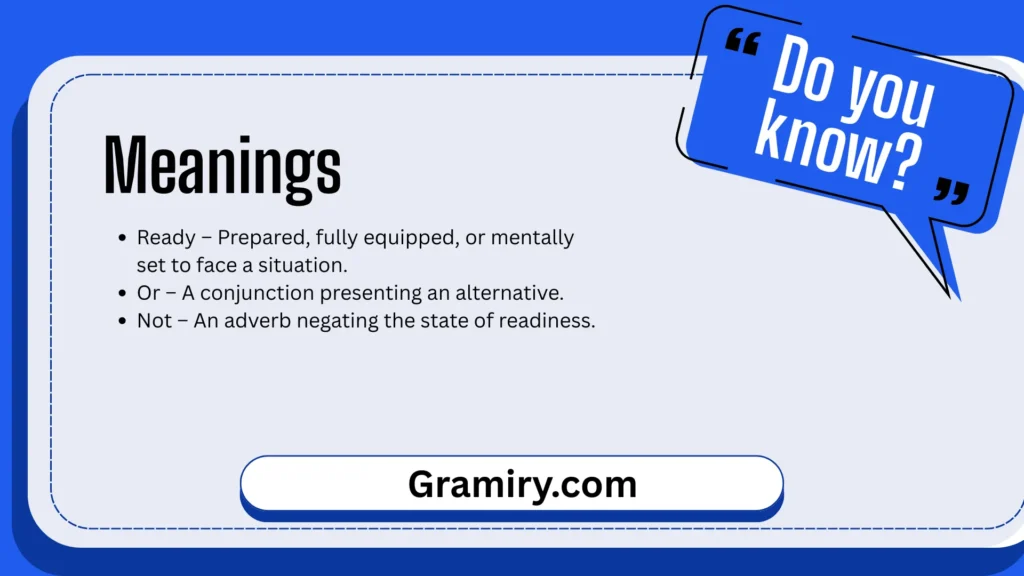
“Ready or not” consists of three simple words that combine into a powerful conditional phrase.
- Ready – Prepared, fully equipped, or mentally set to face a situation.
- Or – A conjunction presenting an alternative.
- Not – An adverb negating the state of readiness.
Together, the phrase means: “Whether you are prepared or unprepared (the outcome or action will proceed anyway).” It often announces an impending event where waiting is over—most famously in the children’s game of hide-and-seek, where the seeker shouts “Ready or not, here I come!”
Pronunciation
Use standard International Phonetic Alphabet (IPA) for General American English:
- Ready – /ˈrɛdi/ (RED-ee)
- First syllable rhymes with “bed.” Second syllable: short “ee” as in “see.”
- Or – /ɔr/ (like “ore”) – In rapid speech, often reduced to /ɚ/ before consonants.
- Not – /nɑt/ (NAHT) – Open back vowel, not the British /nɒt/.
Full phrase in natural speech: /ˈrɛdi ɚ nɑt/ – The “or” becomes a quick schwa-r sound. Avoid over-articulating “or” unless you’re emphasizing sarcasm or urgency.
Common mispronunciation to avoid: Saying “ready are not” with a full, stressed “are.” The vowel in “or” should be lower and more back than “are” (/ɑr/).
The Key Differences
When people search for “ready or not release date,” two completely distinct referents collide. Here are the technical differences:
| Aspect | Ready or Not (Game) | “Ready or not” (Idiom) |
| Part of speech | Proper noun (title) | Conjunction phrase + adjective clause |
| Capitalization | Title case (Ready or Not) | Lowercase or sentence case |
| Release date relevance | Yes – Dec 13, 2023 (full) | No – timeless |
| Grammar function | Noun (subject/object) | Adverbial clause of concession |
| Example | “I bought Ready or Not on Steam.” | “Ready or not, we’re launching the project tomorrow.” |
The game borrowed the idiom as its title. The confusion arises because search engines cannot distinguish intent—linguistic or factual.
Correct Spelling
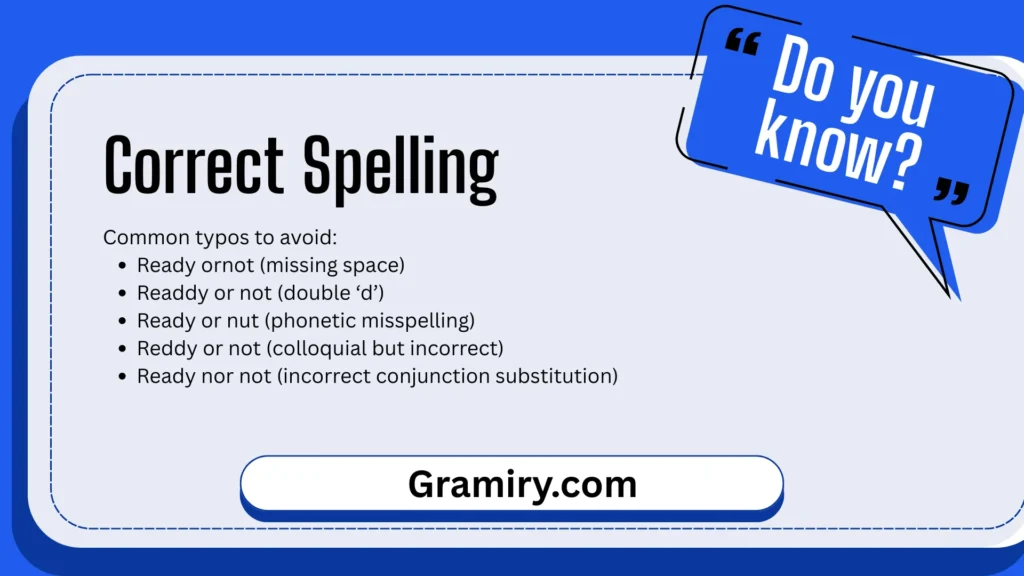
The standard spelling is always ready or not (three words, lowercase except at sentence start or in a title).
Common typos to avoid:
- Ready ornot (missing space)
- Readdy or not (double ‘d’)
- Ready or nut (phonetic misspelling)
- Reddy or not (colloquial but incorrect)
- Ready nor not (incorrect conjunction substitution)
Remember: “or” never becomes “nor” because “nor” pairs with “neither” (neither ready nor not ready → awkward and non-standard).
Singular and Plural Forms
This phrase is fixed and does not change for number in standard English.
- Singular context – “I am ready or not, the test starts now.”
- Plural context – “We are ready or not, the auditors have arrived.”
The phrase behaves like an adverbial clause. You cannot say “readies or not” or “ready or nots” (except as a rare, jocular plural noun: “There were too many ‘ready or nots’ in his speech”). Even then, that is non-standard.
Possessive form – Add ’s to the entire phrase only in informal writing: “The ‘ready or not’s sudden appearance shocked us.” Better: “The sudden appearance of ‘ready or not’ shocked us.”
Grammar Rules
- Part of speech – “Ready or not” functions as a concessive adverbial clause (it concedes a possibility). It modifies the main clause by saying “regardless of whether the subject is prepared.”
- Punctuation – Always set off with a comma when it begins a sentence: “Ready or not, here I come.” When it ends a sentence, use a comma before it: “We must act, ready or not.”
- Ellipsis – The full grammatical structure is “Whether [someone is] ready or [whether someone is] not.” English allows dropping the repeated “whether” and the second “is.”
- Verb agreement – The implied verb “to be” matches the subject of the main clause, not the phrase itself.
- Correct: “The team, ready or not, submits the report.” (Team = singular)
- Correct: “The players, ready or not, submit their forms.” (Players = plural)
- Negative inversion – Do not use double negatives. Never write “not ready or not” or “ready or not not.” The “not” already negates readiness.
- Tense – The phrase is tenseless. It works with past, present, or future:
- Past: “They entered, ready or not.”
- Present: “Ready or not, I am leaving.”
- Future: “Ready or not, the system will reboot.”
Which One Is Unique?
The game title Ready or Not is unique because it transforms a spoken ultimatum into a static proper noun. You can pluralize it only in gamer slang (“I own three tactical shooters, including two Ready or Nots”—meaning versions or copies). But grammatically, that’s an abuse.
The idiomatic phrase is unique in that it breaks the normal “whether X or Y” pattern by omitting the second verb entirely. Compare:
- Standard: “Whether you like it or don’t like it” (repeats verb)
- Unique: “Ready or not” (just “not” standing in for “not ready”)
This elliptical reduction is rare in English. Only a few fixed phrases do this: “like it or not,” “win or lose,” “right or wrong.”
Illustrative Examples
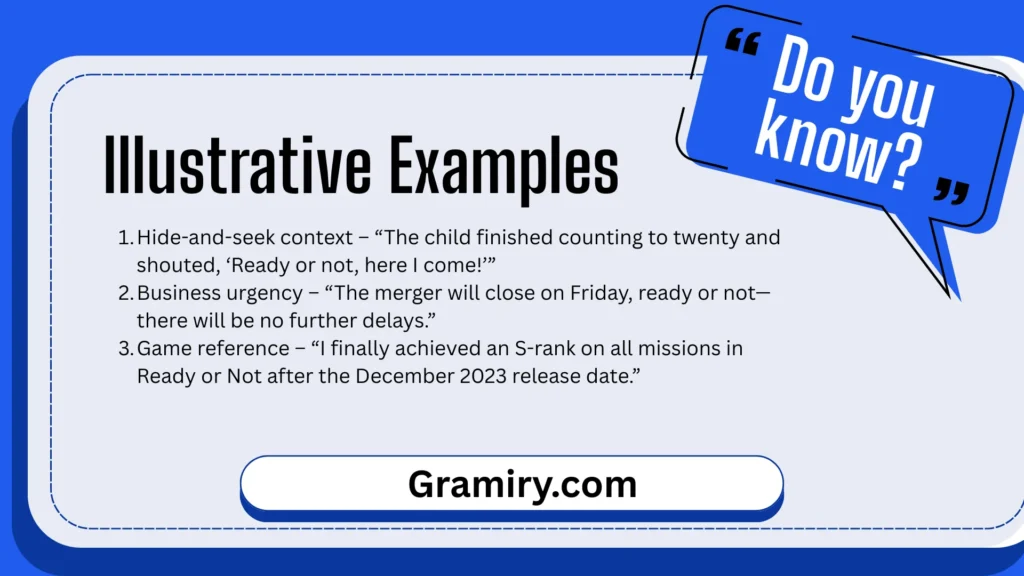
- Hide-and-seek context – “The child finished counting to twenty and shouted, ‘Ready or not, here I come!’”
- Business urgency – “The merger will close on Friday, ready or not—there will be no further delays.”
- Game reference – “I finally achieved an S-rank on all missions in Ready or Not after the December 2023 release date.”
- Personal resolve – “I’m taking the bar exam next week, ready or not, because I’ve already paid the fee.”
- Historical narrative – “The troops landed at dawn, ready or not, as the general had ordered.”
- Sarcastic usage – “Oh, you haven’t studied? Ready or not, the quiz is on my desk right now.”
- Literary – “Life announces itself, ready or not, without a single invitation.”
Practice Section (MCQs)
1. What part of speech does the phrase “ready or not” function as in a sentence?
A) Noun phrase
B) Concessive adverbial clause
C) Prepositional phrase
D) Adjective
2. Choose the correct spelling:
A) Ready ornot
B) Readdy or not
C) Ready or not
D) Reddy or not
3. Which sentence uses correct punctuation?
A) Ready or not here I come.
B) Ready or not, here I come.
C) Ready, or not here I come.
D) Ready or not; here I come.
4. What is the full grammatical form of “ready or not”?
A) Whether ready or not ready
B) If you are ready or you are not
C) Unless ready or not
D) Although ready and not
5. The video game Ready or Not released its full version 1.0 on:
A) December 17, 2021
B) December 13, 2023
C) October 15, 2022
D) January 10, 2024
6. Which of the following is a common typo to avoid?
A) Ready or nut
B) Ready or not
C) Ready or naught
D) Ready or knot
7. How does the phrase behave in plural contexts?
A) Change to “readies or not”
B) Change to “ready or nots”
C) It remains unchanged
D) Change to “ready or not are”
8. In the sentence “The jury, ready or not, will deliver its verdict,” the verb “will deliver” agrees with:
A) The phrase “ready or not”
B) The word “ready”
C) The subject “jury” (singular)
D) The implied “they”
9. Which sentence is grammatically correct?
A) Not ready or not, we proceed.
B) Ready or not not, we proceed.
C) Ready or not, we proceed.
D) Ready and not, we proceed.
10. The phrase “like it or not” is grammatically similar to “ready or not” because both:
A) Use a gerund
B) Omit the second verb after “not”
C) Require a question mark
D) Are proper nouns
11. What is the IPA pronunciation of “or” in natural American speech within the phrase?
A) /ɔr/
B) /oʊr/
C) /ɚ/
D) /ɑr/
12. Which scenario correctly uses the idiom?
A) “Ready or not, the cake is chocolate.”
B) “Ready or not, the store opens at 9 AM regardless of our setup.”
C) “I am ready or not to eat.”
D) “Ready or not she understood the lesson.”
13. True or False: The phrase can be used in the past tense without changing its form.
A) True
B) False
14. Choose the sentence with the game title usage:
A) “Ready or not, the show begins.”
B) “She whispered ‘ready or not’ before turning the corner.”
C) “Ready or Not requires a graphics card update.”
D) “We are ready or not for the final exam.”
15. Which punctuation rule applies when “ready or not” ends a sentence?
A) Place a comma before it
B) Place a semicolon before it
C) Place no punctuation before it
D) Capitalize the word “ready”
Answer Key
1-B, 2-C, 3-B, 4-A, 5-B, 6-A, 7-C, 8-C, 9-C, 10-B, 11-C, 12-B, 13-A, 14-C, 15-A
Frequently Asked Questions (FAQs)
1. Is “ready or not” grammatically correct, or should it be “whether ready or not”?
Both are correct, but “ready or not” is elliptical (words are omitted). “Whether ready or not” is more formal. Use “ready or not” for direct, urgent, or playful tones.
2. Can I use “ready or not” in academic writing?
Yes, but sparingly. It is acceptable in informal academic contexts (blogs, personal essays, case studies). For formal theses, use “regardless of the level of preparedness” or “whether prepared or not.”
3. What is the origin of “ready or not, here I come”?
It originates from the children’s game of hide-and-seek in 19th-century England. The phrase signals the end of counting and the start of searching—no further warning.
4. Does the game Ready or Not have DLC release dates after full launch?
Yes. The game’s first major DLC, Home Invasion, was released in July 2024. Always check the official VOID Interactive store page for upcoming content, not the base “release date.”
5. How can I remember the correct spelling?
Associate “ready” (one ‘d’ like “already”), “or” (the conjunction you learned in first grade), and “not” (the opposite of “hot”). Never merge words. Think: Ready? Or not? The space after “or” is essential.
Conclusion
You came here searching for “ready or not release date,” and now you have both answers: the precise calendar date for the video game (December 13, 2023) and the complete linguistic mastery of the idiomatic phrase. Remember, the game is a proper noun; the expression is a concessive adverbial clause that never changes spelling or plural form.
Use the comma after it, pronounce “or” as a soft schwa in fast speech, and never write “ready ornut.” My final advice: next time you speak or write “ready or not,” pause for one beat because in both grammar and life, that moment of uncertainty is where all the power lies.

Matthew Cooper is a passionate writer who loves exploring human emotions, modern culture, and everyday life experiences through meaningful storytelling. With years of creative writing experience, he has built a reputation for crafting engaging and thought-provoking content that connects naturally with readers.
He is the author of Beneath The Crimson Hour and When The Moon Turned Silver, two original works known for their deep themes and immersive writing style.
Matthew enjoys turning simple ideas into powerful narratives that inspire curiosity and reflection. His work focuses on authenticity, creativity, and delivering valuable insights in a clear and engaging way.
 Jordan Miles
 Amelia Brooks