I remember the first time I saw the terms even and odd functions it felt confusing and overly technical. I kept wondering: “How do I actually know if a function is even or odd?” If you’ve had the same question, you’re not alone. Many students struggle with this concept because it mixes algebra with patterns and symmetry.
But here’s the good news: once you understand a simple rule and a visual trick, everything becomes much clearer. In this guide, I’ll walk you step-by-step so you can confidently identify whether a function is even, odd, or neither without stress.
Direct Answer
To know if a function is even or odd, replace (x) with (-x). If (f(-x) = f(x)), the function is even. If (f(-x) = -f(x)), it is odd. If neither condition is satisfied, the function is neither even nor odd.
Meanings
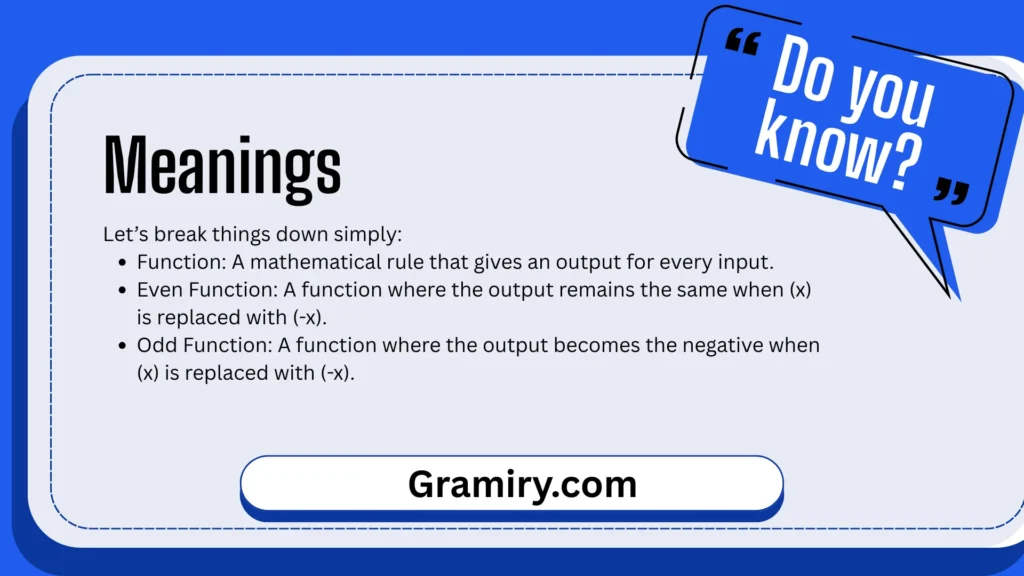
Let’s break things down simply:
- Function: A mathematical rule that gives an output for every input.
- Even Function: A function where the output remains the same when (x) is replaced with (-x).
- Odd Function: A function where the output becomes the negative when (x) is replaced with (-x).
👉 Simple idea:
- Even = same output
- Odd = opposite output
Pronunciation
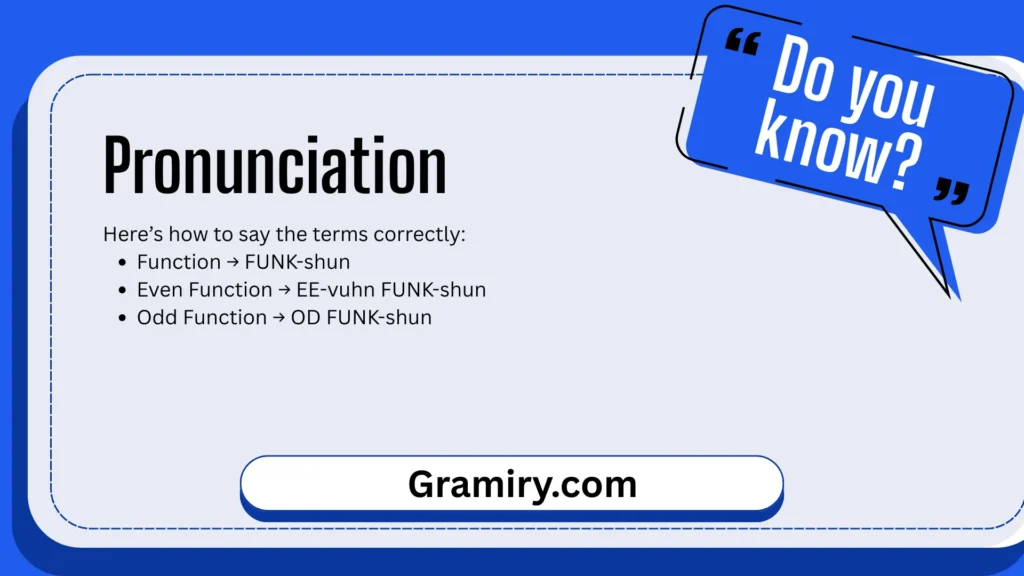
Here’s how to say the terms correctly:
- Function → FUNK-shun
- Even Function → EE-vuhn FUNK-shun
- Odd Function → OD FUNK-shun
💡 Tip: Practice saying them slowly, then naturally in a sentence like:
“This is an even function.”
The Key Differences
Understanding the difference is the most important part:
| Feature | Even Function | Odd Function |
| Formula Test | (f(-x) = f(x)) | (f(-x) = -f(x)) |
| Symmetry | Symmetric about y-axis | Symmetric about origin |
| Example | (x^2, \cos x) | (x^3, \sin x) |
| Output Behavior | Same | Opposite |
👉 In simple words:
- Even functions “mirror” on the vertical axis
- Odd functions “flip” through the origin
Correct Spelling
The correct spelling is:
- even function
- odd function
❌ Common mistakes:
- “eveen function”
- “od function”
- “odd fucntion”
✔ Always double-check spelling in exams and writing.
Singular and Plural Forms
- Singular:
- an even function
- an odd function
- Plural:
- even functions
- odd functions
📌 Example:
- Singular: This is an even function.
- Plural: These are even functions.
Grammar Rules
From a grammar perspective:
- “Function” is a noun
- “Even” and “odd” act as adjectives describing the noun
✔ Structure:
- adjective + noun → even function
- adjective + noun → odd function
📌 Usage in sentences:
- This function is even.
- The given function is odd.
Which One is Unique?
Each type has its own special use:
- Even functions are useful when dealing with symmetry problems, especially graphs mirrored on the y-axis.
- Odd functions are unique in physics and engineering because they often represent balanced or opposite behaviors (like waves or signals).
👉 Special note:
Some functions are neither even nor odd, which makes them unique too.
Illustrative Examples
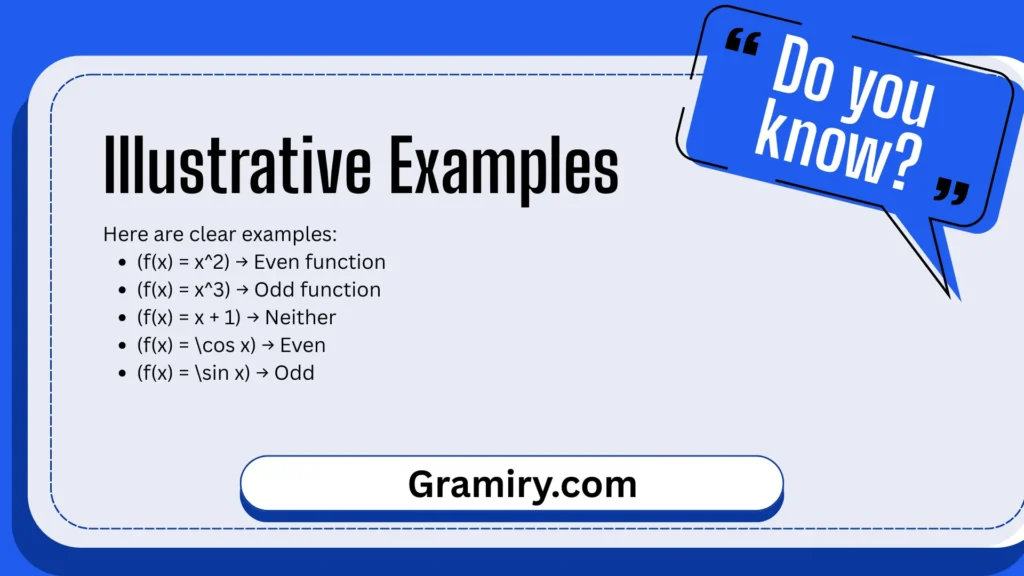
Here are clear examples:
- (f(x) = x^2) → Even function
- (f(x) = x^3) → Odd function
- (f(x) = x + 1) → Neither
- (f(x) = \cos x) → Even
- (f(x) = \sin x) → Odd
📌 Example sentence:
- The function (x^2) is even because replacing (x) with (-x) gives the same result.
Practice Section (MCQs)
Questions
- If (f(-x) = f(x)), the function is:
A) Odd
B) Even
C) Neither
D) Constant - If (f(-x) = -f(x)), the function is:
A) Even
B) Odd
C) Linear
D) Polynomial - (f(x) = x^2) is:
A) Odd
B) Even
C) Neither
D) Both - (f(x) = x^3) is:
A) Even
B) Odd
C) Neither
D) Constant - Even functions are symmetric about:
A) x-axis
B) y-axis
C) origin
D) none - Odd functions are symmetric about:
A) y-axis
B) origin
C) x-axis
D) none - (f(x) = x + 2) is:
A) Even
B) Odd
C) Neither
D) Both - Which is even?
A) (x^3)
B) (x^2)
C) (x)
D) (x^5) - Which is odd?
A) (x^2)
B) (\cos x)
C) (\sin x)
D) (x^4) - Even function means:
A) opposite output
B) same output
C) zero output
D) undefined - Odd function means:
A) same output
B) opposite output
C) constant output
D) positive output - (f(x)=0) is:
A) Even
B) Odd
C) Both
D) Neither - Replacing (x) with (-x) is called:
A) substitution
B) addition
C) division
D) simplification - Symmetry means:
A) balance
B) randomness
C) difference
D) none - A function can be:
A) Only even
B) Only odd
C) Both or neither
D) None
Answer Key
1-B
2-B
3-B
4-B
5-B
6-B
7-C
8-B
9-C
10-B
11-B
12-C
13-A
14-A
15-C
Frequently Asked Questions (FAQs)
1. Can a function be both even and odd?
Yes, but only if (f(x)=0). This is called the zero function.
2. What if a function is neither even nor odd?
That’s completely normal. Many functions don’t follow either rule.
3. Why is symmetry important?
Symmetry helps in graphing and simplifies calculations.
4. Are all polynomials even or odd?
No, only specific ones. Mixed terms usually make them neither.
5. Is there a shortcut to identify them?
Yes! Check powers:
- Even powers → usually even
- Odd powers → usually odd
Conclusion
Understanding how to know if a function is even or odd becomes easy once you apply the simple substitution rule. I always recommend starting by replacing (x) with (-x) and observing the result it’s the fastest method. Remember, even functions stay the same, while odd functions flip their sign.
Practice a few examples daily, and this concept will quickly become second nature. With time, you’ll even recognize patterns instantly without calculation. Keep practicing, stay curious, and math will start making much more sense!

Jordan Miles is a passionate writer known for creating thoughtful and engaging content that connects with modern readers. With years of experience in digital publishing, he focuses on storytelling, culture, lifestyle, and meaningful ideas that inspire curiosity.
He is also the author of The Silent Horizon and Echoes Beyond Midnight, two original works praised for their emotional depth and imaginative writing style.
Jordan believes great writing should feel simple, honest and memorable. Through his work, he continues to share fresh perspectives that keep readers connected and inspired.
 Matthew Cooper
 Amelia Brooks