I’ve seen this mistake countless times people writing therefor when they actually mean therefore. Honestly, it’s one of those tiny grammar slip-ups that can quietly weaken your writing without you even noticing.
I used to double-check it myself because both words look almost identical. But here’s the truth: only one of them is commonly correct in everyday English. In this guide, I’ll clear up the confusion once and for all.
By the end, you’ll not only know the difference but also use the correct word confidently in exams, emails, and professional writing.
Direct Answer
“Therefore” is the correct and commonly used word, meaning “for that reason” or “as a result.” “Therefor” is extremely rare and mostly obsolete, meaning “for that thing.” In modern English, you should almost always use “therefore.”
Meanings
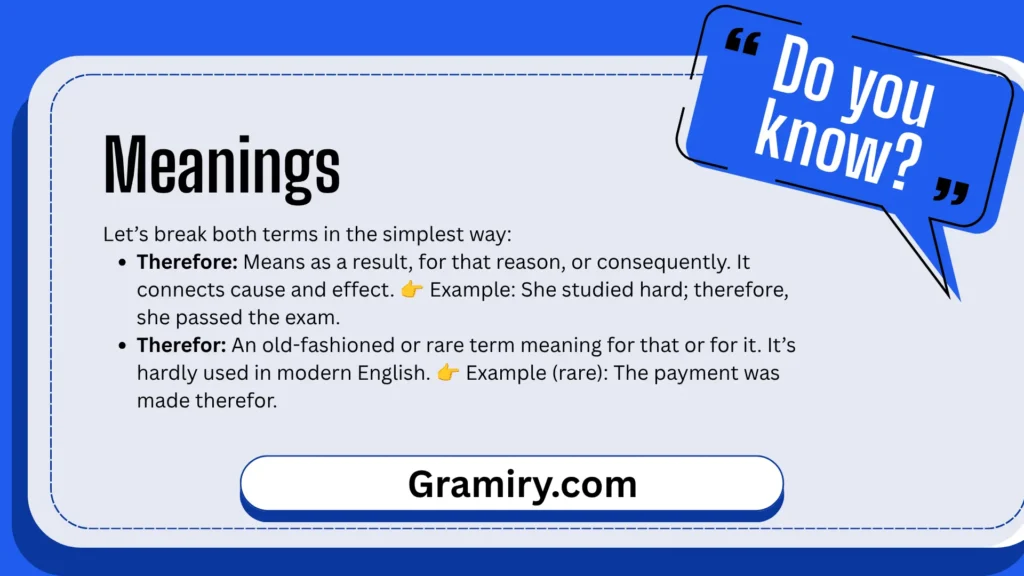
Let’s break both terms in the simplest way:
- Therefore:
Means as a result, for that reason, or consequently. It connects cause and effect.
👉 Example: She studied hard; therefore, she passed the exam. - Therefor:
An old-fashioned or rare term meaning for that or for it. It’s hardly used in modern English.
👉 Example (rare): The payment was made therefor.
👉 Simple tip: If you mean “because of that,” you almost always need therefore.
Pronunciation
Here’s how to say them correctly:
- Therefore:
Pronounced as: /ˈðeə.fɔːr/
👉 Sounds like: THAIR-for - Therefor:
Pronounced as: /ˈðeə.fɔːr/
👉 Same pronunciation, but different meaning and usage
⚠️ Yes, both sound the same—that’s why people get confused!
The Key Differences
Now let’s clearly compare them:
| Feature | Therefore | Therefor |
| Usage | Common | Rare/obsolete |
| Meaning | As a result | For that |
| Grammar Role | Conjunctive adverb | Adverb (archaic) |
| Modern English | Widely used | Almost never used |
| Example | He was late; therefore, he missed the bus | Payment therefor was issued |
👉 Key takeaway:
“Therefore” = logical result
“Therefor” = outdated expression
Correct Spelling
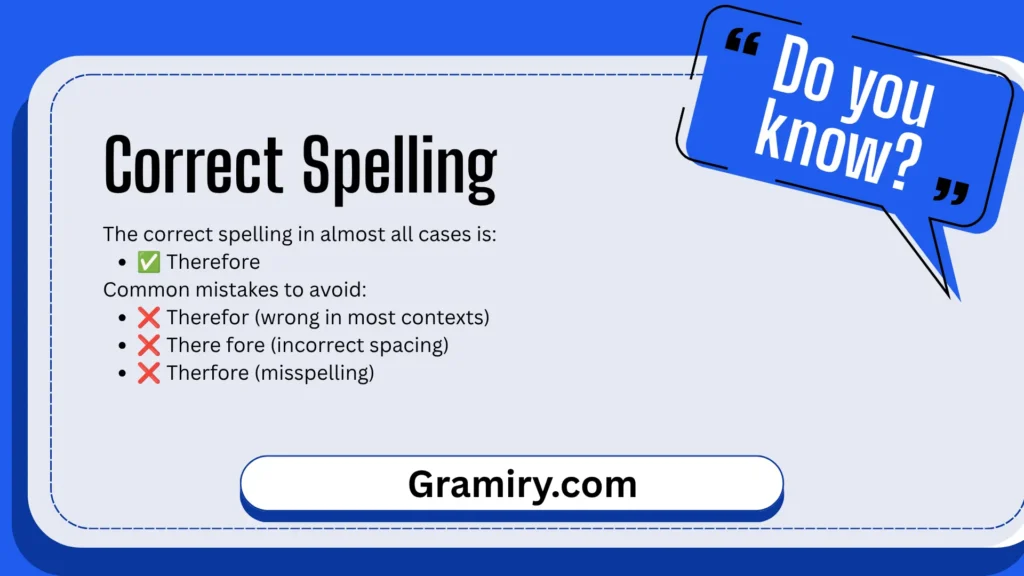
The correct spelling in almost all cases is:
✅ Therefore
Common mistakes to avoid:
- ❌ Therefor (wrong in most contexts)
- ❌ There fore (incorrect spacing)
- ❌ Therfore (misspelling)
👉 Quick memory trick:
“Therefore” has “fore” like before → meaning result comes after something.
Singular and Plural Forms
Good news—this is simple:
- Therefore does NOT have singular or plural forms.
- It is an adverb, so it stays the same in all cases.
👉 Example:
- Correct: Therefore, we proceed.
- ❌ Incorrect: Therefores (not a word)
Grammar Rules
Here’s how to use therefore properly:
1. It is a conjunctive adverb
It connects two ideas where one is the result of another.
👉 Example:
He didn’t prepare; therefore, he failed.
2. Use punctuation correctly
- Often comes after a semicolon (;)
- Followed by a comma (,)
👉 Example:
She was tired; therefore, she went to sleep.
3. Can start a sentence
👉 Example:
Therefore, we must act now.
4. Avoid overuse
Using “therefore” too much can make writing sound robotic.
Which One is Unique?
Let’s be honest:
- “Therefore” is the only useful word in modern English
- “Therefor” is practically obsolete
👉 Use therefor ONLY if:
- You’re reading or writing old legal or historical texts
👉 In everyday writing:
✅ Always choose therefore
Illustrative Examples
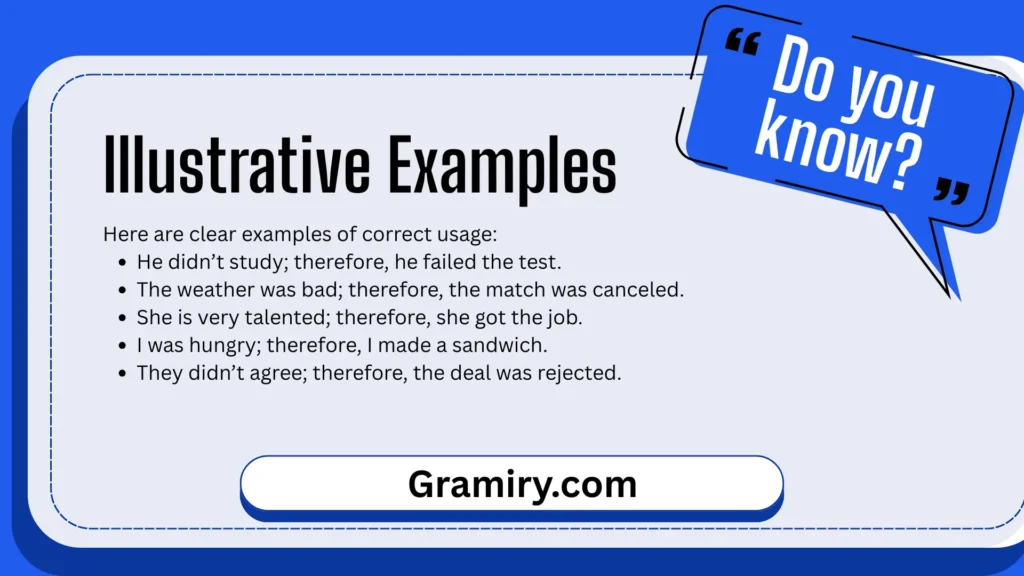
Here are clear examples of correct usage:
- He didn’t study; therefore, he failed the test.
- The weather was bad; therefore, the match was canceled.
- She is very talented; therefore, she got the job.
- I was hungry; therefore, I made a sandwich.
- They didn’t agree; therefore, the deal was rejected.
👉 Bonus (rare usage):
- Payment was made therefor. (Old style, avoid using)
Practice Section (MCQs)
Choose the correct answer:
- He was sick; ____ he stayed home.
a) Therefor
b) Therefore - The evidence was weak; ____ the case was dismissed.
a) Therefore
b) Therefor - Which is commonly used in modern English?
a) Therefor
b) Therefore - “Therefore” means:
a) For that
b) As a result - Choose the correct sentence:
a) He failed, therefor he cried
b) He failed; therefore, he cried - Which is correct spelling?
a) Therefore
b) Therfore - “Therefor” is:
a) Common
b) Rare - She worked hard; ____ she succeeded.
a) Therefore
b) Therefor - “Therefore” is a:
a) Noun
b) Adverb - Choose correct usage:
a) Therefore we go
b) Therefore, we go - Which connects cause and result?
a) Therefore
b) Therefor - “Therefor” means:
a) For that
b) Because - He was late; ____ he missed the train.
a) Therefore
b) Therefor - Which is outdated?
a) Therefore
b) Therefor - Correct sentence:
a) She was tired therefore she slept
b) She was tired; therefore, she slept
Answer Key
1-b, 2-a, 3-b, 4-b, 5-b, 6-a, 7-b, 8-a, 9-b, 10-b, 11-a, 12-a, 13-a, 14-b, 15-b
Frequently Asked Questions (FAQs)
1. Is “therefor” ever correct?
Yes, but it’s extremely rare and mostly used in old or legal texts.
2. Can I use “therefore” in academic writing?
Absolutely! It’s very common in essays and formal writing.
3. Why do people confuse “therefor” and “therefore”?
Because they look and sound almost identical.
4. Is “therefore” formal or informal?
It’s considered formal, but acceptable in most writing styles.
5. What is a simple replacement for “therefore”?
You can use:
- So
- Thus
- Hence
- As a result
Conclusion
I’ve broken this down as clearly as possible: therefore is your go-to word, while therefor is nearly obsolete. The confusion mainly comes from their similar spelling and identical pronunciation.
But once you understand their meanings, the difference becomes obvious. My advice? Stick with therefore in all modern writing unless you’re dealing with historical text.
Practice using it in sentences, and soon it’ll feel completely natural. Mastering small details like this can significantly improve your English and make your writing look polished and professional.

Jordan Miles is a passionate writer known for creating thoughtful and engaging content that connects with modern readers. With years of experience in digital publishing, he focuses on storytelling, culture, lifestyle, and meaningful ideas that inspire curiosity.
He is also the author of The Silent Horizon and Echoes Beyond Midnight, two original works praised for their emotional depth and imaginative writing style.
Jordan believes great writing should feel simple, honest and memorable. Through his work, he continues to share fresh perspectives that keep readers connected and inspired.
 Matthew Cooper
 Amelia Brooks